Mru language
| Mru | |
|---|---|
| Mrung | |
| Region | Bangladesh, Burma, India |
| Ethnicity | Mru people |
Native speakers | 50,000 (1999–2007)[1] |
Language family | Sino-Tibetan
|
Writing system | Mru script, Latin script |
| Language codes | |
| ISO 639-3 | mro |
| Glottolog | mruu1242[3] |

A group of Mrus foraging in the hills
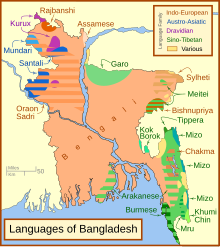
The Mru people and language are located in the lower right hand corner of the map of Bangladesh
Mru (Maru), also known as Mrung (Murung), is a Sino-Tibetan language and one of the recognized languages of Bangladesh. It is spoken by a community of Mros (Mrus) inhabiting the Chittagong Hill Tracts of Bangladesh with a population of 22,000 according to the 1991 census, and in Burma. The Mros are the second-largest tribal group in Bandarban District of the Chittagong Hill Tracts. A small group of Mros also live in Rangamati Hill District.
The Mru language is considered "Severely endangered" by UNESCO.[4]
Contents
1 Classification
2 Distribution
3 Subdivisions
4 Grammar
5 Numerals
6 Script
6.1 Unicode
7 See also
8 References
9 Further reading
Classification
Mru forms the Mruic language branch with Hkongso and Anu, which are spoken in Paletwa Township, Chin State, Myanmar. The position of Mruic with Sino-Tibetan is unclear.
Distribution

Map of Bandarban District
The Mros live in forest areas of Lama, Ruma, Alikaram, and Thanchi near Chimbuk Mountain of Bandarban District (Rashel 2009). They also live in Sittwe (Akiab), Rakhine State, Burma.
Subdivisions
Ethnologue (21st edition) lists 3 main dialects as Anok, Dowpreng (Dopreng), and Sungma (Tshungma), as wel as the 2 minor dialects of Dopreng and Rumma.
- Anok: largest and central
- Tshungma: in the north
- Domrong: in the lowlands north of the Matamuri
- Dopreng: in far south and into Arakan
- Rumma: in far south and into Arakan
There are five Mru dialects according to Ebersole (1996).
- Anawk
- Süngma
- Dopreng
- Tamsa
- Rengmitsa
There are five major Mro clans (Rashel 2009).
- Dengua
- Premsang
- Kongloi
- Maizer
- Ganaroo Gnar
Rashel (2009) also lists another classification scheme which lists ten Mro clans.
- Yarua (subdivisions below)
- Khatpo
- Chimlung
- Zongnow
- Sangkan
- Chawla
- Ngaringcha
- Tang
- Deng
- Kough
- Tam-tu-chah
- Kanbak
- Prenju
- Naichah
- Yomore
Grammar
Unlike the Kuki-Chin languages, Mru has SVO (subject-verb-object) word order (Ebersole 1996).
Numerals
Rashel (2009:159) lists the following Mro numerals.
- lɔk
- pre
- ʃum
- taːli
- taŋa
- trok
- rinit
- riyat
- tako
- h:muit
Script
| Mru .mw-parser-output .nobold{font-weight:normal} Mro, Krama[1] | |
|---|---|
| Type | alphabet |
| Languages | Mru |
| Direction | Left-to-right |
| ISO 15924 | Mroo, 264 |
Unicode alias | Mro |
Unicode range | U+16A40–U+16A6F |
The Mru script is an indigenous, messianic script: In the 1980s Menlay Murang (also known as Manley Mro) created the religion of Khrama (or Crama) and with it a new script for the Mru language.[5][6]
The script is written from left to right and has its own set of digits. It does not use tone marks.
The Mru language is written in both the Latin and Mru scripts.
Unicode
The Mru alphabet was added to the Unicode Standard in June, 2014 with the release of version 7.0.
The Unicode block for the Mru script, called Mro, is U+16A40–U+16A6F:
Mro[1][2] Official Unicode Consortium code chart (PDF) | ||||||||||||||||
| 0 | 1 | 2 | 3 | 4 | 5 | 6 | 7 | 8 | 9 | A | B | C | D | E | F | |
| U+16A4x | 𖩀 | 𖩁 | 𖩂 | 𖩃 | 𖩄 | 𖩅 | 𖩆 | 𖩇 | 𖩈 | 𖩉 | 𖩊 | 𖩋 | 𖩌 | 𖩍 | 𖩎 | 𖩏 |
| U+16A5x | 𖩐 | 𖩑 | 𖩒 | 𖩓 | 𖩔 | 𖩕 | 𖩖 | 𖩗 | 𖩘 | 𖩙 | 𖩚 | 𖩛 | 𖩜 | 𖩝 | 𖩞 | |
| U+16A6x | 𖩠 | 𖩡 | 𖩢 | 𖩣 | 𖩤 | 𖩥 | 𖩦 | 𖩧 | 𖩨 | 𖩩 | 𖩮 | 𖩯 | ||||
Notes
| ||||||||||||||||
See also
Mru word list (Wiktionary)
References
^ ab Mru at Ethnologue (21st ed., 2018)
^ Hammarström, Harald; Forkel, Robert; Haspelmath, Martin, eds. (2017). "Mruic". Glottolog 3.0. Jena, Germany: Max Planck Institute for the Science of Human History..mw-parser-output cite.citation{font-style:inherit}.mw-parser-output .citation q{quotes:"""""""'""'"}.mw-parser-output .citation .cs1-lock-free a{background:url("//upload.wikimedia.org/wikipedia/commons/thumb/6/65/Lock-green.svg/9px-Lock-green.svg.png")no-repeat;background-position:right .1em center}.mw-parser-output .citation .cs1-lock-limited a,.mw-parser-output .citation .cs1-lock-registration a{background:url("//upload.wikimedia.org/wikipedia/commons/thumb/d/d6/Lock-gray-alt-2.svg/9px-Lock-gray-alt-2.svg.png")no-repeat;background-position:right .1em center}.mw-parser-output .citation .cs1-lock-subscription a{background:url("//upload.wikimedia.org/wikipedia/commons/thumb/a/aa/Lock-red-alt-2.svg/9px-Lock-red-alt-2.svg.png")no-repeat;background-position:right .1em center}.mw-parser-output .cs1-subscription,.mw-parser-output .cs1-registration{color:#555}.mw-parser-output .cs1-subscription span,.mw-parser-output .cs1-registration span{border-bottom:1px dotted;cursor:help}.mw-parser-output .cs1-ws-icon a{background:url("//upload.wikimedia.org/wikipedia/commons/thumb/4/4c/Wikisource-logo.svg/12px-Wikisource-logo.svg.png")no-repeat;background-position:right .1em center}.mw-parser-output code.cs1-code{color:inherit;background:inherit;border:inherit;padding:inherit}.mw-parser-output .cs1-hidden-error{display:none;font-size:100%}.mw-parser-output .cs1-visible-error{font-size:100%}.mw-parser-output .cs1-maint{display:none;color:#33aa33;margin-left:0.3em}.mw-parser-output .cs1-subscription,.mw-parser-output .cs1-registration,.mw-parser-output .cs1-format{font-size:95%}.mw-parser-output .cs1-kern-left,.mw-parser-output .cs1-kern-wl-left{padding-left:0.2em}.mw-parser-output .cs1-kern-right,.mw-parser-output .cs1-kern-wl-right{padding-right:0.2em}
^ Hammarström, Harald; Forkel, Robert; Haspelmath, Martin, eds. (2017). "Mru". Glottolog 3.0. Jena, Germany: Max Planck Institute for the Science of Human History.
^ Evans, Lisa (2011-04-15). "Endangered languages: the full list". the Guardian. Retrieved 2018-11-26.
^ Hosken, Martin; Everson, Michael (24 March 2009). "N3589R: Proposal for encoding the Mro script in the SMP of the UCS" (PDF). Retrieved 2 August 2014.
^ Zaman, Mustafa (24 February 2006). "Mother Tongue at Stake". Star Weekend Magazine. The Daily Star. 5 (83).
- Ebersole, Harold. 1996. The Mru Language: A preliminary grammatical sketch. Ms.
- Peterson, David A., "Where does Mru fit into Tibeto-Burman?", The 42nd International Conference on Sino-Tibetan Languages and Linguistics (ICSTLL 42), November 2009, Payap University, Chiangmai, Thailand. Cf. p. 14.
- Rashel, Md Mostafa (2009). "Morphosyntactic Analysis of Mro Language." Dhaka University Journal of Linguistics, Vol, 2, No, 3, February 2009, 141–160.
Further reading
- Clifton, John M. 2009. "Orthography development as an ongoing collaborative process: lessons from Bangladesh". 1st International Conference on Language Documentation and Conservation (ICLDC)
- Mru word list (Luce 1985)
- Mru word list (Matisoff 1987)
 Languages of Myanmar Languages of Myanmar | |||||||||||||||||||||||||||||||||||||||||||||||||
|---|---|---|---|---|---|---|---|---|---|---|---|---|---|---|---|---|---|---|---|---|---|---|---|---|---|---|---|---|---|---|---|---|---|---|---|---|---|---|---|---|---|---|---|---|---|---|---|---|---|
| Official language |
| ||||||||||||||||||||||||||||||||||||||||||||||||
| Semiofficial language |
| ||||||||||||||||||||||||||||||||||||||||||||||||
| Indigenous languages (by state or region) |
| ||||||||||||||||||||||||||||||||||||||||||||||||
| Sign languages |
| ||||||||||||||||||||||||||||||||||||||||||||||||
Types of writing systems | |||||||||||||||||||||||||||||||||||||||||||||||||||||||||||||||||||||||||||||||||||
|---|---|---|---|---|---|---|---|---|---|---|---|---|---|---|---|---|---|---|---|---|---|---|---|---|---|---|---|---|---|---|---|---|---|---|---|---|---|---|---|---|---|---|---|---|---|---|---|---|---|---|---|---|---|---|---|---|---|---|---|---|---|---|---|---|---|---|---|---|---|---|---|---|---|---|---|---|---|---|---|---|---|---|---|
| |||||||||||||||||||||||||||||||||||||||||||||||||||||||||||||||||||||||||||||||||||
| |||||||||||||||||||||||||||||||||||||||||||||||||||||||||||||||||||||||||||||||||||
| |||||||||||||||||||||||||||||||||||||||||||||||||||||||||||||||||||||||||||||||||||
| |||||||||||||||||||||||||||||||||||||||||||||||||||||||||||||||||||||||||||||||||||


