Ten-pin bowling
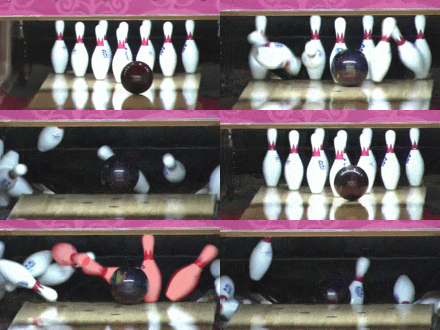 Ball contacts the 1, 3, 5 and 9 pins (sequentially tinted red) to achieve a strike | |
| Highest governing body | World Bowling |
|---|---|
| First played | 18th century, Europe |
| Characteristics | |
| Contact | No |
| Mixed gender | Yes, separate competitions |
| Type | Ball sport |
| Equipment | Bowling ball, pins, alley |
| Venue | Bowling lanes |
| Presence | |
| Olympic | No |
| World Games | 1981–2017 |
Ten-pin bowling is a type of bowling in which a bowler rolls a bowling ball down a wood or synthetic lane toward ten pins positioned in a tetractys (equilateral triangle-based pattern) at the far end of the lane. The objective is to knock down as many pins as possible.
Behind a foul line is an approach approximately 15 feet (5 m) long used to impart speed and apply rotation to the ball. A 41.5-inch-wide (105 cm),[1] 60-foot-long (18 m)[1] lane is bordered along its length by gutters (semicylindrical channels) that collect errant balls. The lane's narrow shape prevents straight-line ball paths from achieving an angle optimally desired to achieve strikes; accordingly, more advanced bowlers impart sideways rotation to hook (curve) the ball into the target. Oil applied in different patterns to the first two-thirds (approximate) of the lane's length adds complexity and challenge to the sport.
Commonly, two finger holes and a thumb hole are drilled into the ball. Ball weights vary considerably to make the sport playable for all ages, and young children may use ramps. While ten-pin bowling leagues and tournaments are common, the sport is also played recreationally by millions of people.
In Canada, the United States, United Kingdom, Ireland and Australia, the game is commonly referred to as just "bowling". In New England, the game is specifically called "ten-pin bowling" or "big-ball bowling" to distinguish it from smaller balls used in candlepin bowling, duckpin bowling, and five-pin bowling.
Contents
1 History
1.1 Early History
1.2 Organization and increased popularity
1.3 1940 to 1960
1.4 1960 to 1980
1.5 1980 to 2000
1.6 2000 to present
2 Facilities and equipment
2.1 Lanes
2.2 Ball motion
2.3 Pins
2.4 Balls
3 Ball delivery and release
3.1 Delivery style categories
3.2 Alternative release styles
4 Scoring
4.1 Traditional scoring
4.2 World Bowling scoring
4.2.1 Variant of World Bowling scoring
4.3 Perfect (300) game
5 Tournaments
5.1 World tournaments
5.1.1 Major world tournaments
5.1.2 World Ranking Masters
5.1.3 Minor world tournaments
5.2 Other tournaments
5.3 Olympic-style international competition
5.3.1 History of Asian and Pan American bowling events
6 League play
7 Governing organizations
7.1 United Kingdom
7.2 United States
8 Drug testing authorities
8.1 Controversy
9 Technology changes and controversy
9.1 History of technological changes
9.2 USBC technology study
10 Brands
11 Ten-pin bowling in media
11.1 In print
11.2 Video games
11.3 In film
11.4 Mainstream media portrayal
12 See also
13 Publications
14 References
History
Early History

Pinsetter boys at a Pittsburgh bowling alley, c. 1908
In 1934, British anthropologist Sir Flinders Petrie, along with a team of archaeologists, discovered various primitive bowling balls, bowling pins and other materials in the grave of a protodynastic Egyptian boy dating to 3200 BCE, very shortly before the reign of Narmer, one of the very first Egyptian pharaohs. Their discovery represents the earliest known historical trace of bowling.[2][3] Others claim that bowling originated in Germany around 300 CE,[2][3] as part of a religious ritual in which people would roll stones at clubs (or "kegels") to absolve themselves of sins.[4]
A site in Southampton, England claims to be the oldest lawn bowling site still in operation, with records showing the game has been played on the green there since 1299.[5] The first written reference to bowling dates to 1366, when King Edward III of England banned his troops from playing it so that they could focus more on their archery practice.[6] It is believed that King Henry VIII bowled using cannonballs. Henry VIII also famously banned bowling for all but the upper classes, because so many working men and soldiers were neglecting their trades.[5]
In Germany the game of Kegel (Kegelspiel) expanded. The Kegel game grew in Germany and around other parts of Europe with Keglers rolling balls at nine pins, or skittles, in a diamond formation (1–2–3–2–1).[7][8] To this day, bowlers in the United States and United Kingdom are also referred to as "keglers".
Ninepin bowling was introduced to the United States from Europe during the colonial era, similar to the game of skittles.[9] It became very popular and was called "Bowl on the Green". The Dutch, English, and Germans all brought their own versions of the game to the New World, where it enjoyed continued popularity, although not without some controversy. In 1841 a law in Connecticut banned ninepin bowling lanes because of associated gambling and crime, and people were said to circumvent the letter of the prohibition by adding an extra pin, resulting in the game of ten-pin bowling.[10]
A painting which dates from around 1810, and has been on display at the International Bowling Hall of Fame and Museum in St. Louis, Missouri (before its relocation on January 26, 2010, to the International Bowling Campus in Arlington, Texas), however, shows British bowlers playing the sport outdoors, with a triangular formation of ten pins, chronologically before it appeared in the United States. A photograph of this painting appeared in the pages of the US-based "Bowler's Journal" magazine in 1988.[11]
While still closely related to the German nine-pin game Kegeln, the modern version of ten-pin bowling that became a popular participant sport worldwide was an American creation. German immigrants were instrumental in fostering the game's popularity in America as they formed their own bowling clubs both before and after the American Civil War. The first indoor bowling alley was Knickerbockers of New York City, built in 1840, and had lanes made of baked clay. The Brunswick Corporation's addition of bowling equipment to their product line also served to increase the sport's popularity. In 1914, Brunswick replaced their line of wooden bowling balls, mostly made with lignum vitae, with hard rubber Mineralite bowling balls. The change was met with great approval.[12]
Since being brought to the United States from Europe, ten-pin bowling (a modern version of the game of skittles) has risen in popularity as its technology has improved. The sport is most popular in the United Kingdom and the United States. Both nations maintain national regulatory organizations that govern the sport's rules and conduct, and many of those countries' best players participate in tournaments on both the national and international stage. Because of the rise in popularity, many companies began making bowling balls and apparel for professionals as well as for recreational bowlers. Bowling has also become more prevalent in the media in recent years, with the continued popularity of bowling publications and the appearance of films centered around the culture of the sport. However, the sport continues to face challenges in garnering mainstream coverage of the athletic aspects of the game.
Organization and increased popularity

Inside a typical ten-pin bowling alley (Shropshire, UK)

A woman bowling during 45th Victory Day celebration Bowling Tournament'15 in Dhaka, Bangladesh
The modern, indoor game of bowling has long been seen as a sport of the working classes.[5] Accordingly, most bowling alleys at the turn of the century were small, private establishments, mainly frequented by men. This began to change as the sport became increasingly regulated and generally gained in prestige. Although it has not shed its working class image entirely, today bowling is a unisex sport, and is enjoyed by people the world over.
In 1875, delegates from 11 bowling clubs in New York City and Brooklyn gathered to form the National Bowling Association (NBA) and adopt a set of standard playing rules. While they agreed on a uniform distance of 60 feet from foul line to head pin and the size of the bowling ball, there were many other disagreements, including scoring, that caused splinter groups to form. It wasn't until 1895, when prominent bowling leaders gathered in New York City to form the American Bowling Congress (ABC), that the bulk of the standard rules for bowling that have survived to the modern day were drafted. The ABC was soon joined by similar organizations geared toward female bowlers, with the Women's National Bowling Association (WNBA) forming in 1916 and later changing its name to Women's International Bowling Congress (WIBC) in 1925. (The ABC and WIBC jointly became the United States Bowling Congress [USBC] in 2005.) At the same time, the sport's image among the upper classes was enhanced by the opening of more luxurious and elegant alleys like The White Elephant in New York City, opened by restaurateur Joe Thum. Many consider Thum to be the father of modern bowling, along with inaugural ABC President Thomas Curtis and later, coming into the second half of the 20th century, American professional bowler Dick Weber.
The oldest known USBC sanctioned bowling lanes in the United States date from 1908, and are still in use in the Milwaukee, Wisconsin-located Holler House tavern, as a pair of lanes that still uses manually-operated pinsetters, in one of the very few facilities that uses manually-set tenpins in North America.
1940 to 1960
The period from 1940 to 1960 is known as the "golden age of bowling" because of the sport's great popularity increase and advances in its play. By 1945, bowling was a billion-dollar industry in the United States. From 1940 to 1958, the number of dues-paying American Bowling Congress members grew from about 700,000 to 2.3 million. The Women's International Bowling Congress grew from 82,000 to 866,000 members, and the American Junior Bowling Congress expanded from 8,000 to 175,000.[13]
Promotion by the U.S. Armed Forces and its image as a sport for the common man made bowling an enticing choice of activity for Americans. For this reason, racial integration was perhaps inevitable. The American Bowling Congress had been a whites-only organization throughout its first 50-plus years in existence, but lobbying by numerous labor organizations and individuals after World War II, including Japanese-American Hiroto Hirashima, quickly led to a reversal of this policy.[14]
Bowling alleys built during this period often featured restaurants or nightclubs where locally or even nationally prominent entertainers would perform. In the 1948 movie Road House, the title refers to a large bowling alley with a nightclub attached, where much of the action takes place. The film provides a good historical glance at bowling alleys of the era.
This era also saw a great increase in bowling technology. Pins had previously been set by human pinsetters or "pin boys", but with the invention of the semi-automatic pinspotter in 1936 (usually just the "spotting table" component), the process became much easier. In 1946 AMF Bowling launched the first commercial fully automatic pinspotter, the AMF Model 82-10, followed closely by the more developed 82–30 model (still in common use in the 21st century) to replace the earlier Brunswick semi-automatic and fully manual bowling establishments. Brunswick itself introduced its own "Model A" automatic pinspotter design to bowling centers in 1955, and along with its successors (A2 and "JetBack", both with quicker delivery of returned balls over the Model A), all three versions are still in widespread use. The television age of the 1950s also helped to increase the popularity of ten-pin bowling, as images of the sport began to enter the homes of millions across the United States. Nationally televised programs like Jackpot Bowling and Make That Spare became popular on Friday nights from the late 1950s into the early 1960s. Following many years of debate over what constituted a professional bowler versus an amateur, Eddie Elias founded the Professional Bowlers Association (PBA) in 1958. The PBA's Pro Bowlers Tour became a permanent part of ABC's sports lineup by the early 1960s, airing through 1997.[8]
1960 to 1980
Ten-pin bowling was introduced in the United Kingdom in 1960. This was driven by the opening of the Stamford Hill and Golders Green bowling alleys in London. Ten-pin bowling took the UK by storm, with alleys opening up one after the other. At its peak, there were over 160 bowling alleys in the UK, but a lack of re-investment and waning interest left the fad in a sorry state. This led to a general deterioration of bowling alleys, with a commensurate decline in their image. In the 1970s a major chain operator, Top Rank, pulled out of bowling and converted many of the more luxurious alleys into Bingo halls. The industry nearly collapsed, with two thirds of the existing alleys closing over the next few years.
The United States, meanwhile, saw league bowling soar in the 1960s and early 1970s—partially influenced by popular professional bowlers Don Carter, Dick Weber, Carmen Salvino and Earl Anthony. The number of sanctioned bowling alleys in the U.S. peaked at about 12,000 in the mid-1960s,[5] while membership in the American Bowling Congress also peaked at just under 4.6 million male bowlers.[15] The popularity of the sport in America was perhaps no more evident than when Don Carter became the first athlete of any kind to sign a US$1 million endorsement contract, inking a multi-year deal with Ebonite International in 1964. By comparison, Arnold Palmer earned just $5,000 in 1961 endorsing Wilson golf equipment, and NFL quarterback Joe Namath made just $10,000 in 1968 to famously shave off his moustache with a Schick razor.[16]
1980 to 2000
A decline in interest has been partially attributed[by whom?] to the manual scoring system. However, automated electronic scoring systems removed this impediment. During the late 1980s and early 1990s the number of ten-pin bowling alleys across the UK rose to over two hundred, exceeding the sport's previous peak popularity in the 1960s.
2000 to present
Bowling has experienced another decline since the late 1990s and into the 2000s, especially in the United States. From 1998 to 2013, the number of bowling alleys in the U.S. fell from about 5,400 to 3,976, a 26% drop. This is partly attributed to the decline of league bowling participation, which used to account for most of a bowling center's revenue, as well as the decline in social activity overall (see Bowling Alone), according to Robert Putnam, public policy professor at Harvard University.[13] Bowling centers once counted on league bowling for about 70% of their revenues, but studies by White Hutchinson Leisure & Learning Group and others suggest that figure is now only about 40%.[13]
Today, over 100 million bowlers play in over 90 different countries. The United States Bowling Congress (USBC), for example, reported over 2.6 million members in 2008, but was down to 1.57 million for the 2014–15 season, and 1.42 million for the 2016–17 season.[17] The bowling industry spends significantly more money each year than any other sport on airlines, restaurants, hotels and rental cars.[18]
Bowling an exhibition sport at the 1988 Summer Olympics. In 1998 ten-pin bowling was included for the first time as a sport at the Commonwealth Games, with the sport being a full medal-level event within the Pan American Games since 1991. Recent efforts to make it a full Olympic sport have been primarily promoted by World Bowling (WB).
Bowling alleys have had to reinvent themselves as large entertainment centers including game rooms, multi-screen cinemas, restaurants and night clubs, affecting the image of the sport among families.[7] Some centers say they are now attracting more white-collar patrons.[13]
Bowling has been named as one of the eight shortlisted sports for inclusion at the 2020 Summer Olympics in Tokyo.[19]
Facilities and equipment
Lanes

True scale drawing: In ten-pin bowling lanes, the nearest pin is 60 feet from the foul line—more than 17 times the lane's 41.5-inch width.[20] Due to the optical illusion of foreshortening that a bowler experiences when standing on the approach, pins appear closer together and bowling ball angles of entry appear more dramatic than they are in fact when viewed from above as in this diagram.
Ten-pin bowling lanes are 60 feet (18.29 m) from the foul line to the center of the head pin (1-pin). About 15 feet (4.57 m) from the foul line are a set of guide arrows. The lane is 41.5 inches (1.05 m) wide and normally consists of 39 wooden boards (commonly rock maple in the "heads", which is the first 15 feet of lane, and in the pin deck, which begins about 2 feet in front of the head pin; the middle of lane is a softer wood) or a synthetic material. The bowling lane has two sets of approach dots; from the foul line back to the first set of approach dots is about 12 feet (3.66 m) and to the second set of approach dots is about 15 feet (4.57 m) back.[20]
@media all and (max-width:720px){.mw-parser-output .tmulti>.thumbinner{width:100%!important;max-width:none!important}.mw-parser-output .tmulti .tsingle{float:none!important;max-width:none!important;width:100%!important;text-align:center}}


Modern bowling lanes have oil patterns designed not only to shield the lanes from damage from bowling ball impacts, but to provide bowlers with different levels of challenge in achieving strikes. As illustrated, a typical house pattern (or THS, typical house shot) has drier outside portions that give bowling balls more friction to hook (curve) into the pocket, but heavier oil concentrations surrounding the centerline so that balls slide directly toward the pocket with less hooking.[21] In the more challenging sport patterns used in tournaments and professional-level matches, a "flat" oil pattern—one with oil distributed more evenly from side to side—provides little assistance in guiding the ball toward the pocket.[21] The ratio of centerline oil concentration to side oil concentration (the oil ratio) can exceed 10-to-1 for THSs but are restricted to 3-to-1 or less for sport shots.[21]
Commonly, lanes are protected by about 18 millilitres (0.63 imp fl oz; 0.61 US fl oz) of oil. PBA events use about 30 millilitres (1.06 imp fl oz; 1.01 US fl oz) of oil, and PWBA events use 25 millilitres (0.88 imp fl oz; 0.85 US fl oz). The oil starts about 4 inches past the foul line and is applied on about the first two-thirds of the lane.
Ball motion

Scale diagram: A straight path, even one starting from the extreme outside corner of the lane, results in an angle of entry of at most 1.45°. Larger entry angles (shown in diagram) are achievable when hooking (curving) the ball. Larger entry angles have been shown to be generally more favorable for achieving strikes.[22][23]

Simplified representation of the skid, hook, and roll phases of bowling ball motion. (Horizontal scale is compressed.)
Because pin spacing is much larger than ball size, it is impossible for the ball to contact all pins. Therefore, a tactical shot is required, which would result in a chain reaction of pins hitting other pins in a process called "pin scatter". In what is considered an ideal shot, the ball contacts only the 1, 3, 5 and 9 pins (right-handers).[22]
Most newer players roll the ball straight, while more experienced bowlers may roll a hook that involves making the ball start out straight but then curve toward a target, to increase likelihood of striking: USBC research[22] has shown that shots more likely to strike enter the pocket at an angle of entry that is achievable only with a hook.[23]
Pins

A ten-pin bowling pin in cross section

A bowling ball impacting the head pin at a point found to be optimum for striking (right handers).[22] Many believe—wrongly—that the ideal "pocket" is more "between" the 1 pin and 3 pin.[23] Entry angles of 0°, 2°, 4° and 6° are also illustrated.
Pin-setting machines set the pins in four rows forming an equilateral triangle with four pins on a side, forming a tetractys. Neighboring pins are set 12 inches (30 cm) apart, center to center. Pins are numbered 1 through 10, starting with the 1 pin in front, proceeding left-to-right in each row, ending with 10 in the right rear.
USBC rules specify that a pin must be 15 inches (38 cm) tall and about 4.7 inches (12 cm) wide at its widest point, slightly above where a rolling ball would make contact to give the pin a slight upward trajectory. There are additional measurements which delineate shape. The weight of a single pin must be at least 3 pounds 6 ounces and no more than 3 pounds 10 ounces (1.53–1.64 kg). Within a set of ten pins, the individual weights may vary by no more than 4 ounces (113.4 g), if made from wood or plastic coated, or just 2 ounces (56.7 g) if synthetic. The top of the pin shall have a uniform arc with a radius of 1.273 ± 1⁄32 inch (32.33 ± 0.79 mm).
USBC regulations govern weight distribution from top to bottom. Pins are allowed one or two voids inside the belly area that balance to prevent the pins from being too bottom-heavy. Standard regulation pins may lean no more than 10 degrees off center without falling.
Balls
The maximum diameter of the ball is 8.595 inches (21.83 cm)[1] and the circumference of the ball must not be more than 27 inches (0.69 m),[1] and the ball cannot weigh more than 16 pounds (7.26 kg).[1] Generally, the lightest ball available for use is 6 pounds (2.72 kg). The ball must have a smooth surface over its entire circumference except for holes or indentations used for gripping the ball, holes or indentations made to bring the ball back into compliance with weight-distribution regulations, identification letters and numbers, and general wear from normal use.
Ball delivery and release

A bowler releasing his ball
A conventional grip, used on non-customized house balls, involves insertion of fingers to the second knuckle. A fingertip grip, involving insertion of fingers only to the first knuckle, enables greater revolution rates and resultant hook potential.
Delivery style categories
Three widely recognized categories are "stroker", "cranker" and "tweener".[24]
Strokers often keep their shoulders square to the foul line and their backswing generally does not go much above parallel to the ground. This type of delivery reduces the ball's rate of revolution, thus decreasing its hook potential and hitting power. Strokers rely on finesse and accuracy, as opposed to crankers, who use speed and power. However, today's modern reactive resin bowling balls now allow strokers to hit the "pocket" at a relatively high angle. Stroking is considered the most classic of all the bowling forms and is still the most popular style of bowling in the PBA. Walter Ray Williams, Jr., the PBA's all-time leader in titles and earnings, is a stroker.
The cranker strives to generate revolutions using a cupped wrist or excessive wrist action. Crankers who rely on wrist action may have a high backswing and open their shoulders to generate ball speed. These bowlers often cup the wrist, but open the wrist at the top of the swing. Crankers may also muscle the ball with a bent elbow because their wrist is not strong enough to be cupped at the release. Crankers often use "late" timing, where the foot gets to the foul line before the ball; a technique known as plant and pull, hardly using any slide on their final step and pulling the ball upwards for leverage. The timing between the feet and the ball being delivered is only a fraction of a second. PBA Hall of Famer Mark Roth is a great example of a cranker.
Tweeners (a term derived from "in-between") are bowlers that deliver the ball in a manner that falls somewhere in between stroking and cranking. This modified delivery could use a higher backswing than is normally employed by a pure stroker or a less powerful wrist position than a pure cranker. Some use the term to refer to a bowler who is simply not a "picture perfect" example of either a stroker or a cranker. A variation on the tweener is the "power stroker". This type of bowler uses a high backswing and/or powerful wrist position, but has the smooth timing and slide step of a stroker. Hall of Famer Pete Weber is perhaps the best-known example of a power stroker.
Alternative release styles
So-called two-handed bowling involves not inserting the thumb into the thumbhole, with the opposite hand supporting and guiding the ball throughout almost the entire forward swing. This release, technically still a one-handed release, allows the inserted fingers to generate higher revolution rates and thus attain greater hook potential.
No-thumbers are similar to so-called two-handed bowlers in that their bowling hand's thumb is not inserted into the ball; however, the opposite hand does not support the ball during the forward swing.

A right-handed bowler demonstrates the "UFO" or "helicopter" release. At the point of release, the thumb is closer to the body, while the middle and ring fingers face the pins.
Especially in parts of Asia, the "spinner", "helicopter" or "UFO" release is more common. A ball spinning about a generally vertical axis of rotation spins like a top down the lane, and slides straighter, regardless of oil pattern. The ball takes an unconventional path along the front pins ("deflection"), creating domino effect pin action. The spin is generated by rotating the hand counter clockwise (right-handed bowlers) until the hand is on top of the ball with two fingers in the 12-o'clock position and the thumb ending in the 6-o'clock position, at which point the fingers and thumb release the ball simultaneously. The forearm also creates spin and pushes the ball onto the lane. Spinning is difficult to master, and can cause injury if not done properly. Using a lighter bowling ball (10 to 12 pounds) with a completely rounded core is recommended, along with a conventional grip. Spinning causes results like a weak 5-pin more frequently.[25]
In the backup style, the bowler rotates the wrist clockwise (for right handers) or counter-clockwise (for left handers), causing the ball to hook in a direction opposite to that of conventional releases. Backup bowling may involve increased risk of injury to the wrist. However, a right handed backup bowler can gain an advantage by using the less-used left side of the lane where there is less traffic and slower change in the general oil pattern.
Children or physically challenged players may use both hands to swing the ball forward from between the legs. Also, the "bounce pass" technique involves thrusting the ball from the chest with two hands.
Scoring
Traditional scoring
In general, one point is scored for each pin that is knocked over: if a player knocks over three pins with the first roll of a frame and six pins with the second roll, the player would receive nine pins for that frame. When a player fails to knock down all ten pins after the second roll, it is known as an open frame. When all ten pins are knocked over (with either one or both rolls of a frame), bonus pins are awarded.

A ten-pin bowling scoresheet showing how a strike is scored
Strike: When all ten pins are knocked down with the first ball (called a strike and typically rendered as an "X" on a scoresheet), a player is awarded ten pins, plus a bonus of whatever is scored with the next two rolls (not necessarily the next two frames). In this way, the pinfall scored for the two subsequent rolls are counted twice.
- Frame 1, ball 1: 10 pins (strike)
- Frame 2, ball 1: 3 pins
- Frame 2, ball 2: 6 pins
The total score from these throws is:
- Frame one: 10 + (3 + 6) = 19
- Frame two: 3 + 6 = 9
- TOTAL = 28
Two consecutive strikes are referred to as a double, three consecutive strikes are known as a turkey or triple, and four consecutive strikes are sometimes called a hambone. Longer strings of consecutive strikes are called by various names, including "-bagger" (example: five=bagger).[26][27][28] Consecutive strikes starting in the first frame, or ending in the final frame are called "front end" or "back end" strikes, respectively. A clean game is one having only strikes and spares (not counting bonus balls in the tenth frame). A perfect game, with score 300, is twelve strikes. In one method, instances of consecutive strikes have been named after birds as follows: Strike 1 – Duck; Strike 2 – Duck; Strike 3 – Turkey; Strike 4 – Goose; Strike 5 – Chicken; Strike 6 – Turducken; Strike 7 – Penguin; Strike 8 – Flamingo; Strike 9 – Turkey Vulture; Strike 10 – Woodpecker; Strike 11 – Eagle; Strike 12 – Turkey Hawk.[29]

A ten-pin bowling scoresheet showing how a spare is scored
Spare: A spare is awarded when a player uses both balls of a frame to clear all ten pins. A player achieving a spare is awarded ten pins, plus a bonus of whatever is scored with the next roll (not necessarily the next frame). A spare is typically rendered as a slash "/" on scoresheets in place of the second roll's pin count.
- Example:
- Frame 1, ball 1: 7 pins
- Frame 1, ball 2: 3 pins (spare)
- Frame 2, ball 1: 4 pins
- Frame 2, ball 2: 2 pins
The total score from these throws is:
- Frame one: 7 + 3 + 4 (bonus) = 14
- Frame two: 4 + 2 = 6
- TOTAL = 20
- The most pins that can be scored in a single frame is 30 pins: 10 for the original strike, plus bonus pins for strikes in the two subsequent frames.
- A player who bowls a strike in the tenth (final) frame is awarded two extra rolls for bonus pins.
- A player who bowls a spare in the first two rolls in the tenth (final) frame is awarded a third roll for bonus pins.
To estimate which bowler is "ahead", it is standard to tentatively assume 20 pins for unbowled frames; a par game scores 200.
World Bowling scoring
The World Bowling scoring system—described as "current frame scoring"[30]—awards pins as follows:
- strike: 30 (regardless of ensuing rolls' results)
- spare: 10 plus pinfall on first roll of the current frame
- open: total pinfall for current frame
The maximum score is 300, achieved with ten, not twelve, consecutive strikes but with no bonus pins received in the tenth frame.[31][32]
World Bowling scoring is thought to make bowling easier to follow than with traditional scoring,[31] increase television viewership,[30] and help bowling to become an Olympic sport.[30][32]
Variant of World Bowling scoring
Another variant of scoring, a 12-frame system introduced at the November 2014 World Bowling Tour (WBT) finals, resembles golf's match play scoring in counting the greater number of frames won rather than measuring accumulated pinfall score.[33] A frame may be won immediately by a higher pincount on the first roll of the frame, and a match may be won when one player is ahead by more frames than remain of the possible 12 frames.[33] This variant reduces match length and scoring complexity for two-player matches.[33]
Perfect (300) game

300 game gold ring
The maximum score in a game of ten-pin is 300, scored by making 12 strikes in a row. Before 1908, no one ever received an award for a game greater than 298. ABC used to award medals (gold, silver and bronze) for the three highest individual games rolled in the nation. The number of perfect games bowled during a season first became a problem for American Bowling Congress (ABC) officials in 1908 when the organization was only 13 years old. The crisis struck when A.C. Jellison and Homer Sanders, both of St. Louis, bowled 300 games in the same season. Perplexed with the problem of having only one gold medal and unwilling to duplicate the award, the ABC decreed that both had to vie for it in a three-game match at the ABC tournament in Pittsburgh. Jellison, who won the match and the gold, is thus recognized for rolling the first perfect game in ABC history, without regard as to whether his feat was chronologically achieved first. For his accomplishment, Sanders received a silver medal and a place in trivia history. Earnest Fosberg of Rockford, IL bowled the first-ever documented 300 game in 1902, however, no ABC recognition was available at that time.
Jeremy Sonnenfeld of Sioux Falls, S.D. made bowling history on February 2, 1997 when he became the first person ever to roll three certified perfect games in a three-game set, or a 900 series. Sonnenfeld was not the first person to shoot a 900 series, but his was the first recognized by ABC. Former PBA bowler Glenn Allison submitted the first-ever 900 series for award consideration, when he accomplished the feat on July 1, 1982. But the ABC refused to certify the score, citing non-compliant lane conditions. ABC/USBC has relaxed their criteria for certifying scores in the past few years, leading many bowling fans to believe that Allison's 900 would have easily been approved under today's rules and procedures.[34][35]
In Britain, the youngest bowler ever to achieve a perfect single game score of 300 (12 consecutive strikes), in certified competition was 12 years, 71 days old Elliot John Crosby, at AMF Purley in South London, England in the Surrey County trials on January 7, 2006.[36] Crosby beat the previous British 300 shooter record holder Rhys Parfitt by more than a year. Parfitt was 13 years, 4 months when he achieved a 300-game at the London international tenpin bowling tournament in 1994. In the United States, Hannah Diem of Seminole, Florida, became the youngest bowler to achieve a perfect 300 game in a certified event on November 17, 2013 at the age of 9 years, 6 months and 19 days. The game was bowled as part of a 730 series (204, 226, 300) in the Youth/Adult League at Liberty Lanes Largo, Florida. The record has been approved by the United States Bowling Congress. The prior record was held by Chaz Dennis, 10 years, 3 months, 16 days, back in 2006. The prior female record holder was set by Brandie Reamy at the age of 12 years, 4 months, 11 days back in 2006.
Tournaments
World tournaments
Note that all major tournaments are non-handicapped ("scratch").
Major world tournaments
The world champion is crowned at the WTBA World Championship held by the World Tenpin Bowling Association since 1954.
The "Weber Cup" is the ten-pin bowling equivalent of golf's Ryder Cup. It is the world-famous major world tournament of Team Europe vs. Team USA bowling championships that happens annually. Other major world-famous bowling tournaments include the World Tenpin Masters and the Qubica/AMF World Cup.
All of the three world major bowling tours above are televised on Sky Sports by Matchroom Sport. All three events are also presented by broadcaster and journalists, Nick Halling and Cass Edwards.
There is also the influential European Tenpin Bowling Federation, which has the prestigious European Bowling Tour, and under that the PTBC Storm English Open.
Among the leading world tournaments is the Professional Bowlers Association (PBA) Tour. The PBA Tour takes place mostly in North America; however, stops on the World Bowling Tour (WBT) have been added as PBA stops in recent years. This tour has 20 or more events per year, and includes four major championship events: the U.S. Open, USBC Masters (known as the ABC Masters prior to 2005), the Tournament of Champions and the PBA World Championship. Although PBA headquarters are in the U.S., the PBA has members from all over the world who also compete in all of its events. The PBA tour is televised in America and certain parts of the world by ESPN and CBS Sports Network.
Along with increased coverage in recent years, these tours have become more profitable for bowlers. Earl Anthony, who bowled left-handed, became the first bowler to earn more than $100,000 (U.S.) in a single season when he finished the 1975 PBA Tour schedule with $107,585. He broke the $1 million mark in career earnings in 1982. From 1987 onward, the PBA held some single tournaments that paid $100,000 to the winner. Norm Duke is the youngest person to win a PBA Tour tournament. He won the 1983 Cleveland Open at age 18 years, 345 days. The youngest person to bowl a PBA event is 14-year-old Kamron Doyle of Brentwood, TN, who participated (and cashed) in the 2012 U.S. Open.[37] The oldest player to win a regular PBA Tour title is John Handegard, who won the 1995 Northwest Classic at age 57 years, 139 days. Walter Ray Williams Jr. is the all-time leader in PBA Tour titles with 47.
The USBC (United States Bowling Congress) has two major "open" championship events: the USBC Open Championships and the USBC Masters (known as the ABC Masters prior to 2005). For female bowlers, the USBC sanctions the U.S. Women's Open, USBC Queens (known as the WIBC Queens prior to 2005) and USBC Women's Championships.
There are also the Commonwealth Tenpin Bowling Championships.
World Ranking Masters
Ten-pin bowling has an international ranking system, as with many professional individual sports. This ten-pin equivalent is known as the World Ranking Masters and is made of three vast tours: the European, Americas and Asian bowling tours.
Minor world tournaments
Other minor tournaments, although major in their respective countries, include Britain's prestigious BTBA Nationals (BTBA National Championships), the Brunswick Ballmaster Open, Brunswick Euro Challenge in Greece, ETBF European Youth Championships, the European Gold Cup and the Mediterranean Challenge Cup. The world's premier amateur event is the WB/WTBA World Championships (World Bowling) which has been running since 1954 and is now held every two years.
Other tournaments
Around the world, there are numerous local, regional and national tournaments held, normally with the only basic requirement that a bowler be a certified member of a national bowling organization. These tournaments may have handicapped or scratch divisions, but, generally, bowlers are entered automatically into each division. The time frame for bowling tournaments can be from one day to several months.
Examples of these:
- Local – a USBC local association or state tournament, open only to certified members of the local or state association where the tournament is being held.
- Regional – larger tournaments that can draw bowlers from across the country, but usually from a large area around the locale of the tournament. The Lilac Tournament in Rochester, New York can be considered one of these.
Similar examples of long-running, nationwide-interest tenpin bowling tournaments are the 1943-origin Hoinke Classic[38] held yearly in Cincinnati, Ohio, and the 1921-origin Petersen Classic[39] held in the Chicago, Illinois metropolitan area. - National – the USBC National Tournament, held in Reno, Nevada and at various locations around the country in alternate years. The then-ABC National Tournament was first held in 1901. The nine-game format (3 games of singles, 3 games of doubles, and 3 games of team play) that was used then is still in use today.[40]
Olympic-style international competition
Currently, the Asian Games and the Pan American Games have tenpin bowling as a full-medal level sport for both men and women – the two most recent Maccabiah Games have also hosted tenpin tournaments, specifically at the ninteenth and twentieth Games, alongside lawn bowls as full medal events.
History of Asian and Pan American bowling events
At the Americas-exclusive 1983 Pan American Games[41] tenpins were a demonstration sport, with the tournament held in a similar manner to how it was held five years later, for similar demonstration purposes, at the 1988 Seoul Games. The sport also appears to have been a full-medal-level sport at two of the Asian Games celebrations before 1991: the first time at the eighth Asian Games in Bangkok, Thailand in 1978 (five years before its Pan American Games demonstration appearance in 1983); with the second medal-level appearance at the Asian Games occurring at its twelfth celebration in Seoul, South Korea in 1986, two years before the Summer Olympics demonstration event there. As a direct result of the 1983 experience in Caracas, Venezuela, for the first time anywhere (that would start a successive series of it being held anywhere), on August 2, 1991 in Havana, Cuba, the tenpin sport earned a continuing, full "medal status" in an international multisport competition: the eleventh competition of the Pan American Games, at which all the nations of the Americas compete every four years. Unlike the Asian Games bowling events held before the 1994 Games in Japan, when bowling joined the full-medal sports held at all successive celebrations at the Asian Games, the medal-level tenpin competition has been held at every Pan American Games since 1991, and is a part of the 2019 Games to be held in Lima, Peru.
League play
Traditionally, a major form of organized bowling has been through league competition. Leagues are typically groups of two- to five-player teams that compete with one another over the course of a 28- to 36-week season, generally starting in September and ending in the spring. Summer leagues are often offered with a much shorter schedule of 10 to 15 weeks, usually starting in May. Additionally, "short" (8- to 12-week) season leagues are now offered in many bowling centers to entice bowlers who may not want to commit to a "long" season league. These "short" leagues generally start around September/October and January/February.
In most leagues, teams of one to five individuals bowl three games (called a "series") each. A typical league will schedule their teams to bowl two at a time against each other on each pair of lanes the league uses each week. Usually the winner of each game is decided by adding up the scores of all teammates (plus a team "handicap" in most leagues). Leagues typically decide standings by awarding a certain number of points for each team game win. Additionally, points are usually awarded for total pinfall for each team over the course of the series (commonly referred to as "total wood"). Some common methods for calculating points in a given three-game match include:
- 3-point system (one point per game)
- 4-point system (one point per game, one point for total wood)
- 7-point system (two points per game, one point for total wood)
- 8-point system (two points per game, two points for total wood)
The 7- and 8-point systems are favored, because a tie game can result in each team getting one point. (In a 4-point system, half-points would be required for ties.) Throughout the course of a season, each team will usually face all of the other teams in scheduled competition. "Position Rounds", where 1st place bowls against 2nd place, 3rd place bowls against 4th place, and so on, are often added at one or more points during the season.
There are some leagues that are organized as "match point" leagues. In these leagues, each bowler on a team bowls "head-to-head" against his opponent for points, and, along with the team game points and total wood, the point system can total 30 or more.
Leagues can have various formats. While most leagues are mixed leagues, containing both men and women, men's and women's leagues are still common, along with junior leagues for young bowlers. There are also different types of competition. Scratch leagues are those in which the actual pin count determines the winner. Most leagues are not scratch, but handicap leagues.
In handicap leagues, the scores are a combination of the actual pins knocked down, plus addition of a handicap value, to give teams with lower averages a chance to compete against teams that have higher averaged bowlers. The handicap system provides a means to compare scores across the whole league. When computing averages, however, resultant totals that have a decimal component (numbers to the right of the decimal point) discard all numbers to the right of the decimal point, leaving only a whole number, as rounding any decimal number equal or higher than 0.500, "up" to the next highest whole number when calculating averages is prohibited by USBC rules on scoring in tenpins.
As of the 2014–15 season, approximately 1.57 million people compete in bowling leagues in the United States. At its peak in 1980, over eight million men and women competed in leagues throughout the United States.[42]
Governing organizations
Rules and guidelines from national-level organizations are clarified by the World Tenpin Bowling Association in its "Statutes and Playing Rules".[43]
United Kingdom
The British Tenpin Bowling Association (BTBA)[44] is devoted to the interest of the game itself and like the US equivalent it ensures the integrity and protection of the future of the sport, providing programs and services and enhancing the bowling experience, including a coaching education and qualification system. The NAYBC (National Association of Youth Bowling Clubs) is responsible to the BTBA for organizing ten-pin bowling for the under-18-year-olds. There is also the Tenpin Bowling Proprietors Association (TBPA), the trade association for ten-pin bowling of Britain. For BTBA qualified Instructors and Coaches, the British Tenpin Bowling Coaching Association has been set up to help with the exchange of information and ideas between members. In addition, affiliated to the BTBA is the Young Adults Club (YAC).[45][46] University & College tenpin bowling is administered jointly by the British Universities Tenpin Bowling Association and the Tenpin Bowling Sports Advisory Group of BUCS (British Universities & Colleges Sport). Wales, Scotland and Northern Ireland all have their own governing bodies, with similar responsibilities to the BTBA for their respective regions of the UK.
United States
The United States Bowling Congress (USBC)[47] became the administering organization on January 1, 2005, after the following groups merged: the American Bowling Congress (ABC, founded in 1895 and the original codifier of tenpin bowling rules and equipment specifications); the Women's International Bowling Congress (WIBC, founded in 1927 as the women's equivalent of the then male-only ABC); the Young America Bowling Alliance (YABA, formerly known as the American Junior Bowling Congress, AJBC, founded in 1958); and College and USA Bowling. The USBC's main function is to ensure the integrity and protect the future of the sport, while providing programs and services to enhance the bowling experience.
The International Bowling Hall of Fame formerly located in St. Louis, Missouri, and in Arlington, Texas since 2010, includes separate wings for honorees of the ABC, Professional Bowlers Association (PBA), and WIBC.
The Ladies Pro Bowlers Tour Hall of Fame is located in Las Vegas, Nevada.
Drug testing authorities
In the United Kingdom, UK Sport, the official sports body that governs drugs testing on ten-pin bowlers and other athletes in the UK on a regular basis and is conducted by a Doping Control Officer (DCO), is Britain's "National Anti-Doping Organization" (NADO). It is a subsection of the internationally recognized and authoritative World Anti-Doping Agency (WADA). WADA is recognised by the Olympic Games and Commonwealth Games of which ten-pin bowling plays a part.[48]
Controversy
In December 2005, at the Premier Tenpin Bowling Club Tour (PTBC), hosted by Airport Bowl, two of Britain's BTBA Nationals Team England were banned for testing positive for chemicals produced from the consumption of cocaine. UK Sport was responsible for the testing and reported their findings to the BTBA governing body. The individuals were subsequently banned for two years, which is standard WADA recommendation. They were due to be re-instated into the official bowling tournament community in early 2008, subject to WADA and BTBA review. This story was first reported on in Go Tenpin magazine.[49]
Technology changes and controversy
Pin characteristics, the bowling ball, and the lane surface are regulated by the USBC, BTBA and others. Technological changes throughout the history of the sport have often required new regulations. This continues today, often with great debate. The controversies usually involve "scoreability" related to greater strike carry on less-than-perfect shots. The increasing frequency and degree of higher scoring irks many bowling purists, who say that it is damaging the integrity of the sport.
History of technological changes
Before 1970, nearly all bowling balls had a hard rubber surface. As the coatings applied to wood lanes changed from softer lacquer to a harder urethane in the early 1970s, the first polyester balls became widely available. Subsequent changes since the early 1980s — particularly with urethane surfaced and later "reactive" resin or composite ("particle") surfaced bowling balls—have been altering the physics of how the ball rolls and strikes the pins. Coupled with synthetic lane surfaces and advanced oiling machines presenting the opportunity to lay out lane oil patterns that make targeting easier, there have been numerous concerns. In 1989, for example, 34 teams at the National ABC Tournament in the U.S. rolled scores of 3200 or greater. There had only been 31 team scores above 3200 in the previous 85 years of the tournament.[50] Honor scores (for 300 games, 800 series, 900 series, etc.) have increased by several thousand percent on a per-member basis in the time period from 1980 to the present. To many, this has cheapened the intrinsic value of honor scores and created other workarounds.

An automatic machine that oils the lanes
Up until the early 1970s, the ABC/WIBC honor awards were genuine treasures because they were so rarely won. In response to the view that advanced equipment is spoiling the integrity of the sport, the USBC introduced in 2000 the "Sport Bowling" program which offers a different optional league certification and the USBC provides a separate set of honor awards. In Sport Bowling, lane conditions are more highly regulated and controlled than in traditional leagues, and the oiling patterns used are generally more even with regards to volume and ratios of oil across the surface of the lane. Sport Bowling conditions are similar to those used at some major championships of professional bowling, particularly the U.S. Open. In more recent years, "PBA Experience" leagues have been introduced that allow bowlers to compete on the five main lane conditions currently used on the PBA Tour.
Not everyone has embraced the Sport Bowling concept. PBA Hall of Famer Johnny Petraglia argues that Sport Bowling combats changes in bowling balls simply by making it tougher to roll a shot into the "pocket" (the 1–3 pins for a right-hander, 1–2 pins for a left-hander). According to Petraglia, Sport Bowling is merely an attempt to "create the scores that were shot 30 years ago. The problem is, 30 years ago the game wasn't tougher. You could hit the pocket as easily as you do now, but you couldn't knock over the same [number] of pins with a rubber bowling ball. Sport bowling is, for the first time, intentionally trying to make the lanes tough."[51] Petraglia's suggestion to combat high-tech bowling balls is to use heavier pins that are single-voided on the bottom (versus double-voided), making them less top-heavy.
Bowling alley proprietors and lane maintenance personnel have also argued that changes in ball technology have made it more difficult to lay out fair and credible conditions for participants. This is because advanced players using high-tech balls need more oil to score high, and might complain about the radical behavior of their balls on "dry" lanes. At the same time, less aggressive players with older equipment might complain when they cannot get their balls to hook on ever-increasing amounts of oil. Such complaints about lane conditions have actually been part of the game throughout bowling history, and will likely continue.
USBC technology study
Among advanced players, there is little argument about whether technological changes have enabled higher scoring. The general consensus has been that they have. Yet there are those who have seen their scores decline, often because they did not change their technique or bowling balls appropriately. Some argue that such high technology unfairly affects competition, making high scores too dependent on how much money one spends on equipment. The USBC, for various reasons, has struggled to regulate these changes well enough to protect the integrity of their honor score award program.
The problem mostly stemmed from the feature of modern oil patterns, especially house patterns that help exhibit performance of modern bowling balls allegedly for marketing reasons. Every such pattern provides better odds to bowlers with certain line of bowling, release, ball speed and certain type of bowling balls. If a bowler has a specific form of bowling suitable for a specific oil pattern, coupled with the right bowling ball, his margin of error is highly increased versus other bowlers. The result is that sometimes the bowler throwing the more accurate shot loses to the bowler who has created a larger "target area". Some advanced bowlers simplified this to: "To a large degree, the equipment and oil pattern determines the winner."
At the end of 2007, the USBC completed a two-year study on bowling ball motion and how advanced, high-tech equipment may influence lane conditions and scoring. Establishing a Bowling Ball Specifications Task Force—comprising research engineers and volunteers from ball manufacturing companies—the USBC sought to better understand the motion of bowling balls using scientific research and data analysis. Test equipment included, but was not limited to, a robotic ball-thrower, a Computer Aided Tracking System ("Super C.A.T.S."), 59 reactive resin and particle bowling balls from various manufacturers, and eight lanes in a climate-controlled facility.
The driving force behind the study was summed up by USBC Technical Director Neil Stremmel: "USBC is concerned that technology has overtaken player skill [as the primary factor] in determining success in the sport of bowling."[52]
The USBC completed data analysis and released a lengthy report on its website (www.bowl.com) to the public in the spring of 2008. As of April 1, 2009, The USBC now regulates the chemical surface roughness of all bowling balls manufactured for certified ten-pin bowling. This specification is a direct result from the ball motion study, as the surface roughness of the coverstock of a bowling ball was the number one variable (out of 18) that affected the strength (how much a ball hooks) of a bowling ball. The radius of gyration specification has also been tightened and went into effect in 2010. For up to date information on ball specifications, check the USBC Equipment Specifications website at http://bowl.com/equipandspecs/index.jsp.
Brands
Today there are an exceptional number of major sports-related and non sports-related companies that focus specifically on designing, producing and or supporting the production of many items specifically designed for ten-pin bowling equipment.
Such items include scoring systems, balls, bags, cleaning products, wrist supports, shirts, shoes, trousers, shorts and gloves, etc. Some of the major world-famous equipment producers and supporters include AMF, Brunswick, Dacos, Ebonite, MOTIV, Kegel, and Storm.
Other manufacturers and suppliers include Lane#1, Track, DV8, Roto-Grip, Hammer, Circle Athletic, Columbia 300, Dyno-Thane, Fun Balls, Legends, MoRich, Robby, and Via Bowling. Specially designed shoe design and manufacture is also a significant enterprise that many companies have gotten involved in next to ball production. Some of the major shoe designers are Circle, Dexter, Etonic, and Linds.
Individual stores that sell the merchandise made by these companies specifically for ten-pin bowlers are called pro shops.
In the United States, bowling equipment sales totaled US$215 million in 1997 which is around the same figure as in 1996 when the Sporting Goods Manufacturers Association (SGMA) released their reports.[53] In Britain "Mintel International Group Ltd" produced a "Market Research Report" in July 2004 which gave the UK's Tenpin bowling sales and market by sector from 1999–2003 and also the type of customer.[54]
Ten-pin bowling in media
In print
The Indian Tenpin Bowling Association (ITBA) produces the magazine Go Tenpin. However, it is not specific to the United Kingdom and is highly respected around the globe in ten-pin bowling circles. (The final issue of the magazine was August 2009 it has been superseded by an online e-zine). The United States Bowling Congress (USBC) publishes a magazine for its entire membership called U.S. Bowler.
Other widely acclaimed ten-pin magazines and news services are the international and world-renowned Bowling Digital News, the international Bowlers Journal Online and the International Bowling Industry. Specific American magazines of note are the Bowling This Month magazine and the Bowling Digest.
Additionally, other than books written by bowling instructors on the coaching and training of the sport, books on the humorous and historical side of ten-pin bowling have become extremely popular. Some of these include A Funnier Approach, The Funniest Approach, Bowled Over, The New Bowling Trivia Book, Two For Stew and The Tour Would Be Great.
Ten-pin bowling has been referenced in many fictional works. One of the most notable recent examples is Harry Potter and the Philosopher's Stone by J. K. Rowling. Although it and its sequels establish that the magical characters featured know nothing about the non-magical (i.e., "real") world, Philosopher's Stone reveals that one major character, Professor Albus Dumbledore is a fan of ten-pin bowling.[55]
Video games
Since the electronic gaming industry began, ten-pin bowling has been seen in many formats on many big name gaming machines. Mattel's Intellivision game line introduced PBA Bowling, the first fully electronic bowling game, in 1980. JAMDAT Mobile (now known as EA Mobile), made the Jamdat Bowling series. Some of the many bowling games include PlayStation's "Bowling Xciting", "Black Market Bowling", "Strike Force Bowling", "Ten Pin Alley", "Brunswick Circuit Pro Bowling", "King of Bowling" and "Big Strike Bowling". Some of those on the PC are "Fast Lanes Bowling", "Flintstones: Bedrock Bowling", "Arcade Bowling", "Bowling Mania", "10 Pin Bowling Fever" and "GutterBall 3D" amongst many others on other gaming units.
More recently, Bowling appeared as one of the games featured in Wii Sports for Nintendo's Wii. To throw the ball, the player swings the Wii Remote in a motion similar to throwing a real bowling ball. Bowling returned in the sequel Wii Sports Resort, with the controls adapted for the Wii MotionPlus; the Resort incarnation also includes versions with obstacles and with a 100-pin setup. High Velocity Bowling, released for PlayStation 3 in December 2007, likewise mimics the arm movement using the motion sensors of the "Six-Axis" controller.
Ten-pin bowling is also featured as one of the various minigames in Grand Theft Auto IV, Tekken: Dark Resurrection, Tekken Tag Tournament, Mario Party 8, Yakuza 3, and Yakuza 4 that the character can play.
In film
Possibly ten-pin bowling's most noted appearance in film is in the Coen Brother's 1998 cult classic The Big Lebowski, in which the game serves as a sort of limbo from the otherwise complicated plotline. During these breaks in the action, the characters usually debrief their escapades and engage in several sub-plots, such as their run-ins with Jesus Quintana and the famed "Mark it zero" scene.
A well-known movie that revolves all around ten-pin bowling is the Farrelly brothers' 1996 comedy Kingpin. A few professional bowlers appear in the film as extras.
In the 1996 film Greedy, Michael J. Fox stars as a professional bowler. Many professional bowlers appear as extras in the film.
Alley Cats Strike, a Disney movie made in 2000 featuring a star athlete at his school joining the bowling team.
Dreamer is a 1979 film starring Tim Matheson as a man aspiring to be a professional bowler. The film features bowling great Dick Weber as one of Dreamer's challengers.
In The Bowling Alley Cat, an animated short from 1942, the cartoon duo of Tom and Jerry battle inside a bowling center.
Mainstream media portrayal
ABC Sports' coverage of PBA events had been the network's second longest series of live sporting events, behind only their college football coverage. PBA events had also aired on NBC, CBS, and ESPN (where it was broadcast exclusively from 2002–2012). CBS Sports Network has aired some events since the 2012–13 season, while ESPN continues to be the primary network for PBA coverage.
Amateur bowling competitions such as Bowling for Dollars and other programs built around a similar concept, where league and amateur bowlers competed for cash and prizes, were staples on local American television stations for many years up until the end of the 1980s.
However, while the prevalence of bowling media has greatly increased in recent years, many mainstream media outlets continue to lack adequate coverage of the sport. Reasons for this discrepancy may include bowling's blue collar demographic, its lack of corporate sponsorship, and the lack of any one bowling star to follow.[56]
It has also been suggested that the perpetuation of negative stereotypes about bowling pushes away the elite members of the journalism community. This includes the bowling atmosphere, which is frequently associated with beer drinking, as well as the personality and physical condition of the average bowler. These ideas may stem from the notion of bowling as only being a recreational activity. Professional bowlers have tried to dispel this idea by offering demonstrations (such as skills competitions and trick shot challenges) of the complex technique required to bowl successfully and compete at higher levels.[57] However, the debate over whether bowling should be considered a "sport" or a "game" continues.
See also
- Open bowling
- Glossary of bowling
- List of ten-pin bowlers
World Bowling, the international governing body for bowling worldwide- Lofting (bowling)
- Hook (bowling)
- Bowling league
Publications
Benner, Donald; Mours, Nicole; Ridenour, Paul; USBC, Equipment Specifications and Certifications (2009). "Pin Carry Study: Bowl Expo 2009" (Slide show presentation). bowl.com. Archived (PDF) from the original on December 7, 2010..mw-parser-output cite.citation{font-style:inherit}.mw-parser-output q{quotes:"""""""'""'"}.mw-parser-output code.cs1-code{color:inherit;background:inherit;border:inherit;padding:inherit}.mw-parser-output .cs1-lock-free a{background:url("//upload.wikimedia.org/wikipedia/commons/thumb/6/65/Lock-green.svg/9px-Lock-green.svg.png")no-repeat;background-position:right .1em center}.mw-parser-output .cs1-lock-limited a,.mw-parser-output .cs1-lock-registration a{background:url("//upload.wikimedia.org/wikipedia/commons/thumb/d/d6/Lock-gray-alt-2.svg/9px-Lock-gray-alt-2.svg.png")no-repeat;background-position:right .1em center}.mw-parser-output .cs1-lock-subscription a{background:url("//upload.wikimedia.org/wikipedia/commons/thumb/a/aa/Lock-red-alt-2.svg/9px-Lock-red-alt-2.svg.png")no-repeat;background-position:right .1em center}.mw-parser-output .cs1-subscription,.mw-parser-output .cs1-registration{color:#555}.mw-parser-output .cs1-subscription span,.mw-parser-output .cs1-registration span{border-bottom:1px dotted;cursor:help}.mw-parser-output .cs1-hidden-error{display:none;font-size:100%}.mw-parser-output .cs1-visible-error{font-size:100%}.mw-parser-output .cs1-subscription,.mw-parser-output .cs1-registration,.mw-parser-output .cs1-format{font-size:95%}.mw-parser-output .cs1-kern-left,.mw-parser-output .cs1-kern-wl-left{padding-left:0.2em}.mw-parser-output .cs1-kern-right,.mw-parser-output .cs1-kern-wl-right{padding-right:0.2em}
Freeman, James; Hatfield, Ron (July 15, 2018). Bowling Beyond the Basics: What's Really Happening on the Lanes, and What You Can Do about It. BowlSmart. ISBN 978-1 73 241000 8.
Stremmel, Neil; Ridenour, Paul; Stervenz, Scott (2008). "Identifying the Critical Factors That Contribute to Bowling Ball Motion on a Bowling Lane" (PDF). United States Bowling Congress. Archived (PDF) from the original on June 3, 2012. Study began in 2005. Publication date is estimated based on article content.
United State Bowling Congress (USBC) (February 2012). "USBC Equipment Specifications and Certifications Manual" (PDF). bowl.com. pp. 26–29. Archived from the original on December 28, 2018.
United States Bowling Congress (USBC) (February 2018). "Bowling Technology Study: An Examination and Discussion on Technology's Impact in the Sport of Bowling" (PDF). bowl.com. Archived (PDF) from the original on December 31, 2018.
United State Bowling Congress (USBC) (2018). "2018-2019 Playing Rules and Commonly Asked Questions" (PDF). bowl.com. Archived from the original on December 27, 2018.
References
^ abcde "Equipment Specifications and Certifications Manua" (PDF). Bowl.com. Retrieved July 16, 2013.
^ ab ububu.com Archived December 8, 2006, at Archive.today
^ ab bowlingmuseum.com Archived October 24, 2008, at the Wayback Machine.
^ "The Jordan of ... Bowling". Article in ESPN the Magazine on Mаrch 26, 2008. [1]
^ abcd Hunsinger, Earl. "Bowling – The Sport of Kings and Working Men". Article at www.buzzle.com
^ Hall, Loretta. "Bowling Ball – Background, History, Structural Evolution". www.madehow.com. Retrieved April 22, 2006.
^ ab TBPA. "A History of Bowling in the United Kingdom". www.gotenpin.co.uk. Retrieved April 17, 2006.
^ ab TenpinBowling.org Staff (2006). "TenpinBowling.org: All about bowling". TenpinBowling.org. Archived from the original on April 15, 2006. Retrieved March 31, 2006.
^ Masters, James (2005). "Skittles, Nine Pins – Online Guide". Tradgames.org.uk. Archived from the original on June 2, 2009. Retrieved March 31, 2006.
^ Yahoo Staff (June 6, 2005). "Who invented bowling?". Yahoo.com. Retrieved March 31, 2006.
^ Pluckhahn, Bruce; "Bowling Games People Play". Bowler's Journal magazine, December 1988 issue, pg. 121.
^ Woloson, Wendy (2002). "St. James Encyclopedia of Popular Culture: Bowling". Gale Group. Archived from the original on December 14, 2004. Retrieved March 31, 2006.
^ abcd Witsil, Frank (May 9, 2015). "Is bowling in its final frames — or on a roll?". Detroit Free Press. Retrieved May 12, 2015.
^ Rigali, James. H., Walter, John C. (July 2005). "Afro-Americans in New York Life and History: The integration of the American Bowling Congress: the Buffalo experience". Afro-American Historical Association of the Niagara Frontier. Archived from the original on 2006-06-15. Retrieved March 31, 2006.CS1 maint: Multiple names: authors list (link)
^ Independent Lens recap of A League of Ordinary Gentlemen/Bowling Through the decades at www.pbs.org [2]
^ "Don Carter – Bowling's First Million-Dollar Man." Article at www.doncarter.com.
^ "Press Room" at Bowl.com, the official website of the United States Bowling Congress
^ Qubica/AMF (2006). "AMF Tenpin Bowling Facts". amfbowlingworldcup.com. Archived from the original on July 12, 2006. Retrieved April 9, 2006.
^ https://tokyo2020.jp/en/news/index.php?mode=page&id=1381
^ ab United State Bowling Congress (USBC) (February 2012). "USBC Equipment Specifications and Certifications Manual" (PDF). bowl.com. pp. 26–29. Archived from the original on December 28, 2018.
^ abcde Freeman & Hatfield 2018, Chapter 15 ("Lane play").
^ abcd Benner, Mours & Ridenour 2009.
^ abc Freeman & Hatfield 2018, Chapter 8 ("Why Does My Ball Hook?").
^ "Understanding Bowling Styles". kingpin Bowling. January 6, 2011. Archived from the original on May 21, 2013. Retrieved July 16, 2013.
^ The Game – Styles Archived June 14, 2007, at the Wayback Machine.
^ Pederson, Randy (2006). "Professional Bowlers Association: Randy's Rants: Bowling Lingo". Professional Bowlers Association. Retrieved April 1, 2006.
^ Michael (2006). "Tenpin Bowling Dot Org: The Game » Glossary: Bowling Lingo". Tenpin Bowling Dot Org. Archived from the original on December 14, 2004. Retrieved April 1, 2006.
^ Partch, Jerry (2008). "From four-ganner to the hambone?". Rockfor Register Star. Archived from the original on January 4, 2013. Retrieved May 18, 2010.
^ "Duck Duck Turkey Bowling!". Duck Duck Turkey Bowling!. Retrieved January 29, 2016.
^ abc Mackay, Duncan (February 20, 2016). "New scoring system introduced for World Bowling Tour finals to try to help sport's Olympic ambitions". InsideTheGames.biz. Archived from the original on September 13, 2016.
^ ab "Weber to go to World Scoring". Weber Cup. July 29, 2016. Archived from the original on September 13, 2016.
^ ab Mackay, Duncan (February 21, 2016). "World Bowling Tour final winner backs new scoring system if it helps Olympic campaign". InsideTheGames.biz. Archived from the original on September 13, 2016.
^ abc "New Scoring System for Competitive Bowling to be Unveiled During World Bowling Tour Finals at WSOB VI". World Bowling. October 2014. Archived from the original on November 7, 2014.
^ The 11th Frame: USBC won’t budge on any recognition for Glenn Allison’s 900 Richgels, Jeff on November 22, 2014. Retrieved November 26, 2014.
^ USBC concludes re-evaluation of Glenn Allison 900 series Bigham, Terry on November 22, 2014. Retrieved November 27, 2014
^ Bowler's Club 2005 Staff (January 14, 2006). "Elliot Crosby becomes the youngest player in the UK to shoot 300". Bowler's Club 2005. Retrieved April 12, 2006.
^ Vint, Bill. "Shafer Leads U.S. Open, But 14-Year-Old Kamron Doyle Becomes Youngest Casher in PBA Tour History." Article at www.pba.com on February 23, 2012. [3]
^ Hoinke Classic tournament homepage
^ Petersen Classic tournament homepage
^ Grosso, John; Hartman, Eric R. "Briell, Francis in Historical Dictionary of Bowling, p. 67". Rowman & Littlefield. Retrieved January 31, 2018.
^ Grasso, John; Hartman, Eric R. (2014). Historical Dictionary of Bowling. Lanhan, MD USA: Rowman & Littlefield. p. 441. ISBN 978-0-8108-8021-4.In 1951 the Pan American Games, a quadrennial multiple sports competition for Western Hemisphere countries, was inaugurated. Tenpin bowling was added to the official program in 1991. In 1983 it was contested as a demonstration sport.
^ Independent Lens recap of A League of Ordinary Gentlemen/Bowling Through the Decades, at www.pba.org [4]
^ "WTBA Rules & Regulations" (PDF). World Tenpin Bowling Association. 2006. Archived from the original (PDF) on May 8, 2006. Retrieved April 21, 2006.
^ "BTBA – Official Web Site of the British Tenpin Bowling Association – Playing Rules" (PDF). British Tenpin Bowling Association. August 1, 2005. Archived from the original (PDF) on October 12, 2006. Retrieved April 11, 2006.
^ Godfrey, David (March 29, 2006). "England YAC". Young Adults Club. Archived from the original on August 29, 2006. Retrieved April 8, 2006.
^ Mcdonnell, Arthur J. (2006). "The British Tenpin Bowling Association". British Tenpin Bowling Coaching Association. Retrieved April 8, 2006.
^ "bowl.com – Official Web Site of the United States Bowling Congress – Playing Rules". United States Bowling Congress. August 1, 2005. Archived from the original on March 25, 2006. Retrieved April 2, 2006.
^ UK Sport Staff (2006). "UK Sport – Drug Free Sport". UK Sport Association. Archived from the original on January 5, 2006. Retrieved April 8, 2006.
^ bowlingdigital.com writers (2006). "Just Don't Do It". Go Tenpin Magazine. Retrieved April 8, 2006.
^ Bowlers Journal Timeline – 1989 yudu.com, retrieved from bowl.com on September 17, 2013.
^ Chat log of Johnny Petraglia in "Talk Today" at www.usatoday.com, 1/21/05
^ "Research complete on USBC bowling ball motion study", article by Patrick Brettingen, 12/17/07 at www.bowl.com
^ Krakowka, Lisa (July 1998). "American Demographics: Bowling throws a strike". Media Central, Inc. Archived from the original on 2004-09-26. Retrieved April 2, 2006.
^ Mintel International Group Ltd (July 2004). "Tenpin Bowling – UK". Mintel International Group Ltd. Retrieved April 12, 2006.
^ J.K. Rowling, Harry Potter and the Philosopher's Stone (Vancouver: Raincoast Books, 2004 paperback edition), p. 114
^ Clark, Tom (June 2, 2004). "Why the Media Hates Bowling". Luby Publishing, Inc. Archived from the original on May 1, 2005. Retrieved April 2, 2006.
^ Clark, Tom (October 30, 2001). "Bowling's three hurdles to gain respect". USA Today. Retrieved April 2, 2006.
Bowling | |
|---|---|
| |
|
 Category
 Commons
 Portal

