Slutsk
- This article is about the city in Belarus. For the town near Saint Petersburg known as Slutsk 1918-1944, see Pavlovsk, Saint Petersburg.
Slutsk Слуцк | |||
|---|---|---|---|
City | |||
 City Hall of Slutsk | |||
| |||
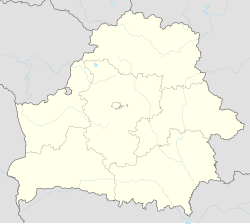  Slutsk Слуцк Location of Slutsk | |||
| Coordinates: 53°02′N 27°34′E / 53.033°N 27.567°E / 53.033; 27.567 | |||
Country Voblast Raion |  Belarus Belarus Minsk Voblast Minsk VoblastSlutsk Raion | ||
| Founded | 1116 | ||
| Area | |||
| • Total | 24.6 km2 (9.5 sq mi) | ||
| Elevation | 250 m (820 ft) | ||
| Population (2009) | |||
| • Total | 61,444 | ||
| • Density | 2,500/km2 (6,500/sq mi) | ||
| [1] | |||
| Time zone | UTC+3 (FET) | ||
| • Summer (DST) | UTC+3 (FET) | ||
| Postal code | 223610 | ||
| Area code(s) | +375 1795 | ||
| License plate | 5 | ||
| Website | Official website | ||


Cinema-Theatre "Belarus"
Slutsk (officially transliterated as Sluck, Belarusian: Слуцк; Russian: Слуцк; Polish: Słuck, Lithuanian: Sluckas, Yiddish/Hebrew: סלוצק Slotsk) is a city in Belarus, located on the Sluch River 105 km (65 mi) south of Minsk. As of 2010 its population is of 61,400.[2] Slutsk is the administrative center of Slutsk Raion.
Contents
1 Geography
2 History
3 Jewish community
4 People
5 International relations
5.1 Twin towns — brother cities
6 See also
7 References
8 Gallery
9 External links
Geography
The city is situated in the south-west of its Region, 26 km (16 mi) north of Soligorsk.
History
Slutsk was first mentioned in writing in 1116. It was part of the Principality of Turov and Pinsk, but in 1160 it became the capital of a separate principality. From 1320–1330 it was part of the domain of the Grand Duchy of Lithuania. Later it was owned by the Olelkovich and Radziwiłł families, which transformed it into a center of the Polish Reformed Church with a gymnasium and a strong fortress.
Following the 17th century the city became famous for its manufactories of kontusz belts, some of the most expensive and luxurious pieces of garment of the szlachta. Because of the popularity of the cloths made here, belts worn over the żupan were often called of Slutsk despite their real place of origin.
Slutsk was part of Russian Empire after Second Partition of Poland in 1793. It was occupied by Germany in 1918 and by Poland between 1919 and 1920 during Polish Soviet War. In 1920 it was the centre of a major anti-bolshevik uprising known as the Slutsk defence action.
Until World War II and the Slutsk Affair the city was predominantly Jewish, now the population includes no more than 100 Jews. Slutsk was occupied by the German Army on 26 June 1941 and placed under the administration of Reichskommissariat Ostland. The period of German occupation ended on 30 June 1944, when troops of the 1st Belorussian Front recaptured the town during the Minsk Offensive of the Red Army.
Jewish community
The first indication of Jews in Slutsk is from 1583 when the city was part of Lithuania.[3] Formal recognition came in 1601. By 1623, Jews owned 16 homes. In 1691, Slutsk became one of the five leading communities of area of Lithuania.[3] By 1750 there were 1,593 Jews. Although this number represented a third of the cities population, 75% of the town's merchants were Jews, and a similar proportion accounted for Jewish ownership and merchandizing of alcohol.[3] After annexation by Russia in 1793, growth of the city slowed, in part due to it being bypassed by the railroad. By 1897 the Jewish community numbered 10,264 inhabitants, or 77% of the city population.[3] They played a central role in the cities markets, particularly in agricultural produce.
Slutsk was not insignificant in terms of Torah study. Among the rabbinic figures who served there were Yehudah Leib Pohovitser, Chayim ha-Kohen Rapoport, Yosef Dov Ber Soloveichik (1865–1874), and Isser Zalman Meltzer.[3] According to legend the Baal Shem Tov visited Slutsk in 1733 at the invitation of Shmuel Ickowicz.[3] Despite this, the town was known for its anti-hasidic misnagdim. The Haskalah and modern Jewish political parties also were represented among the population.[3]
People
Mikhail Basalyha – Belarusian painter
Uladzimir Basalyha – Belarusian painter
Isaac Dov Berkowitz – Jewish and Israeli author
Eliyahu Feinstein – rabbinic authority
Yaakov Yosef Herman – Orthodox Jewish pioneer in America
Semyon Kosberg – Jewish Soviet engineer
Shneur Kotler – rosh yeshiva, Lakewood yeshiva
- Harry Lefrak – father of Samuel J. LeFrak, builder and realtor
- Shmuel David Leibowitz-Father of Boruch Ber Leibowitz
Boruch Ber Leibowitz – leading rosh yeshiva
- Yisroel Leibowitz-leading Rabbi in Vilna from 1926
- Chaim Sholom Leibowitz-Son of Yisroel Leibowitz - Editor Of Birkas Shmuel, magnum opus of His Uncle Boruch Ber Leibowitz
Isser Zalman Meltzer – Rabbi of Slutsk from 1903 to 1923
Anastasiya Prokopenko, world champion and Olympic bronze medalist in modern pentathlon
Gregory Razran, (1901-1973), Russian American psychologist
Princess Sophia of Slutsk, medieval Eastern Orthodox saint
Edward Sperling – Jewish writer and humorist
Mikola Statkevich – Belarusian politician
Meyer Waxman – Rabbi and author
Mikhail Yakimovich – Belarusian handball player
Lidia Yermoshina – Belarusian politician
Shaul Yisraeli – religious Zionist rabbi
International relations
Twin towns — brother cities
Slutsk is twinned with:
 Shaki, Azerbaijan
 Serpukhov, Russia
 Brovary, Ukraine
 Sisian, Armenia (since 2008)


See also
- Slutsk Affair
- Slutsk defence action
- Slutsky
- List of cities and towns in Belarus
- Pas kontuszowy
- Słuck Confederation
References
^ "World Gazetteer". Archived from the original on 2013-01-11..mw-parser-output cite.citation{font-style:inherit}.mw-parser-output .citation q{quotes:"""""""'""'"}.mw-parser-output .citation .cs1-lock-free a{background:url("//upload.wikimedia.org/wikipedia/commons/thumb/6/65/Lock-green.svg/9px-Lock-green.svg.png")no-repeat;background-position:right .1em center}.mw-parser-output .citation .cs1-lock-limited a,.mw-parser-output .citation .cs1-lock-registration a{background:url("//upload.wikimedia.org/wikipedia/commons/thumb/d/d6/Lock-gray-alt-2.svg/9px-Lock-gray-alt-2.svg.png")no-repeat;background-position:right .1em center}.mw-parser-output .citation .cs1-lock-subscription a{background:url("//upload.wikimedia.org/wikipedia/commons/thumb/a/aa/Lock-red-alt-2.svg/9px-Lock-red-alt-2.svg.png")no-repeat;background-position:right .1em center}.mw-parser-output .cs1-subscription,.mw-parser-output .cs1-registration{color:#555}.mw-parser-output .cs1-subscription span,.mw-parser-output .cs1-registration span{border-bottom:1px dotted;cursor:help}.mw-parser-output .cs1-ws-icon a{background:url("//upload.wikimedia.org/wikipedia/commons/thumb/4/4c/Wikisource-logo.svg/12px-Wikisource-logo.svg.png")no-repeat;background-position:right .1em center}.mw-parser-output code.cs1-code{color:inherit;background:inherit;border:inherit;padding:inherit}.mw-parser-output .cs1-hidden-error{display:none;font-size:100%}.mw-parser-output .cs1-visible-error{font-size:100%}.mw-parser-output .cs1-maint{display:none;color:#33aa33;margin-left:0.3em}.mw-parser-output .cs1-subscription,.mw-parser-output .cs1-registration,.mw-parser-output .cs1-format{font-size:95%}.mw-parser-output .cs1-kern-left,.mw-parser-output .cs1-kern-wl-left{padding-left:0.2em}.mw-parser-output .cs1-kern-right,.mw-parser-output .cs1-kern-wl-right{padding-right:0.2em}
^ (in Russian) 2010 Belarus population statistics Archived 2010-09-18 at the Wayback Machine (RAR file format)
^ abcdefg Adam Teller, "Slutsk," YIVO Encyclopedia of Jews in Eastern Europe, (19 October 2010), accessed 25 January 2015.
Gallery
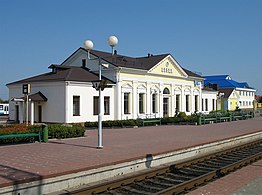
Slutsk train station

Slutsk bus depot in the 1920s

Slutsk Homeland Museum

Commercial college
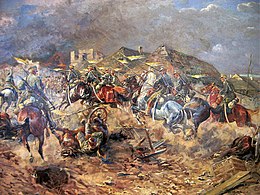
Painting of the Slutsk Defence Action

Calvinist Church and high school
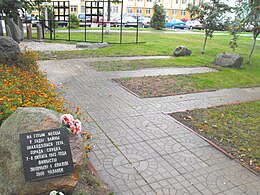
Site of the Slutstk Ghetto (today a playground and park)
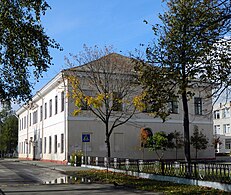
Slutsk high school

The high school, "The oldest school in Slutsk"

Native Belarusian man

Slutsk family

Studying Talmud in Slutsk
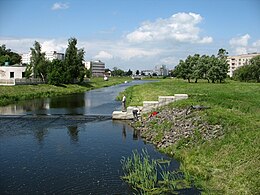
The Slutsk River


External links
 | Wikimedia Commons has media related to Sluck. |
- Home page of the city of Slutsk
Slutsk, Belarus at JewishGen
 Subdivisions of Minsk Region, Belarus Subdivisions of Minsk Region, Belarus | ||
|---|---|---|
| Districts .mw-parser-output .nobold{font-weight:normal} (raiony) |
|  |
| Cities |
| |
1 Seat of Minsk Region but administratively separated | ||
Coordinates: 53°02′N 27°34′E / 53.033°N 27.567°E / 53.033; 27.567
Authority control  |
|
|---|


