1992 Irish general election
 | |||||||||||||||||||||||||||||||||||||||||||||||||||||||||||||||||||||||||||||||||||||||||||||||||||||
165 of 166 seats in Dáil Éireann 84 seats needed for a majority | |||||||||||||||||||||||||||||||||||||||||||||||||||||||||||||||||||||||||||||||||||||||||||||||||||||
|---|---|---|---|---|---|---|---|---|---|---|---|---|---|---|---|---|---|---|---|---|---|---|---|---|---|---|---|---|---|---|---|---|---|---|---|---|---|---|---|---|---|---|---|---|---|---|---|---|---|---|---|---|---|---|---|---|---|---|---|---|---|---|---|---|---|---|---|---|---|---|---|---|---|---|---|---|---|---|---|---|---|---|---|---|---|---|---|---|---|---|---|---|---|---|---|---|---|---|---|---|---|
| Turnout | 68.5% | ||||||||||||||||||||||||||||||||||||||||||||||||||||||||||||||||||||||||||||||||||||||||||||||||||||
| |||||||||||||||||||||||||||||||||||||||||||||||||||||||||||||||||||||||||||||||||||||||||||||||||||||
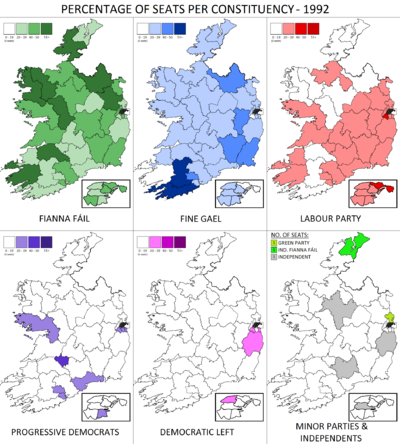 Percentage of seats gained by each of the five biggest parties, and number of seats gained by smaller parties and independents. | |||||||||||||||||||||||||||||||||||||||||||||||||||||||||||||||||||||||||||||||||||||||||||||||||||||
| |||||||||||||||||||||||||||||||||||||||||||||||||||||||||||||||||||||||||||||||||||||||||||||||||||||


The Irish general election of 1992 was held on Wednesday, 25 November 1992, almost three weeks after the dissolution of the Dáil on 5 November. The newly elected 166 members of the 27th Dáil assembled at Leinster House on 14 December 1992, but a new Taoiseach was not elected. A new Fianna Fáil-Labour Party coalition government was not appointed until 12 January 1993 after Albert Reynolds was re-elected Taoiseach.
The general election took place in 41 parliamentary constituencies throughout Ireland for 166 seats in Dáil Éireann.
Contents
1 Campaign
2 Results
2.1 Voting summary
2.2 Seats summary
3 Dáil membership changes
4 See also
5 References
6 External links
Campaign
The general election of 1992 was precipitated by the collapse of the Fianna Fáil–Progressive Democrats coalition government. Allegations of dishonesty at the Beef Tribunal forced Desmond O'Malley and his party to part ways with Albert Reynolds's Fianna Fáil. Both Albert Reynolds and John Bruton of Fine Gael were fighting their first general election as leader of their respective parties. For Reynolds it would be his only election as leader. The campaign went very poorly for Fianna Fáil with Reynolds's support dropping by 20%.
Among the left, the Labour Party had increased their support in the local elections the previous year and many were predicting major gains for the party in the Dáil. The Workers' Party of Ireland had split at a special convention that year over a motion to re-constitute the party, similar to the move made the same year by the Italian Communist Party, and sever all links with the Official IRA. Six out of their seven TD's and a majority of their councillors left the party when the motion failed to be passed and hastily formed Democratic Left to contest the election.
Many political pundits had predicted that Fianna Fáil would not be re-elected and that a "Rainbow Coalition" involving Fine Gael, the Labour Party and possibly Democratic Left would be formed. John Bruton, the leader of Fine Gael, had problems of his own. Opinion polls showed that if a "Rainbow Coalition" came to power, Dick Spring of the Labour Party was seen as a better potential Taoiseach than Bruton. The possibility of a rotating Taoiseach was also hinted at in the media.
The big winner of the campaign was Dick Spring and the Labour Party. They distanced themselves completely from Fine Gael and fought an independent line. During the campaign Spring made very little comment about what the party would do after the election, however, he did say that if the Labour Party was part of a coalition he would have to be granted a turn as Taoiseach.
The election also saw Moosajee Bhamjee (Labour Party) become the first Muslim Teachta Dála (TD).
Results
| Party | Leader | Seats | ± | % of seats | First Pref votes | % FPv | ±% | |
|---|---|---|---|---|---|---|---|---|
Fianna Fáil | Albert Reynolds | 68 |  9 9 | 41.0 | 674,650 | 39.1 | 5.0 | |
Fine Gael | John Bruton | 45 | 10 | 27.1 | 422,106 | 24.5 | 4.8 | |
Labour Party | Dick Spring | 33 |  18 18 | 19.8 | 333,013 | 19.3 | 9.8 | |
Progressive Democrats | Desmond O'Malley | 10 | 4 | 6.0 | 80,787 | 4.7 | 0.8 | |
Democratic Left | Proinsias De Rossa | 4 | New | 2.4 | 47,945 | 2.8 | – | |
Sinn Féin | Gerry Adams | 0 |  0 0 | 0 | 27,809 | 1.6 | 0.4 | |
Green Party | N/A | 1 | 0 | 0.6 | 24,110 | 1.4 | 0.1 | |
Workers' Party | Tomás Mac Giolla | 0 | 7† | 0 | 11,533 | 0.7 | 4.3 | |
Christian Centrist | 0 | New | 0 | 3,413 | 0.2 | – | ||
Independent | N/A | 5 | 1 | 3.0 | 99,487 | 5.8 | 2.5 | |
| Spoilt votes | 26,498 | — | — | |||||
Total | 166 | 0 | 100 | 1,751,351 | 100 | — | ||
| Electorate/Turnout | 2,557,036 | 68.5% | — | |||||
In 1989 the Democratic Socialist Party won 0.6% of the vote and 1 seat; the party merged with the Labour Party in 1990. Independents include Independent Fianna Fáil (5,248 votes, 1 seat).
†In early 1992, 6 Workers' Party TDs left the party and founded Democratic Left (DL).
- Fianna Fáil–Labour Party coalition government formed.
When the votes were counted the picture was clear. Fianna Fáil had its worst performance since 1927, winning less than 40% of the vote. Fine Gael, in spite of predictions of success, actually lost 10 seats. The Labour Party recorded its best ever result, an event dubbed the "Spring Tide" and more than doubled its number of seats. Talks between Fine Gael and Labour on establishing a minority government floundered after several weeks, partly over the issue of the 'revolving Taoiseach'. Spring had to enter into coalition with Fianna Fáil, or force another election. The coalition deal proved very unpopular with many of Labour's supporters, because Dick Spring had campaigned heavily against Fianna Fáil and particularly Albert Reynolds. As a result of the coalition, Albert Reynolds was elected Taoiseach with over 100 votes, the biggest majority by any Taoiseach in Irish political history until 2011.
Following a number of scandals in 1994, particularly over the beef industry, the Labour Party left the coalition and, after negotiations, formed the "Rainbow Coalition" with Fine Gael and Democratic Left on 15 December 1994, as three by-election gains had by then made a Fine Gael-Labour-Democratic Left majority government possible.[4] This was the first and to date, only occasion in Irish political history that a party had left a governing coalition and gone into government with opposition parties without first holding an election.
Voting summary
Seats summary
Dáil membership changes
The following changes took place as a result of the election:
- 11 outgoing TDs retired
- 155 TDs stood for re-election
- 126 of those were re-elected
- 30 failed to be re-elected
- 41 successor TDs were elected
- 33 were elected for the first time
- 8 had previously been TDs
- There were 10 successor female TDs, increasing the total number by 7 to 20
- There were changes in 29 of the 41 constituencies contested
Outgoing TDs are listed in the constituency they contested in the election. For some, such as John Stafford, this differs from the constituency they represented in the outgoing Dáil. Where more than one change took place in a constituency the concept of successor is an approximation for presentation only.
| Constituency | Departing TD | Party | Change | Comment | Successor TD | Party | ||
|---|---|---|---|---|---|---|---|---|
Carlow–Kilkenny | No membership changes | |||||||
Cavan–Monaghan | John Wilson | Fianna Fáil | Retired | Brendan Smith | Fianna Fáil | |||
Bill Cotter | Fine Gael | Lost seat | Seymour Crawford | Fine Gael | ||||
Clare | Brendan Daly | Fianna Fáil | Lost seat | Tony Killeen | Fianna Fáil | |||
Madeleine Taylor-Quinn | Fine Gael | Lost seat | Moosajee Bhamjee | Labour Party | ||||
Cork East | Joe Sherlock | Democratic Left | Lost seat | John Mulvihill | Labour Party | |||
Cork North-Central | Denis Lyons | Fianna Fáil | Lost seat | Burke – Former TD | Liam Burke | Fine Gael | ||
Cork North-West | Laurence Kelly | Fianna Fáil | Lost seat | Moynihan – Former TD | Donal Moynihan | Fianna Fáil | ||
Cork South-Central | John Dennehy | Fianna Fáil | Lost seat | O'Keeffe – Former TD | Batt O'Keeffe | Fianna Fáil | ||
Pearse Wyse | Progressive Democrats | Retired | Pat Cox | Progressive Democrats | ||||
Cork South-West | No membership changes | |||||||
Donegal North-East | No membership changes | |||||||
Donegal South-West | No membership changes | |||||||
Dublin Central | Dermot Fitzpatrick | Fianna Fáil | Lost seat | Joe Costello | Labour Party | |||
Dublin North | New seat | Trevor Sargent | Green Party | |||||
Dublin North-Central | Vincent Brady | Fianna Fáil | Retired | Derek McDowell | Labour Party | |||
Charles Haughey | Fianna Fáil | Retired | Son of outgoing TD | Seán Haughey | Fianna Fáil | |||
Pat Lee | Fine Gael | Lost seat | Previously represented Dublin Central but due to boundary changes ran in Dublin North-Central | |||||
John Stafford | Fianna Fáil | Lost seat | Previously represented Dublin Central but due to boundary changes ran in Dublin North-Central | |||||
Dublin North-East | Michael Joe Cosgrave | Fine Gael | Lost seat | Seán Kenny | Labour Party | |||
Pat McCartan | Democratic Left | Lost seat | Tommy Broughan | Labour Party | ||||
Dublin North-West | Michael Barrett | Fianna Fáil | Retired | Noel Ahern | Fianna Fáil | |||
Jim Tunney | Fianna Fáil | Lost seat | Róisín Shortall | Labour Party | ||||
Dublin South | Nuala Fennell | Fine Gael | Retired | Eithne FitzGerald | Labour Party | |||
Roger Garland | Green Party | Lost seat | Liz O'Donnell | Progressive Democrats | ||||
Dublin South-Central | Eric Byrne | Democratic Left | Lost seat | Pat Upton | Labour Party | |||
Fergus O'Brien | Fine Gael | Retired | Seats reduced from 5 to 4 | |||||
Dublin South-East | Garret FitzGerald | Fine Gael | Retired | Frances Fitzgerald | Fine Gael | |||
Joe Doyle | Fine Gael | Lost seat | McDowell – Former TD | Michael McDowell | Progressive Democrats | |||
Gerard Brady | Fianna Fáil | Lost seat | Eoin Ryan | Fianna Fáil | ||||
Dublin South-West | New seat | Eamonn Walsh | Labour Party | |||||
Dublin West | Tomás Mac Giolla | Workers' Party | Lost seat | Joan Burton | Labour Party | |||
Dún Laoghaire | Monica Barnes | Fine Gael | Lost seat | Helen Keogh | Progressive Democrats | |||
Brian Hillery | Fianna Fáil | Lost seat | Became a minister on first day | Niamh Bhreathnach | Labour Party | |||
Galway East | No membership changes | |||||||
Galway West | Frank Fahey | Fianna Fáil | Lost seat | Éamon Ó Cuív | Fianna Fáil | |||
Kerry North | Tom McEllistrim | Fianna Fáil | Lost seat | Foley – Former TD | Denis Foley | Fianna Fáil | ||
Kerry South | Michael Moynihan | Labour Party | Retired | Daughter of outgoing TD | Breeda Moynihan-Cronin | Labour Party | ||
Kildare | No membership changes | |||||||
Laois–Offaly | Tom Enright | Fine Gael | Lost seat | Pat Gallagher | Labour Party | |||
Limerick East | No membership changes | |||||||
Limerick West | No membership changes | |||||||
Longford–Roscommon | Louis Belton | Fine Gael | Lost seat | Represented Longford–Westmeath but due to constituency changes was one of 5 outgoing TDs standing in this new 4 seat constituency | ||||
Terry Leyden | Fianna Fáil | Lost seat | Doherty – Former TD | Seán Doherty | Fianna Fáil | |||
Louth | No membership changes | |||||||
Mayo East | Seán Calleary | Fianna Fáil | Retired | Tom Moffatt | Fianna Fáil | |||
Mayo West | Martin O'Toole | Fianna Fáil | Retired | Séamus Hughes | Fianna Fáil | |||
Meath | John Farrelly | Fine Gael | Lost seat | Brian Fitzgerald | Labour Party | |||
Sligo–Leitrim | Gerry Reynolds | Fine Gael | Lost seat | Declan Bree | Labour Party | |||
Tipperary North | No membership changes | |||||||
Tipperary South | No membership changes | |||||||
Waterford | No membership changes | |||||||
Westmeath | Due to boundary changes, only 2 outgoing TDs from Longford–Westmeath moved to this 3 seat constituency | Willie Penrose | Labour Party | |||||
Wexford | Séamus Cullimore | Fianna Fáil | Lost seat | Byrne – Former TD | Hugh Byrne | Fianna Fáil | ||
Michael D'Arcy | Fine Gael | Lost seat | Doyle – Former TD | Avril Doyle | Fine Gael | |||
Wicklow | Dick Roche | Fianna Fáil | Lost seat | Johnny Fox | Independent | |||
| New seat | Liz McManus | Democratic Left | ||||||
See also
- Members of the 27th Dáil
- 23rd Government of Ireland
- 24th Government of Ireland
- Ministers of State of the 27th Dáil
- Members of the 20th Seanad
References
^ "27th Dáil 1992 General Election". ElectionsIreland.org. Retrieved 22 July 2009..mw-parser-output cite.citation{font-style:inherit}.mw-parser-output .citation q{quotes:"""""""'""'"}.mw-parser-output .citation .cs1-lock-free a{background:url("//upload.wikimedia.org/wikipedia/commons/thumb/6/65/Lock-green.svg/9px-Lock-green.svg.png")no-repeat;background-position:right .1em center}.mw-parser-output .citation .cs1-lock-limited a,.mw-parser-output .citation .cs1-lock-registration a{background:url("//upload.wikimedia.org/wikipedia/commons/thumb/d/d6/Lock-gray-alt-2.svg/9px-Lock-gray-alt-2.svg.png")no-repeat;background-position:right .1em center}.mw-parser-output .citation .cs1-lock-subscription a{background:url("//upload.wikimedia.org/wikipedia/commons/thumb/a/aa/Lock-red-alt-2.svg/9px-Lock-red-alt-2.svg.png")no-repeat;background-position:right .1em center}.mw-parser-output .cs1-subscription,.mw-parser-output .cs1-registration{color:#555}.mw-parser-output .cs1-subscription span,.mw-parser-output .cs1-registration span{border-bottom:1px dotted;cursor:help}.mw-parser-output .cs1-ws-icon a{background:url("//upload.wikimedia.org/wikipedia/commons/thumb/4/4c/Wikisource-logo.svg/12px-Wikisource-logo.svg.png")no-repeat;background-position:right .1em center}.mw-parser-output code.cs1-code{color:inherit;background:inherit;border:inherit;padding:inherit}.mw-parser-output .cs1-hidden-error{display:none;font-size:100%}.mw-parser-output .cs1-visible-error{font-size:100%}.mw-parser-output .cs1-maint{display:none;color:#33aa33;margin-left:0.3em}.mw-parser-output .cs1-subscription,.mw-parser-output .cs1-registration,.mw-parser-output .cs1-format{font-size:95%}.mw-parser-output .cs1-kern-left,.mw-parser-output .cs1-kern-wl-left{padding-left:0.2em}.mw-parser-output .cs1-kern-right,.mw-parser-output .cs1-kern-wl-right{padding-right:0.2em}
^ "Dáil elections since 1918". ARK Northern Ireland. Retrieved 22 July 2009.
^ Dieter Nohlen & Philip Stöver (2010) Elections in Europe: A data handbook, pp1009-1017
ISBN 978-3-8329-5609-7
^ "Dáil Éireann By Elections 1918–2005". ElectionsIreland.org. Retrieved 22 July 2009.
External links
1992 election: Party leaders' debate RTÉ archives
 Elections and referendums in the Republic of Ireland Elections and referendums in the Republic of Ireland | |
|---|---|
| General elections |
|
| Seanad elections |
|
| Presidential elections |
|
| European elections |
|
| Local elections |
|
| Referendums |
|
| |


