University of Sarajevo
Univerzitet u Sarajevu Универзитет у Сарајеву | |
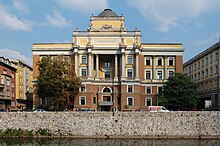 Sarajevo University rector seat & Faculty of Law building, built in the 1850s. | |
Latin: Universitas Studiorum Saraievoensis | |
| Type | Public |
|---|---|
| Established | 1949 (1537 as an Islamic polytechnic) |
| Rector | Rifat Škrijelj |
Academic staff | 1,302 |
Administrative staff | 990 |
| Students | 30,866 |
| Location | Sarajevo, Bosnia and Herzegovina |
| Campus | Urban |
| Affiliations | European University Association |
| Website | www.unsa.ba (in Bosnian) (in English) |
 | |
The University of Sarajevo (Bosnian: Univerzitet u Sarajevu / Универзитет у Сарајеву) is a public university located in Sarajevo, Bosnia and Herzegovina. It is the largest and oldest university in the country, as well as the oldest institution of tertiary learning in the former Yugoslavia, tracing its initial origins to 1537 as an Islamic school of law.[1][2]
With 20 faculties, three academies and three faculties of theology and with 30,866 enrolled students as of 2014, it ranks among the largest universities in the Balkans in terms of enrollment. Since opening its doors in 1949, a total of 122,000 students received bachelor's degrees, 3,891 received master's degrees and 2,284 received doctorate degrees in 45 different fields.[3] It is now widely regarded as the most prestigious university in Bosnia and Herzegovina,[3] and employs more than one thousand faculty members.[4]
Contents
1 History
1.1 Ottoman period, late Medieval-early Modern
1.2 Austria-Hungary period and first Yugoslavia, late Modern-end of WWII
1.3 Establishment and post WWII development
1.3.1 From 1949 to 1955
1.3.2 From 1955 to 1970
1.3.3 From 1970 to 1982
1.3.4 From 1982 to 1992
1.3.5 From 1992 to 1995
1.3.6 Since 1996 onward
2 Partner relations
3 Objective
4 Organization
5 Rectors
6 Notable alumni
7 Notable faculty
8 See also
9 References
10 External links
History

Main gate of Gazi Husrev-bey's Madrasa, Library, Hanikah & Museum Complex, built in 1537 at Baščaršija.
Ottoman period, late Medieval-early Modern
Before establishment of modern University of Sarajevo, first schools of higher educations in Sarajevo and Bosnia and Herzegovina were founded during 16th century under tutelage of Ottomans. As Ottoman institute of higher education first Madrasa in Bosnia, namely Gazi Husrev-beg Madrasa & Library, was inaugurated in Sarajevo 1537 by Gazi Husrev-beg.[5][6][7][8]
Austria-Hungary period and first Yugoslavia, late Modern-end of WWII
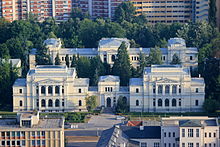
National Museum of Bosnia and Herzegovina, from Austria-Hungarian period.
The university in its modern, secular incarnation being developed during Austro-Hungarian Empire rule, when many of the institutions of higher education and culture such as National Museum of Bosnia and Herzegovina, still active today, were established. [4] The modern history of the University of Sarajevo continued after the World War I, and before World War II as well as during the war, successfully extanding its development with new schools and institutes opened, such as the Faculty of Agriculture and Forestry in 1940, the Medical Faculty in 1944. The Medical Faculty was re-established in 1946, the Faculty of Law, the Teacher Training College were opened and, in 1948, the Faculty of Agriculture and Forestry was re-established.
Establishment and post WWII development
From 1949 to 1955
In 1949, the Engineering Faculty was opened. On 2 December of that year with the appointment of the first rector, the University of Sarajevo was officially established. With the opening of the Faculty of Philosophy (1950) and the Faculty of Economics (1952) the initial phase of establishment of the Sarajevo University was completed.
From 1955 to 1970
The second phase of development (1955–69) was characterized by the affirmation of the university, the opening of new institutions of higher education and the relative satisfaction of the needs for highly educated personnel in Bosnia and Herzegovina. Another significant achievement is the organization and initiation of postgraduate studies at the university.
From 1970 to 1982
The third phase (1970–82) was defined by more institutions of higher education being opened at the university, a scientific promotion of the university and its intensified involvement and promotion on the international academic plane. The university contributed directly and indirectly to the establishment of new universities in Banja Luka, Mostar and Tuzla.
From 1982 to 1992
The fourth phase (1982–92) was characterized by the separation of scientific activities from the university and the formation of favored scientific institutes outside it. This brought considerable damage to the University of Sarajevo, because the coherence of university education and scientific research was endangered. This resulted in a lower quality of education and a technological stagnation of the university. The uncontrolled enrollment of an enormous number of students resulted in a significantly lower efficiency of studies and a hyper-production of personnel in certain areas of education.
From 1992 to 1995
The fifth phase (1992–95) was marked by devastation of the facilities and equipment of the university, caused by the war in Bosnia and Herzegovina and the Siege of Sarajevo.
Despite all of these difficulties of life and work during the four-year siege of Sarajevo, because of the help and the enthusiasm, professionalism, patriotism and perseverance of university teachers and associates as well as the students, the University of Sarajevo managed to retain its continuity of work and life. This was a specific aspect of intellectual academic resistance against everything that is barbaric and uncivilized. It represented the university's contribution to the affirmation of freedom and democracy, the outcry against the war and aggression and the affirmation of the sovereignty of Bosnia and Herzegovina.
Since 1996 onward
At the beginning of 1996 the University of Sarajevo entered the phase of post-war physical and academic renewal and reconstruction. The physical renewal is aimed at the reconstruction and the rebuilding of destroyed facilities (through the realization of the New University Campus Project), the replacement of destroyed educational and scientific equipment and the reconstruction of student dormitories. Significant results have been achieved on this plane and the conditions for higher quality studies have been formed in certain areas. However, despite the numerous reconstruction projects the University of Sarajevo still hasn't reached the full prewar potential. The quality and number of student dormitories are still far below the required, technology is mostly outdated, and since the working conditions could be much better academic staff is also lacking. In addition, the war caused a rift even among the academics and many who worked at the university before the war didn't continue after. The quality of studies is slowly improving, partly because of the Bologna Process implementation, but there is still hyper-production in some areas of education since the Bosnia and Herzegovina doesn't have a unified program of higher education (one could say that it has as many as 11 programs, each implementing Bologna Accord in its own manner).
The process of renewal and reconstruction of the university is supported by the activities of the European University Association, the European Council, the European Union as well as a whole line of international organizations and institutions involved in the field of higher education.
Partner relations
The University of Sarajevo enjoys partnerships with over 120 universities in Europe, the USA, Canada, and the Middle East.[9][10]
Objective
The main objective of all the university's current activities is to raise the quality of studies, to create a contemporary university of European origins, which will be a respectable representative of Bosnia and Herzegovina on the international level and a promoter of the traditional, historical, cultural, scientific and artistic values of the country, and Southeastern Europe.
Organization

Veterinary faculty

Faculty of natural science and mathematics

Faculty of philosophy

Academy of Fine Arts
The University comprises 32 faculties, academies and colleges, further subdivided into 6 academic groups, and an additional number of other programs:
- School of Economics and Business Sarajevo
- Academy of Fine Arts in Sarajevo
- Academy of Performing Arts in Sarajevo
- Faculty of Architecture
- Faculty of Electrical Engineering
- Faculty of Criminal Science
- Faculty of Political Science in Sarajevo
- Faculty of Sport and Physical Education
- Faculty of Traffic Engineering and Communications
- Faculty of Pharmacy
- Faculty of Philosophy
- Faculty of Civil Engineering
- Faculty of Mechanical Engineering
Medical Faculty- Sarajevo Music Academy
- College of Teacher Education
- Faculty of Agriculture
- Sarajevo Law School
- Faculty of Science and Technology
- Faculty of Natural Sciences and Mathematics
- Faculty of Dental Medicine
- Faculty of Forestry
- Faculty of Veterinary Medicine
- Faculty of Health Studies
- Join Members
- Faculty of Islamic Studies
- Faculty of Catholic Theology
- Faculty of Public Administration
- Institutes
- Institute of History
- Institute for Research of Crimes Against Humanity and International Law
- Institute for Genetic Engineering and Biotechnology
- Oriental Institute
- Students Center Sarajevo
- Institute for Social Research
Rectors

The University of Sarajevo Faculty of Law building, built in the 1850s.
- Vaso Butozan 1949-1950, 1952-1956
- Drago Krndija 1950-1952
- Edhem Čamo 1956-1960
- Aleksandar Trumić 1960-1965
- Fazli Alikalfić 1965-1969
- Hamdija Čemerlić 1969-1972
- Zdravko Besarović 1972-1977
- Arif Tanović 1977-1981
- Božidar Matić 1981-1985
- Ljubomir Berberović 1985-1988
- Nenad Kecmanović 1988-1991
- Jusuf Mulić 1991-1993
- Faruk Selesković 1993-1995
- Nedžad Mulabegović 1995-2000
- Boris Tihi 2000-2004
Hasan Muratović 2004-2006
Faruk Čaklovica 2006-2012- Muharem Avdispahić 2012-2016
- Rifat Škrijelj 2016-present
Notable alumni
Ademir Kenović, Bosnian movie director, producer and cinematography professor
Aleksandar Hemon, Bosnian writer
Alija Behmen, former mayor of Sarajevo
Alija Izetbegović, first President of Bosnia and Herzegovina
Bakir Izetbegović, Former member of the Bosnian Presidency
Boris Nemšić, former Chief Executive Officer of the Russian telecom company VimpelCom, former Chief Executive Officer of Telekom Austria Group
Branko Đurić, Bosnian actor
Dejan Milošević, Bosnian theoretical physicist
Ivica Osim, ex-Head Coach for Yugoslavia national football team and Japan national football team
Jasmila Žbanić, Bosnian film director
Jasmin Geljo, Bosnian actor
Kornelije Kovač, Serbian composer
MayaSar, Bosnian singer
Miljenko Jergović, Bosnian and Croatian writer
Neda Ukraden, folk singer
Omer Halilhodžić, automotive designer
Predrag Finci, philosopher and essayist
Rasim Ljajić, Serbian Deputy Prime Minister
Rifat Hadžiselimović, genetist
Safet Isović, prominent Bosnian sevdalinka singer
Selmo Cikotić, Bosnian Minister of Defense
Semiha Borovac, former mayor of Sarajevo
Senad Bašić, Bosnian actor
Sulejman Tihić, President of Bosnia and Herzegovina
Sven Alkalaj, foreign minister of Bosnia and Herzegovina
Vlado Pravdić, Bosnian organist
Zdravko Čolić, Bosnian pop singer
Željko Komšić, president of Bosnia and Herzegovina
Živko Radišić, former President of Bosnia and Herzegovina
Zlatko Lagumdžija, former Prime Minister of Bosnia and Herzegovina
Zlatko Topčić, famous Bosnian writer and screenwriter
Notable faculty
Alija Behmen, former mayor of Sarajevo and former prime minister of Federation of Bosnia and Herzegovina
Dejan Milošević, theoretical physicist
Ejup Ganić, former prime minister of Federation of Bosnia and Herzegovina
Hamdija Pozderac, president of SR Bosnia and Herzegovina from 1971 to 1974
Haris Silajdžić, former president of Bosnia and Herzegovina
Zlatko Lagumdžija, former Prime Minister of Bosnia and Herzegovina
Zoran G. Jančić, Bosnian pianist
Haris Pašović, Bosnia and Herzegovina director and founder of East West Theatre Company
Danis Tanović, Oscar-winning director
Zdravko Grebo, founder of the Open Society Foundation of Bosnia and Herzegovina
Tomislav Dretar, writer, critic and philosopher
Predrag Finci, philosopher and essayist
See also
- Balkan Universities Network
- List of universities in Bosnia and Herzegovina
- Education in Bosnia and Herzegovina
- List of colleges and universities
References
^ Agency, Anadolu. "Saraybosna'da 476 yıldır yaşayan medrese! (Sarajevo Celebrates 476 Years of its Medresa!)". Haber7. Retrieved 11 November 2013..mw-parser-output cite.citation{font-style:inherit}.mw-parser-output q{quotes:"""""""'""'"}.mw-parser-output code.cs1-code{color:inherit;background:inherit;border:inherit;padding:inherit}.mw-parser-output .cs1-lock-free a{background:url("//upload.wikimedia.org/wikipedia/commons/thumb/6/65/Lock-green.svg/9px-Lock-green.svg.png")no-repeat;background-position:right .1em center}.mw-parser-output .cs1-lock-limited a,.mw-parser-output .cs1-lock-registration a{background:url("//upload.wikimedia.org/wikipedia/commons/thumb/d/d6/Lock-gray-alt-2.svg/9px-Lock-gray-alt-2.svg.png")no-repeat;background-position:right .1em center}.mw-parser-output .cs1-lock-subscription a{background:url("//upload.wikimedia.org/wikipedia/commons/thumb/a/aa/Lock-red-alt-2.svg/9px-Lock-red-alt-2.svg.png")no-repeat;background-position:right .1em center}.mw-parser-output .cs1-subscription,.mw-parser-output .cs1-registration{color:#555}.mw-parser-output .cs1-subscription span,.mw-parser-output .cs1-registration span{border-bottom:1px dotted;cursor:help}.mw-parser-output .cs1-hidden-error{display:none;font-size:100%}.mw-parser-output .cs1-visible-error{font-size:100%}.mw-parser-output .cs1-subscription,.mw-parser-output .cs1-registration,.mw-parser-output .cs1-format{font-size:95%}.mw-parser-output .cs1-kern-left,.mw-parser-output .cs1-kern-wl-left{padding-left:0.2em}.mw-parser-output .cs1-kern-right,.mw-parser-output .cs1-kern-wl-right{padding-right:0.2em}
^ "Things to do in Sarajevo". Gezip Gördüm. Retrieved 11 November 2013.
^ ab "Univerzitet u Sarajevu - O Univerzitetu". unsa.ba (in Bosnian). Retrieved 26 April 2017.
^ ab "A History of the University of Sarajevo". City of Sarajevo. 19 May 2010. Retrieved 10 June 2012.
^ "History". www.ghb.ba. Retrieved 26 April 2017.
^ "Gazi Husrev-begova medresa". www.medresa.ba (in Bosnian). Retrieved 26 April 2017.
^ Agency, Anadolu. "Saraybosna'da 476 yıldır yaşayan medrese! (Sarajevo Celebrates 476 Years of its Medresa!)" (in Turkish). Haber7. Retrieved 11 November 2013.
^ "Things to do in Sarajevo". Gezip Gördüm. Retrieved 11 November 2013.
^ "University of Sarajevo – DEPARTMENT FOR INTERNATIONAL COLLABORATION". www.erasmus-unsa.ba. Retrieved 27 April 2017.
^ "University of Sarajevo - INFO - International agreements" (.pdf). www.unsa.ba (in Bosnian). Retrieved 27 April 2017.
External links
 | Wikimedia Commons has media related to University of Sarajevo. |
Official website (in Bosnian) (in English)

Sarajevo | ||
|---|---|---|
| History of Sarajevo |
|  |
| Municipalities |
| |
| Neighborhoods | Alipašino polje, Babića bašća, Baščaršija, Čengić vila, Dobrinja, Grbavica, Džidžikovac, Hrasno, Koševo, Mejtaš, Marijin dvor, Otoka, Višnjik | |
| Buildings and landmarks |
| |
| Places of worship |
| |
| Culture |
| |
| Galleries and museums |
| |
| Education |
| |
| Sports venues |
| |
| Transport |
| |
| Events |
| |
| ||
 Category
 Portal
 Universities in Bosnia and Herzegovina Universities in Bosnia and Herzegovina | |||||
|---|---|---|---|---|---|
| Federation of Bosnia and Herzegovina |
| ||||
| Republika Srpska |
| ||||
| Brčko District |
| ||||
Education in Bosnia and Herzegovina | |||||
Balkan Universities Network | ||
|---|---|---|
| Albania |
|  |
| Bosnia and Herzegovina |
| |
| Bulgaria |
| |
| Croatia |
| |
| Cyprus |
| |
| Greece |
| |
| Kosovo (disputed status) |
| |
| Macedonia |
| |
| Moldova |
| |
| Montenegro |
| |
| Romania |
| |
| Serbia |
| |
| Turkey |
| |
| Guest members |
| |
Coordinates: 43°52′N 18°25′E / 43.867°N 18.417°E / 43.867; 18.417


