Corytophanidae
| Corytophanidae | |
|---|---|
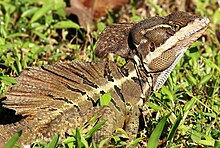 | |
Striped basilisk | |
Scientific classification  | |
| Kingdom: | Animalia |
| Phylum: | Chordata |
| Class: | Reptilia |
| Order: | Squamata |
| Suborder: | Iguania |
| Family: | Corytophanidae Fitzinger, 1843[1][2] |
| Genera | |
Basiliscus Laurenti, 1768 | |
Synonyms | |
Corythophanae Fitzinger, 1843[1] | |
Corytophanidae is a family of iguanian lizards, also called casquehead lizards or helmeted lizards,[4]endemic to the New World. Nine species of casquehead lizards from three genera are recognized.
Contents
1 Geographic range
2 Description
3 Behavior
4 Habitat
5 Reproduction
6 Genera and species
7 References
8 Further reading
Geographic range
Corytophanids are found from Mexico, through Central America, and as far south as Ecuador.
Description
The casquehead lizards are moderately sized lizards, with laterally compressed bodies, and typically have well-developed head crests in the shape of a casque helmet. This crest is a sexually dimorphic characteristic in males of Basiliscus, but is present in both sexes of Corytophanes and Laemanctus.[5]
Behavior
In Corytophanes, the head crests are used in defensive displays, where the lateral aspect of the body is brought about to face a potential predator in an effort to look bigger.[5] Unlike many of their close relatives, they are unable to break off their tails when captured, probably because the tail is essential as a counterbalance during rapid movement.[citation needed]
Habitat
Casquehead lizards are forest-dwelling.
Reproduction
Despite the small number of species in the family Corytophanidae, it includes both egg-laying species and species that give birth to live young.[4]
Genera and species
Family Corytophanidae
- Genus Basiliscus
Basiliscus basiliscus (Linnaeus, 1758) — common basilisk
Basiliscus galeritus A.M.C. Duméril & A.H.A. Duméril, 1851 — red-headed basilisk, western basilisk
Basiliscus plumifrons Cope, 1875 — green basilisk, plumed basilisk
Basiliscus vittatus Wiegmann, 1828 — brown basilisk, striped basilisk
- Genus Corytophanes
Corytophanes cristatus (Merrem, 1820) — helmeted iguana
Corytophanes hernandesii (Wiegmann, 1831) — Hernandez's helmeted basilisk
Corytophanes percarinatus A.H.A. Duméril, 1856 — Guatemalan helmeted basilisk
- Genus Laemanctus
Laemanctus longipes Wiegmann, 1834 — eastern casquehead iguana
Laemanctus serratus Cope, 1864 — serrated casquehead iguana
Nota bene: A binomial authority in parentheses indicates that the species was originally described in a different genus.
References
^ ab Frost DR, Etheridge R (1989). "A Phylogenetic Analysis and Taxonomy of Iguanian Lizards (Reptilia: Squamata)". Univ. Kansas Mus. Nat. Hist., Misc. Pub. (81): 1-65. ("Corytophanidae Fitzinger, 1843", p. 34.)
^ http://animaldiversity.ummz.umich.edu/site/accounts/information/Corytophanidae.html
^ "Corytophanidae". Dahms Tierleben. www.dahmstierleben.de/systematik/Reptilien/Squamata/Iguania/corytophanidae.
^ ab Bauer, Aaron M. (1998). Cogger, H.G.; Zweifel, R.G., eds. Encyclopedia of Reptiles and Amphibians. San Diego: Academic Press. pp. 134–136. ISBN 0-12-178560-2..mw-parser-output cite.citation{font-style:inherit}.mw-parser-output .citation q{quotes:"""""""'""'"}.mw-parser-output .citation .cs1-lock-free a{background:url("//upload.wikimedia.org/wikipedia/commons/thumb/6/65/Lock-green.svg/9px-Lock-green.svg.png")no-repeat;background-position:right .1em center}.mw-parser-output .citation .cs1-lock-limited a,.mw-parser-output .citation .cs1-lock-registration a{background:url("//upload.wikimedia.org/wikipedia/commons/thumb/d/d6/Lock-gray-alt-2.svg/9px-Lock-gray-alt-2.svg.png")no-repeat;background-position:right .1em center}.mw-parser-output .citation .cs1-lock-subscription a{background:url("//upload.wikimedia.org/wikipedia/commons/thumb/a/aa/Lock-red-alt-2.svg/9px-Lock-red-alt-2.svg.png")no-repeat;background-position:right .1em center}.mw-parser-output .cs1-subscription,.mw-parser-output .cs1-registration{color:#555}.mw-parser-output .cs1-subscription span,.mw-parser-output .cs1-registration span{border-bottom:1px dotted;cursor:help}.mw-parser-output .cs1-ws-icon a{background:url("//upload.wikimedia.org/wikipedia/commons/thumb/4/4c/Wikisource-logo.svg/12px-Wikisource-logo.svg.png")no-repeat;background-position:right .1em center}.mw-parser-output code.cs1-code{color:inherit;background:inherit;border:inherit;padding:inherit}.mw-parser-output .cs1-hidden-error{display:none;font-size:100%}.mw-parser-output .cs1-visible-error{font-size:100%}.mw-parser-output .cs1-maint{display:none;color:#33aa33;margin-left:0.3em}.mw-parser-output .cs1-subscription,.mw-parser-output .cs1-registration,.mw-parser-output .cs1-format{font-size:95%}.mw-parser-output .cs1-kern-left,.mw-parser-output .cs1-kern-wl-left{padding-left:0.2em}.mw-parser-output .cs1-kern-right,.mw-parser-output .cs1-kern-wl-right{padding-right:0.2em}
^ ab Pough et al. (2003).
Further reading
Fitzinger L (1843). Systema Reptilium, Fasciculus Primus, Amblyglossae. Vienna: Braumüller & Seidel. 106 pp. + indices. (Family Corythophanae, p. 52). (in Latin).- Pough FH, Andrews RM, Cadle JE, Crump ML, Savitsky AH, Wells KD (2003). Herpetology, Third Edition. Upper Saddle River, New Jersey: Pearson Education, Inc. 736 pp.
ISBN 978-0131008496. (Corytophanidae, p. 129).


