Butterflies of Sri Lanka
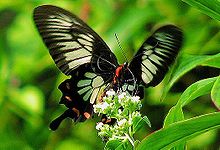
Ceylon Rose is a globally threatened butterfly endemic to Sri Lanka.
Sri Lanka is home to 245 species of butterflies with 23 of these being endemic to the island.[1] Of the 245 species, 76 are listed as threatened nationally, while Ceylon Rose is designated as critically endangered.[2]
Contents
1 General description
2 History of studies on butterflies
3 New species
4 Conservation
5 Endemic species
6 See also
7 References
General description
| Part of a series on |
| Wildlife of Sri Lanka |
|---|
 |
Protected areas Protected areas of Sri Lanka National parks Biosphere reserves Sanctuaries |
Flora and Fauna Birds of Sri Lanka (Endemics) Mammals of Sri Lanka (Endemics) Pteridophytes of Sri Lanka |
Gardens Zoological gardens Pinnawela Elephant Orphanage Dehiwala Zoo Pinnawala Open Zoo Ridiyagama Safari Park Botanical gardens Hakgala Botanical Garden Henarathgoda Botanical Garden Mirijjawila Botanical Garden Peradeniya Botanic Gardens Seetawaka Botanical Garden |
Organizations Authorities Department of Forest Conservation Department of Wildlife Conservation Civil societies Field Ornithology Group |
Related topics Deforestation · Ecoregions Tourism |
The majority of species are found in the foothills (up to 3,000 feet (910 m) elevation). A much smaller number of species are found above 4,000 feet (1,200 m), while 20 species of butterfly are restricted to the low lying dry zone (below 500 feet (150 m) elevation). The number of butterflies peaks in two seasons during the year. The first of these is during the Southwestern monsoon in the months of March to April. The second is during the Northeastern monsoon which continues from September to October.
| Feature | Butterflies | Moths |
|---|---|---|
| Shape and structure of antennae | thin slender filamentous antennae which are club-shaped at the end. | comb-like or feathery antennae, or filamentous and unclubbed. |
| Wing-coupling mechanisms | lack a frenulum. | have a frenulum which is a filament arising from the hindwing and coupling (matching up) with barbs on the forewing. The frenulum can be observed only when a specimen is in hand. Some moths have a lobe on the forewing called a jugum that helps in coupling with the hindwing. |
| Pupae | form an exposed pupa, also termed a chrysalis. | moth caterpillars spin a cocoon made of silk within which they metamorphose into the pupal stage. |
| Colouration of the wings | bright colours on their wings. | usually plain brown, grey, white or black and often with obscuring patterns of zigzags or swirls. |
| Activity | diurnal. | nocturnal and crepuscular. |
| Structure of the body | have slender and smoother abdomens. | have stout and hairy or furry-looking bodies. |
| Scales | possess fine scales. | larger scales on their wings which makes them look more dense and fluffy. |
| Appearance of Eyes | apposition eyes. | superposition eyes. |
| Resting posture | fold their wings above their backs when they are perched. | rest with their wings spread out to their sides. |
Within Sri Lanka, the latest revision of lepidopterans described 1903 species with 58 families of butterflies and moths. Out of these 1903 species, 208 species are butterflies and 1695 species are moths.
The family-wise number of butterfly species are :[2]:53
| Family | Species |
|---|---|
Papilionidae | 15 |
Pieridae | 27 |
Nymphalidae | 69 |
Lycaenidae | 86 |
Hesperiidae | 46 |
Riodinidae | 1 |
History of studies on butterflies
The first studies of Ceylon butterflies were published by James Emerson Tennent in Ceylon, Physical, Historical and Topographical based on work by Robert Templeton and Edgar Leopold Layard active in the 1840s.In these early years William de Alwis made watercolour illustrations of life histories.Later in the century this was followed by The Lepidoptera of Ceylon by Frederic Moore which was published in 1880.Pioneering studies based on field observations were published by Walter Ormiston,a tea planter from Kalupahani, Haldumille, in 1924, Lionel Gilbert Ollyet Woodhouse and Henry in 1942 and by Woodhouse again in 1950. Bernard d'Abrera published The butterflies of Ceylon in 1998 based on examination of specimens in the Natural History Museum in London. Recently, papers have been published on status of particular butterfly families, check-lists of various localities, life-cycles and natural history as well as butterfly migration.[2]
New species
In 2008, Dr. Michael van der Poorten discovered a new species of Sri Lankan butterfly, the first such discovery in 60 years.[3] The species has been identified as Catopsilia scylla.
Conservation
Habitat destruction and degradation, air pollution, over-usage of pesticides, and over-exploitation for ornamental trade are the main threats to butterflies in Sri Lanka.[2] Prolonged droughts and over-predation also pose a threat to them. Opportunistic predators such as ants and birds prey on butterfly eggs, caterpillars, pupae and adult individuals. The Ceylon Rose and Ceylon Birdwing species are presently included in the appendices of the Convention on International Trade in Endangered Species of Wild Fauna and Flora (CITES). This United Nations initiative aims to protect these species against over-exploitation by restricting trade across borders.
Endemic species

Ceylon Birdwing is the largest butterfly endemic to Sri Lanka.
A majority of endemic species are restricted to the wet zone forests.[2] The Ceylon Birdwing is one of the largest endemics of the country and is found in large numbers in the Sinharaja Forest Reserve.[4]
| Common name | Binomial name |
|---|---|
| Ceylon Tree-Nymph | Idea iasonia |
| Ceylon Tiger | Parantica taprobana |
| Ceylon Palmfly | Elymnias singhala |
| Ceylon Treebrown | Lethe daretis |
| Ceylon Forester | Lethe dynsate |
| Cingalese Bushbrown | Mycalesis rama |
| Sinhalese five-ring | Ypthima singala |
| Blue Oak Leaf | Kallima philarchus |
| Ormiston's Oakblue | Arhopala ormistoni |
| Ceylon Cerulean | Jamides coruscans |
| Milky Cerulean | Jamides lacteata |
| Woodhouse's Four Lineblue | Nacaduba ollyetti |
| Pale Ceylon Six Lineblue | Nacaduba sinhala |
| Green's Silverline | Cigaritis greeni |
| Clouded Silverline | Cigaritis nubilus |
| Ceylon Indigo Royal | Tajuria arida |
| Ceylon Hedge Blue | Udara lanka |
| Lesser Albatross | Appias galene |
| One Spot Grass Yellow | Eurema andersonii |
| Ceylon Rose | Pachliopta jophon |
| Common Birdwing | Troides darsius |
| Black Flat | Celaenorrhinus spilothyrus |
| Decorated Ace | Halpe decorata |
source: srilankaninsects.net[1]
See also
Harish Gaonkar
References
^ ab "Butterflies of Sri Lanka". srilankaninsects.net. Archived from the original on 2009-11-26. Retrieved 2009-11-07..mw-parser-output cite.citation{font-style:inherit}.mw-parser-output .citation q{quotes:"""""""'""'"}.mw-parser-output .citation .cs1-lock-free a{background:url("//upload.wikimedia.org/wikipedia/commons/thumb/6/65/Lock-green.svg/9px-Lock-green.svg.png")no-repeat;background-position:right .1em center}.mw-parser-output .citation .cs1-lock-limited a,.mw-parser-output .citation .cs1-lock-registration a{background:url("//upload.wikimedia.org/wikipedia/commons/thumb/d/d6/Lock-gray-alt-2.svg/9px-Lock-gray-alt-2.svg.png")no-repeat;background-position:right .1em center}.mw-parser-output .citation .cs1-lock-subscription a{background:url("//upload.wikimedia.org/wikipedia/commons/thumb/a/aa/Lock-red-alt-2.svg/9px-Lock-red-alt-2.svg.png")no-repeat;background-position:right .1em center}.mw-parser-output .cs1-subscription,.mw-parser-output .cs1-registration{color:#555}.mw-parser-output .cs1-subscription span,.mw-parser-output .cs1-registration span{border-bottom:1px dotted;cursor:help}.mw-parser-output .cs1-ws-icon a{background:url("//upload.wikimedia.org/wikipedia/commons/thumb/4/4c/Wikisource-logo.svg/12px-Wikisource-logo.svg.png")no-repeat;background-position:right .1em center}.mw-parser-output code.cs1-code{color:inherit;background:inherit;border:inherit;padding:inherit}.mw-parser-output .cs1-hidden-error{display:none;font-size:100%}.mw-parser-output .cs1-visible-error{font-size:100%}.mw-parser-output .cs1-maint{display:none;color:#33aa33;margin-left:0.3em}.mw-parser-output .cs1-subscription,.mw-parser-output .cs1-registration,.mw-parser-output .cs1-format{font-size:95%}.mw-parser-output .cs1-kern-left,.mw-parser-output .cs1-kern-wl-left{padding-left:0.2em}.mw-parser-output .cs1-kern-right,.mw-parser-output .cs1-kern-wl-right{padding-right:0.2em}
^ abcde Perera, W.P.N. & Bambaradeniya, C.N.B. (2006). "Species richness, Distribution and Conservation Status of Butterflies in Sri Lanka". In Bambaradeniya, Channa N. B. The fauna of Sri Lanka: status of taxonomy, research, and conservation (illustrated ed.). Colombo, Sri Lanka: IUCN. p. 55. ISBN 955-8177-51-2. Retrieved 2009-11-07.
^ Hopman, Tahnee (February 24, 2008). "Lanka gets new butterfly". The Sunday Times. Retrieved 2009-11-07.
^ "Nature's jewels at Sinharaja". Sunday Observer. November 27, 2005. Archived from the original on 2011-06-06. Retrieved 2009-11-07.
- Channa N.B. Bambaradeniya E. 2006. The fauna of Sri Lanka : status of taxonomy, research, and conservation Colombo, The World Conservation Union (IUCN) [1]
- D'Abrera, B.L. (1998) The Butterflies of Ceylon. Hill House: Melbourne; London. 224pp.
ISBN 0-947352-35-X
- Henry, G. M. R., Woodhouse, L. G. O. (1942) The Butterfly Fauna of Ceylon. Colombo ; Ceylon. 153pp.
- Moore, F. C. (1880–87) The Lepidoptera of Ceylon. L. Reeve & Co. : London. 3 v.
- Ormiston, W. (1924) The butterflies of Ceylon Colombo, H. W. Cave
- Pethiyagoda, R. (1998) The family de Alwis Seneviratne of Sri Lanka: pioneers in biological illustration. Journal of South Asian natural history. Vol.4, pp. 99–110.


