Rožňava
Rožňava Rozsnyó | ||
|---|---|---|
Town | ||
 Town center | ||
| ||
| Motto(s): Mesto s výhľadom | ||
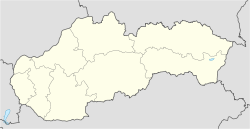  Rožňava Location of Rožňava in Slovakia | ||
| Coordinates: 48°39′30″N 20°31′51″E / 48.65833°N 20.53083°E / 48.65833; 20.53083Coordinates: 48°39′30″N 20°31′51″E / 48.65833°N 20.53083°E / 48.65833; 20.53083 | ||
| Country | Slovakia | |
| Region | Košice Region | |
| District | Rožňava District | |
| First mentioned | 1291 | |
| Government | ||
| • Mayor | Pavol Burdiga | |
| Area | ||
| • Total | 45.614 km2 (17.612 sq mi) | |
| Elevation | 313 m (1,027 ft) | |
| Population (31 December 2014) | ||
| • Total | 18,368 | |
| • Density | 400/km2 (1,000/sq mi) | |
| Time zone | UTC+1 (CET) | |
| • Summer (DST) | UTC+2 (CEST) | |
| Postal code | 048 01 | |
| Area code(s) | 421-58 | |
| Car plate | RV | |
| Website | http://www.roznava.sk | |
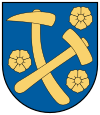
Rožňava (Hungarian: Rozsnyó, German: Rosenau, Latin: Rosnavia) is a town in Slovakia, approximately 71 kilometres (44 miles) by road from Košice in the Košice Region, and has a population of 19,505.
The town is an economic and tourist centre of the Gemer. Rožňava is now a popular tourist attraction with a beautiful historic town centre. The town is an episcopal seat. It has above all food, textile and remnants of mining industries.
Contents
1 History
2 Noteworthy buildings
3 Demographics
4 Notable citizens
5 Parts of the town
6 International relations
6.1 Twin towns — Sister cities
7 References
8 External links
History
Archaeological finds show that the region was densely settled by miners as early as around 1200. The first written mention stems from 1291, the royal free town status from 1410. The Roman Catholic diocese of Rozsnyó was founded in 1776.
In the Middle Ages, Rozsnyó was a prosperous mining town for gold, silver, and iron. Mining activities stagnated from the 16th century (when territories to the south of the town were conquered by Ottoman Turks). Mining - this time mainly of iron ore - was renewed around 1800 and was present in the town throughout the 20th century. It was ruled by Ottoman Empire as part of Filek sanjak (Its centre was Rimaszombat) during periods of 1554-1593 and 1596-1686. It was known as "Rojna" during Ottoman period.
The name of the town probably derives from the German word for rose (Rose, in the German name of the town "Rosenau").
During World War II, Rožňava was captured on 23 January 1945 by troops of the Romanian 4th Army, acting as a part of the Soviet 2nd Ukrainian Front.
On 13 September 2003, Rožňava was visited by Pope John Paul II.
Noteworthy buildings
- an important Mining Museum
- a completely preserved medieval central town square with burgher houses
- the Cathedral (Gothic, late 13th century) with many precious historic art objects, especially a Renaissance painting of Mestercia showing realistic mining motifs
- the Town Tower (Renaissance, 1654) in the middle of the central town square
- the Jesuit church (Baroque, 1687)
- the Bishop's residence (Baroque-Classical, arose 1778 from older houses) with a plague column in front of the building
- a town hall (Classical, 1711)
- an Evangelic Lutheran church (Classical, 1786)
- a Reformed church (neo-Gothic, 1905)
Demographics
According to the 2001 census, the town had 19,261 inhabitants. 69.27% of inhabitants were Slovaks, 26.80% Hungarians, 1.59% Roma and 0.69% Czechs.[1] The religious make-up was 41.08% Roman Catholics, 32.34% people with no religious affiliation, 12.03% Lutherans and 1.33% Greek Catholics.[1]
Notable citizens
Pavel Jozef Šafárik, poet and philologist.
Adam Szentpétery, artist.
Dana Velďáková, triple jumper
Jana Velďáková, long jumper
Henrieta Farkašová, gold medal winner at the 2010 Winter Paralympics and at 2014 Sochi Paralympics
Parts of the town
- Nadabula
- Rožňavská Baňa (Rožňava Mine)
International relations
Twin towns — Sister cities
Rožňava is twinned with:
 Bačka Topola
 Cieszyn
 Český Těšín
 Szerencs


References
- Notes
^ ab "Municipal Statistics". Statistical Office of the Slovak republic. Archived from the original on 2007-12-17. Retrieved 2007-12-28..mw-parser-output cite.citation{font-style:inherit}.mw-parser-output q{quotes:"""""""'""'"}.mw-parser-output code.cs1-code{color:inherit;background:inherit;border:inherit;padding:inherit}.mw-parser-output .cs1-lock-free a{background:url("//upload.wikimedia.org/wikipedia/commons/thumb/6/65/Lock-green.svg/9px-Lock-green.svg.png")no-repeat;background-position:right .1em center}.mw-parser-output .cs1-lock-limited a,.mw-parser-output .cs1-lock-registration a{background:url("//upload.wikimedia.org/wikipedia/commons/thumb/d/d6/Lock-gray-alt-2.svg/9px-Lock-gray-alt-2.svg.png")no-repeat;background-position:right .1em center}.mw-parser-output .cs1-lock-subscription a{background:url("//upload.wikimedia.org/wikipedia/commons/thumb/a/aa/Lock-red-alt-2.svg/9px-Lock-red-alt-2.svg.png")no-repeat;background-position:right .1em center}.mw-parser-output .cs1-subscription,.mw-parser-output .cs1-registration{color:#555}.mw-parser-output .cs1-subscription span,.mw-parser-output .cs1-registration span{border-bottom:1px dotted;cursor:help}.mw-parser-output .cs1-hidden-error{display:none;font-size:100%}.mw-parser-output .cs1-visible-error{font-size:100%}.mw-parser-output .cs1-subscription,.mw-parser-output .cs1-registration,.mw-parser-output .cs1-format{font-size:95%}.mw-parser-output .cs1-kern-left,.mw-parser-output .cs1-kern-wl-left{padding-left:0.2em}.mw-parser-output .cs1-kern-right,.mw-parser-output .cs1-kern-wl-right{padding-right:0.2em}
External links
- Rožňava
- Information on Rožňava and the Gemer region
Information on tourist sights (with photo of the main square)
Medial information site about life in Rožňava (In slovak language)
Official site (Slovak only)
Municipalities of Rožňava District | ||
|---|---|---|
|  | |
 | Wikimedia Commons has media related to Rožňava. |


