Požega County
| Požega County Požeška županija Pozsega vármegye | |||||
County of the Kingdom of Croatia-Slavonia | |||||
| |||||
 Coat of arms Coat of arms | |||||
 | |||||
Capital | Požega 45°20′N 17°41′E / 45.333°N 17.683°E / 45.333; 17.683Coordinates: 45°20′N 17°41′E / 45.333°N 17.683°E / 45.333; 17.683 | ||||
History | |||||
| • | Established | 12th century | |||
| • | Treaty of Trianon | 4 June 1920 | |||
Area | |||||
| • | 1910 | 4,933 km2(1,905 sq mi) | |||
Population | |||||
| • | 1910 | 265,272 | |||
Density | 53.8 /km2 (139.3 /sq mi) | ||||
Today part of | Croatia | ||||
Part of a series on the |
|---|
| History of Slavonia |
 |
Antiquity
|
Medieval
|
Ottoman Empire
|
Habsburg Monarchy
|
20th century
|
Croatian War of Independence
|

Old map of Požega County
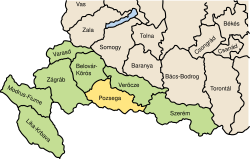
Požega County (Croatian: Požeška županija; Hungarian: Pozsega vármegye) was a historic administrative subdivision (županija) of the Kingdom of Croatia-Slavonia. Croatia-Slavonia was an autonomous kingdom within the Lands of the Crown of Saint Stephen (Transleithania), the Hungarian part of the dual Austro-Hungarian Empire. Its territory is now in eastern Croatia. The capital of the county was Požega (Croatian, in Hungarian: Pozsega).
Contents
1 Geography
2 History
3 Demographics
4 Subdivisions
5 References
Geography
Požega county shared borders with the Austrian land Bosnia-Herzegovina and the counties of Zagreb, Bjelovar-Križevci, Virovitica and Srijem (all in Croatia-Slavonia). The county stretched along the left (northern) bank of the river Sava. Its area was 4933 km² around 1910.
History
The territory of Požega County was part of the Kingdom of Croatia when it entered a personal union with the Kingdom of Hungary in 1102, and with it became part of the Habsburg Monarchy in 1526. Požega County was re-established after it was liberated from Ottoman occupation in the late 17th century. In 1920, by the Treaty of Trianon the county became part of the newly formed Kingdom of Serbs, Croats and Slovenes (later renamed to Yugoslavia). Since 1991, when Croatia became independent from Yugoslavia, the county is part of Croatia.
Demographics
In 1900, the county had a population of 229,361 people and was composed of the following linguistic communities:[1]
Total:
Croatian: 124,207 (54.2%)
Serbian: 58,905 (25.6%)
Hungarian: 13,762 (6.0%)
German: 12,965 (5.7%)
Slovak: 1,245 (0.5%)
Romanian: 269 (0.1%)
Ruthenian: 181 (0.1%)- Other or unknown: 17,827 (7.8%)
According to the census of 1900, the county was composed of the following religious communities:[2]
Total:
Roman Catholic: 161,883 (70.6%)
Greek Orthodox: 59,332 (25.9%)
Lutheran: 3,216 (1.4%)
Jewish: 2,390 (1.0%)
Calvinist: 2,270 (1.0%)
Greek Catholic: 217 (0.1%)
Unitarian: 1 (0.0%)- Other or unknown: 52 (0.0%)
In 1910, the county had a population of 265,272 people and was composed of the following linguistic communities:[3]
Total:
Croatian: 142,616 (53.76%)
Serbian: 66,783 (25.18%)
Hungarian: 16,462 (6.21%)
German: 13,143 (4.95%)
Slovak: 3,352 (1.26%)
Romanian: 154 (0.06%)
Ruthenian: 2,888 (1.09%)- Other or unknown: 19,874 (7.49%)
According to the census of 1910, the county was composed of the following religious communities:[4]
Total:
Roman Catholic: 185,896 (70.1%)
Greek Orthodox: 67,273 (25.4%)
Lutheran: 3,410 (1.3%)
Calvinist: 3,227 (1.2%)
Greek Catholic: 2,986 (1.1%)
Jewish: 2,432 (0.9%)
Unitarian: 5 (0.0%)- Other or unknown: 43 (0.0%)
Subdivisions
In the early 20th century, the subdivisions of Pozsega county were:
| Districts | |
|---|---|
| District | Capital |
| Slavonski Brod | Slavonski Brod |
| Daruvar | Daruvar |
| Novska | Novska |
| Pakrac | Pakrac |
| Požega | Požega |
| Nova Gradiška | Nova Gradiška |
| Urban districts | |
Slavonski Brod | |
Požega | |
References
^ "KlimoTheca :: Könyvtár". Kt.lib.pte.hu. Retrieved 2012-12-06..mw-parser-output cite.citation{font-style:inherit}.mw-parser-output q{quotes:"""""""'""'"}.mw-parser-output code.cs1-code{color:inherit;background:inherit;border:inherit;padding:inherit}.mw-parser-output .cs1-lock-free a{background:url("//upload.wikimedia.org/wikipedia/commons/thumb/6/65/Lock-green.svg/9px-Lock-green.svg.png")no-repeat;background-position:right .1em center}.mw-parser-output .cs1-lock-limited a,.mw-parser-output .cs1-lock-registration a{background:url("//upload.wikimedia.org/wikipedia/commons/thumb/d/d6/Lock-gray-alt-2.svg/9px-Lock-gray-alt-2.svg.png")no-repeat;background-position:right .1em center}.mw-parser-output .cs1-lock-subscription a{background:url("//upload.wikimedia.org/wikipedia/commons/thumb/a/aa/Lock-red-alt-2.svg/9px-Lock-red-alt-2.svg.png")no-repeat;background-position:right .1em center}.mw-parser-output .cs1-subscription,.mw-parser-output .cs1-registration{color:#555}.mw-parser-output .cs1-subscription span,.mw-parser-output .cs1-registration span{border-bottom:1px dotted;cursor:help}.mw-parser-output .cs1-hidden-error{display:none;font-size:100%}.mw-parser-output .cs1-visible-error{font-size:100%}.mw-parser-output .cs1-subscription,.mw-parser-output .cs1-registration,.mw-parser-output .cs1-format{font-size:95%}.mw-parser-output .cs1-kern-left,.mw-parser-output .cs1-kern-wl-left{padding-left:0.2em}.mw-parser-output .cs1-kern-right,.mw-parser-output .cs1-kern-wl-right{padding-right:0.2em}
^ "KlimoTheca :: Könyvtár". Kt.lib.pte.hu. Retrieved 2012-12-06.
^ "KlimoTheca :: Könyvtár". Kt.lib.pte.hu. Retrieved 2012-12-06.
^ "KlimoTheca :: Könyvtár". Kt.lib.pte.hu. Retrieved 2012-12-06.


Counties of the Lands of the Crown of Saint Stephen | ||
|---|---|---|
| Kingdom of Hungary |
|  |
| Corpus separatum |
| |
| Kingdom of Croatia-Slavonia |
| |


