RML 7 inch gun
| Ordnance RML 7 inch gun | |
|---|---|
 7 inch 6½ ton Mk I gun and crew on HMS Minotaur | |
| Type | Naval gun Coast defence gun |
| Place of origin | United Kingdom |
| Service history | |
| Used by | Royal Navy |
| Production history | |
| Designer | Royal Gun Factory |
| Designed | 1865 (7 & 6½ ton) 1874 (90 cwt) |
| Manufacturer | Royal Arsenal |
| Unit cost | £425[1] |
| Variants | 7 ton Mks I - IV 6½ ton Mks I - III 90 cwt |
| Specifications | |
Barrel length | 7 ton : 126 inches (3,200 mm) 6½ ton & 90 cwt : 111 inches (2,800 mm)[2] |
| Shell | 112 to 115 pounds (51 to 52 kg) Palliser, Common, Shrapnel[3] 160 pounds (73 kg) double common shell |
| Calibre | 7-inch (177.8 mm) |
| Muzzle velocity | 7 ton : 1,561 feet per second (476 m/s) 6½ ton : 1,525 feet per second (465 m/s) 90 cwt : 1,325 feet per second (404 m/s) |
| Maximum firing range | 5,500 yards (5,000 m) |
The RML 7 inch guns were various designs of medium-sized rifled muzzle-loading guns used to arm small to medium-sized British warships in the late 19th century, and some were used ashore for coast defence.
Contents
1 Design and history
1.1 RML 7 inch 7 ton gun
1.2 RML 7 inch 6½ ton gun
1.3 RML 7 inch 90 cwt gun
2 Ammunition
3 Surviving examples
4 See also
5 Notes and references
6 Bibliography
7 External links
Design and history

"Woolwich" rifling introduced in 1865
These guns were the first to incorporate the new "Woolwich" rifling system, a modification of the French system, of from 3 - 9 broad shallow grooves after Britain abandoned the Armstrong "shunt" rifling system in May 1865 : "...M.L. 7-inch guns in course of manufacture were rifled on this principle, upon which all of our heavy pieces since have been rifled. The 7-inch referred to, and introduced into the service in 1865, were the first of the so-called Woolwich guns, which then meant "wrought iron M.L. guns built up on Sir W. Armstrong's principle, improved upon by hooking the coils over one another, and having solid ended steel barrels, rifled on the system shown above, for studded projectiles".[4]
All versions were constructed of a steel A tube surrounded by various numbers and thicknesses of wrought-iron coils. Rifling was 3 grooves with a uniform 1 turn in 35 calibres i.e. in 245 inches.[2]
The diagrams below show the progression from the original expensive Armstrong construction in Mk I of multiple relatively thin coils, through to the simplified and cheaper Woolwich design of Mk III.

The 4 Marks of 7 ton gun
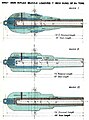
The 3 Marks of 6½ ton gun

90 cwt gun


RML 7 inch 7 ton gun

Remains of a 7-ton Mk III gun on Flat Holm island, UK
This was a coast defence gun introduced in 1865 to replace the failed RBL 7 inch Armstrong gun.Three marks were produced.
RML 7 inch 6½ ton gun
This was a naval gun introduced in 1865 "...as a broadside or pivot gun for frigates, to replace the 7-inch B.L. and 68-pr S.B. guns, and is now very extensively used, 331 having been made... These guns are in total length 18 inches shorter than the land service [i.e. 7-ton] 7-inch gun, being a length more suited to the requirements of the Navy".[5]
The following warships were armed with the gun :
Amazon-class sloops in commission from 1865
HMS Bellerophon commissioned in 1866
HMS Vixen commissioned 1866
HMS Viper commissioned 1866
Minotaur-class ironclads commissioned 1867
Eclipse-class sloops in commission from 1867
Defence-class ironclads (as re-gunned in 1867)
HMS Enterprise & HMS Research (as re-gunned in 1868)
Warrior-class ironclads (as re-gunned in 1867-1868)
Hector-class ironclads (from 1868)
HMS Achilles (as re-gunned in 1868)
HMS Inconstant in commission from 1869
HMS Shah in commission from 1876
Briton-class screw corvettes in commission from 1871
RML 7 inch 90 cwt gun
This was a lighter (90 cwt = 4½ tons) low-powered naval gun introduced in 1874 as a broadside gun on unarmoured vessels, and not intended for attacking armour plate. Early models were made by simply turning off some of the jacket around 7-inch 6½ ton guns, as firing with reduced charges placed less strain on the coils. Some new guns were made to similar design.
The following warships were armed with the gun :
Osprey-class sloops in commission from 1874
HMS Raleigh in commission from 1874
Fantome-class sloops in commission from 1874
Bacchante-class corvettes in commission from 1877
Condor-class gunvessels in commission from 1877
Ammunition
The primary projectile for 7 ton and 6½ ton guns was Palliser shot or shell for attacking armoured warships, fired with a large "battering" charge for maximum velocity. All guns were also equipped with shrapnel shells for anti-personnel use and explosive common shells for attacking unarmoured targets. The "double" common shell was much longer than the standard common shell, and hence contained approximately twice as much gunpowder. It was unstable in flight and hence inaccurate beyond 2,000 yards but was considered useful for attacking wooden warships at ranges below 2,000 yards.[6]
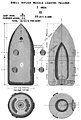
Mk III Palliser shell

Mk VI Palliser shot

Mk III shrapnel shell

Mk V common shell

Mk III double common shell


This was the only RML heavy gun not to be issued with gas-checks.
Surviving examples
- Restored 6½ ton Mk I Numbers 148 & 163 at Garden Island Rockingham, Western Australia (Fleet Base West). For restoration story see http://www.defence.gov.au/news/navynews/editions/4719/feature/feature06.htm
- Several 6½ ton Mk I guns on Ascension Island
6½ ton Mk I at Fort Siloso, Singapore- 6½ ton Mk III of 1869, at Elizabeth Castle, Jersey, UK
- Remains of several 7 ton Mk III guns on Flat Holm island, UK
- Nine 7 ton Mk III guns on Steep Holm island, UK
A 7-ton Mk I gun at The Citadel, Nova Scotia, Canada
A 6½ ton Mk I gun on Signal Hill (Cape Town), South Africa.
See also
- List of naval guns
Notes and references
^ Unit cost of £424 11 shillings 10 pence is quoted for the 7 inch 6½ ton gun in "The British Navy" Volume II, 1882, by Sir Thomas Brassey. Page 38
^ ab Treatise on construction of ordnance in the British service, 1877, Table XXIX
^ Treatise on Ammunition 1877 and Treatise on construction of ordnance in the British service, 1877 describe a 115-pound projectile; Text Book of Gunnery 1887 and Brassey's Naval Annual 1888 describe a 112-pound 1 oz projectile. 112 lb 1 oz appears to be the weight of the empty Palliser shell i.e. without gunpowder filling which was typically 2 lb 10 oz. By 1887 palliser shell had been discontinued and existing shell converted to shot by removing the gunpowder - hence old Palliser ammunition would then be 112 lb 1 oz.
^ Treatise on construction of ordnance in the British service, 1877, Page 91
^ Treatise on construction of ordnance in the British service, 1877, Page 269
^ Treatise on Ammunition 1877, Page 189
Bibliography
- Treatise on the construction and manufacture of ordnance in the British service. War Office, UK, 1877
Treatise on Ammunition. War Office, UK, 1877[permanent dead link]
- Victorian Forts Website. Rifled Muzzle Loading Guns
Sir Thomas Brassey, The British Navy, Volume II. London: Longmans, Green and Co. 1882
- Text Book of Gunnery, 1887. LONDON : PRINTED FOR HIS MAJESTY'S STATIONERY OFFICE, BY HARRISON AND SONS, ST. MARTIN'S LANE
- Brassey's Naval Annual, 1888
External links
 | Wikimedia Commons has media related to RML 7 inch gun. |
Handbook for the 7-inch R.M.L. guns of 6½ and 7 tons on sliding and Moncrieff carriage land service, 1888 at State Library of Victoria- Diagram showing 7 ton Mk III gun on Moncrieff mounting Mk I
- Diagram showing 7 ton Mk III gun on Moncrieff mounting Mk II


