Mycielskian
In the mathematical area of graph theory, the Mycielskian or Mycielski graph of an undirected graph is a larger graph formed from it by a construction of Jan Mycielski (1955). The construction preserves the property of being triangle-free but increases the chromatic number; by applying the construction repeatedly to a triangle-free starting graph, Mycielski showed that there exist triangle-free graphs with arbitrarily large chromatic number.
Contents
1 Construction
2 Iterated Mycielskians
3 Properties
4 Cones over graphs
5 References
6 External links
Construction

Mycielskian construction applied to a 5-cycle graph, producing the Grötzsch graph with 11 vertices and 20 edges, the smallest triangle-free 4-chromatic graph (Chvátal 1974).
Let the n vertices of the given graph G be v1, v2, . . . , vn. The Mycielski graph μ(G) contains G itself as a subgraph, together with n+1 additional vertices: a vertex ui corresponding to each vertex vi of G, and an extra vertex w. Each vertex ui is connected by an edge to w, so that these vertices form a subgraph in the form of a star K1,n. In addition, for each edge vivj of G, the Mycielski graph includes two edges, uivj and viuj.
Thus, if G has n vertices and m edges, μ(G) has 2n+1 vertices and 3m+n edges.
The only new triangles in μ(G) are of the form vivjuk, where vivjvk is a triangle in G. Thus, if G is triangle-free, so is μ(G).
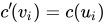
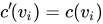
To see that the construction increases the chromatic number χ(G)=k{displaystyle chi (G)=k}







Iterated Mycielskians

M2, M3 and M4 Mycielski graphs
Applying the Mycielskian repeatedly, starting with the one-edge graph, produces a sequence of graphs Mi = μ(Mi−1), sometimes called the Mycielski graphs. The first few graphs in this sequence are the graph M2 = K2 with two vertices connected by an edge, the cycle graph M3 = C5, and the Grötzsch graph M4 with 11 vertices and 20 edges.
In general, the graph Mi is triangle-free, (i−1)-vertex-connected, and i-chromatic. The number of vertices in Mi for i ≥ 2 is 3 × 2i−2 − 1 (sequence A083329 in the OEIS), while the number of edges for i = 2, 3, . . . is:
- 1, 5, 20, 71, 236, 755, 2360, 7271, 22196, 67355, ... (sequence A122695 in the OEIS).
Properties

Hamiltonian cycle in M4 (Grötzsch graph)
- If G has chromatic number k, then μ(G) has chromatic number k + 1 (Mycielski 1955).
- If G is triangle-free, then so is μ(G) (Mycielski 1955).
- More generally, if G has clique number ω(G), then μ(G) has clique number max(2,ω(G)).(Mycielski 1955).
- If G is a factor-critical graph, then so is μ(G) (Došlić 2005). In particular, every graph Mi for i ≥ 2 is factor-critical.
- If G has a Hamiltonian cycle, then so does μ(G) (Fisher, McKenna & Boyer 1998).
- If G has domination number γ(G), then μ(G) has domination number γ(G)+1. (Fisher, McKenna & Boyer 1998).
Cones over graphs

A generalized Mycielskian, formed as a cone over the 5-cycle, Δ3(C5) = Δ3(Δ2(K2)).
A generalization of the Mycielskian, called a cone over a graph, was introduced by Stiebitz (1985) and further studied by Tardif (2001) and Lin et al. (2006). In this construction, one forms a graph Δi(G) from a given graph G by taking the tensor product of graphs G × H, where H is a path of length i with a self-loop at one end, and then collapsing into a single supervertex all of the vertices associated with the vertex of H at the non-loop end of the path. The Mycielskian itself can be formed in this way as μ(G) = Δ2(G).
While the cone construction does not always increase the chromatic number, Stiebitz (1985) proved that it does so when applied iteratively to K2. That is, define a sequence of families of graphs, called generalized Mycielskians, as
- ℳ(2) = {K2} and ℳ(k+1) = {Δi(G) | G ∈ ℳ(k), i ∈ ℕ}.
For example, ℳ(3) is the family of odd cycles. Then each graph in ℳ(k) is k-chromatic. The proof uses methods of topological combinatorics developed by László Lovász to compute the chromatic number of Kneser graphs.
The triangle-free property is then strengthened as follows: if one only applies the cone construction Δi for i ≥ r, then the resulting graph has odd girth at least 2r + 1, that is, it contains no odd cycles of length less than 2r + 1.
Thus generalized Mycielskians provide a simple construction of graphs with high chromatic number and high odd girth.
References
Chvátal, Vašek (1974), "The minimality of the Mycielski graph", Graphs and Combinatorics (Proc. Capital Conf., George Washington Univ., Washington, D.C., 1973), Lecture Notes in Mathematics, 406, Springer-Verlag, pp. 243–246.mw-parser-output cite.citation{font-style:inherit}.mw-parser-output q{quotes:"""""""'""'"}.mw-parser-output code.cs1-code{color:inherit;background:inherit;border:inherit;padding:inherit}.mw-parser-output .cs1-lock-free a{background:url("//upload.wikimedia.org/wikipedia/commons/thumb/6/65/Lock-green.svg/9px-Lock-green.svg.png")no-repeat;background-position:right .1em center}.mw-parser-output .cs1-lock-limited a,.mw-parser-output .cs1-lock-registration a{background:url("//upload.wikimedia.org/wikipedia/commons/thumb/d/d6/Lock-gray-alt-2.svg/9px-Lock-gray-alt-2.svg.png")no-repeat;background-position:right .1em center}.mw-parser-output .cs1-lock-subscription a{background:url("//upload.wikimedia.org/wikipedia/commons/thumb/a/aa/Lock-red-alt-2.svg/9px-Lock-red-alt-2.svg.png")no-repeat;background-position:right .1em center}.mw-parser-output .cs1-subscription,.mw-parser-output .cs1-registration{color:#555}.mw-parser-output .cs1-subscription span,.mw-parser-output .cs1-registration span{border-bottom:1px dotted;cursor:help}.mw-parser-output .cs1-hidden-error{display:none;font-size:100%}.mw-parser-output .cs1-visible-error{font-size:100%}.mw-parser-output .cs1-subscription,.mw-parser-output .cs1-registration,.mw-parser-output .cs1-format{font-size:95%}.mw-parser-output .cs1-kern-left,.mw-parser-output .cs1-kern-wl-left{padding-left:0.2em}.mw-parser-output .cs1-kern-right,.mw-parser-output .cs1-kern-wl-right{padding-right:0.2em}.
Došlić, Tomislav (2005), "Mycielskians and matchings", Discussiones Mathematicae Graph Theory, 25 (3): 261–266, doi:10.7151/dmgt.1279, MR 2232992.
Fisher, David C.; McKenna, Patricia A.; Boyer, Elizabeth D. (1998), "Hamiltonicity, diameter, domination, packing, and biclique partitions of Mycielski's graphs", Discrete Applied Mathematics, 84 (1–3): 93–105, doi:10.1016/S0166-218X(97)00126-1.
Lin, Wensong; Wu, Jianzhuan; Lam, Peter Che Bor; Gu, Guohua (2006), "Several parameters of generalized Mycielskians", Discrete Applied Mathematics, 154 (8): 1173–1182, doi:10.1016/j.dam.2005.11.001.
Mycielski, Jan (1955), "Sur le coloriage des graphes" (PDF), Colloq. Math., 3: 161–162.
Stiebitz, M. (1985), Beiträge zur Theorie der färbungskritschen Graphen, Habilitation thesis, Technische Universität Ilmenau. As cited by Tardif (2001).
Tardif, C. (2001), "Fractional chromatic numbers of cones over graphs", Journal of Graph Theory, 38 (2): 87–94, doi:10.1002/jgt.1025.
External links
- Weisstein, Eric W. "Mycielski Graph". MathWorld.


