Cartesian product of graphs
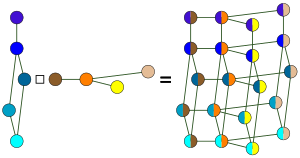
The Cartesian product of graphs.
In graph theory, the Cartesian product G ◻{displaystyle square }
- the vertex set of G ◻{displaystyle square }
- two vertices (u,u' ) and (v,v' ) are adjacent in G ◻{displaystyle square }
u = v and u' is adjacent to v' in H, or
u' = v' and u is adjacent to v in G.
The operation is associative, as the graphs (F ◻{displaystyle square }
The operation is commutative as an operation on isomorphism classes of graphs, and more strongly the graphs G ◻{displaystyle square }
The notation G × H has often been used for Cartesian products of graphs, but is now more commonly used for another construction known as the tensor product of graphs. The square symbol is an intuitive and unambiguous notation for the Cartesian product, since it shows visually the four edges resulting from the Cartesian product of two edges.[1]
Contents
1 Examples
2 Properties
3 Algebraic graph theory
4 History
5 Notes
6 References
7 External links
Examples
- The Cartesian product of two edges is a cycle on four vertices: K2◻{displaystyle square }
- The Cartesian product of K2 and a path graph is a ladder graph.
- The Cartesian product of two path graphs is a grid graph.
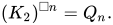
- The Cartesian product of n edges is a hypercube:
- (K2)◻n=Qn.{displaystyle (K_{2})^{square n}=Q_{n}.}
- (K2)◻n=Qn.{displaystyle (K_{2})^{square n}=Q_{n}.}
- Thus, the Cartesian product of two hypercube graphs is another hypercube: Qi◻{displaystyle square }
- The Cartesian product of two median graphs is another median graph.
- The graph of vertices and edges of an n-prism is the Cartesian product graph K2◻{displaystyle square }
- The rook's graph is the Cartesian product of two complete graphs.
Properties
If a connected graph is a Cartesian product, it can be factorized uniquely as a product of prime factors, graphs that cannot themselves be decomposed as products of graphs.[2] However, Imrich & Klavžar (2000) describe a disconnected graph that can be expressed in two different ways as a Cartesian product of prime graphs:
- (K1 + K2 + K22) ◻{displaystyle square }
where the plus sign denotes disjoint union and the superscripts denote exponentiation over Cartesian products.
A Cartesian product is vertex transitive if and only if each of its factors is.[3]
A Cartesian product is bipartite if and only if each of its factors is. More generally, the chromatic number of the Cartesian product satisfies the equation
- χ(G ◻{displaystyle square }
The Hedetniemi conjecture states a related equality for the tensor product of graphs. The independence number of a Cartesian product is not so easily calculated, but as Vizing (1963) showed it satisfies the inequalities
- α(G)α(H) + min{|V(G)|-α(G),|V(H)|-α(H)} ≤ α(G ◻{displaystyle square }
The Vizing conjecture states that the domination number of a Cartesian product satisfies the inequality
- γ(G ◻{displaystyle square }
Cartesian product graphs can be recognized efficiently, in linear time.[5]
Algebraic graph theory
Algebraic graph theory can be used to analyse the Cartesian graph product.
If the graph G1{displaystyle G_{1}}


A1◻2=A1⊗In2+In1⊗A2{displaystyle mathbf {A} _{1square 2}=mathbf {A} _{1}otimes mathbf {I} _{n_{2}}+mathbf {I} _{n_{1}}otimes mathbf {A} _{2}},
where ⊗{displaystyle otimes }


History
According to Imrich & Klavžar (2000), Cartesian products of graphs were defined in 1912 by Whitehead and Russell. They were repeatedly rediscovered later, notably by Gert Sabidussi (1960).
Notes
^ Hahn & Sabidussi (1997).
^ Sabidussi (1960); Vizing (1963).
^ Imrich & Klavžar (2000), Theorem 4.19.
^ Sabidussi (1957).
^ Imrich & Peterin (2007). For earlier polynomial time algorithms see Feigenbaum, Hershberger & Schäffer (1985) and Aurenhammer, Hagauer & Imrich (1992).
^ Kaveh & Rahami (2005).
References
Aurenhammer, F.; Hagauer, J.; Imrich, W. (1992), "Cartesian graph factorization at logarithmic cost per edge", Computational Complexity, 2 (4): 331–349, doi:10.1007/BF01200428, MR 1215316.mw-parser-output cite.citation{font-style:inherit}.mw-parser-output q{quotes:"""""""'""'"}.mw-parser-output code.cs1-code{color:inherit;background:inherit;border:inherit;padding:inherit}.mw-parser-output .cs1-lock-free a{background:url("//upload.wikimedia.org/wikipedia/commons/thumb/6/65/Lock-green.svg/9px-Lock-green.svg.png")no-repeat;background-position:right .1em center}.mw-parser-output .cs1-lock-limited a,.mw-parser-output .cs1-lock-registration a{background:url("//upload.wikimedia.org/wikipedia/commons/thumb/d/d6/Lock-gray-alt-2.svg/9px-Lock-gray-alt-2.svg.png")no-repeat;background-position:right .1em center}.mw-parser-output .cs1-lock-subscription a{background:url("//upload.wikimedia.org/wikipedia/commons/thumb/a/aa/Lock-red-alt-2.svg/9px-Lock-red-alt-2.svg.png")no-repeat;background-position:right .1em center}.mw-parser-output .cs1-subscription,.mw-parser-output .cs1-registration{color:#555}.mw-parser-output .cs1-subscription span,.mw-parser-output .cs1-registration span{border-bottom:1px dotted;cursor:help}.mw-parser-output .cs1-hidden-error{display:none;font-size:100%}.mw-parser-output .cs1-visible-error{font-size:100%}.mw-parser-output .cs1-subscription,.mw-parser-output .cs1-registration,.mw-parser-output .cs1-format{font-size:95%}.mw-parser-output .cs1-kern-left,.mw-parser-output .cs1-kern-wl-left{padding-left:0.2em}.mw-parser-output .cs1-kern-right,.mw-parser-output .cs1-kern-wl-right{padding-right:0.2em}.
Feigenbaum, Joan; Hershberger, John; Schäffer, Alejandro A. (1985), "A polynomial time algorithm for finding the prime factors of Cartesian-product graphs", Discrete Applied Mathematics, 12 (2): 123–138, doi:10.1016/0166-218X(85)90066-6, MR 0808453.
Hahn, Geňa; Sabidussi, Gert (1997), Graph symmetry: algebraic methods and applications, NATO Advanced Science Institutes Series, 497, Springer, p. 116, ISBN 978-0-7923-4668-5.
Imrich, Wilfried; Klavžar, Sandi (2000), Product Graphs: Structure and Recognition, Wiley, ISBN 0-471-37039-8.
Imrich, Wilfried; Klavžar, Sandi; Rall, Douglas F. (2008), Graphs and their Cartesian Products, A. K. Peters, ISBN 1-56881-429-1.
Imrich, Wilfried; Peterin, Iztok (2007), "Recognizing Cartesian products in linear time", Discrete Mathematics, 307 (3–5): 472–483, doi:10.1016/j.disc.2005.09.038, MR 2287488.
Kaveh, A.; Rahami, H. (2005), "A unified method for eigendecomposition of graph products", Communications in Numerical Methods in Engineering with Biomedical Applications, 21 (7): 377–388, doi:10.1002/cnm.753, MR 2151527.
Sabidussi, G. (1957), "Graphs with given group and given graph-theoretical properties", Canadian Journal of Mathematics, 9: 515–525, doi:10.4153/CJM-1957-060-7, MR 0094810.
Sabidussi, G. (1960), "Graph multiplication", Mathematische Zeitschrift, 72: 446–457, doi:10.1007/BF01162967, MR 0209177.
Vizing, V. G. (1963), "The Cartesian product of graphs", Vycisl. Sistemy, 9: 30–43, MR 0209178.
External links
- Weisstein, Eric W. "Graph Cartesian Product". MathWorld.


