World's End, Kensington and Chelsea
| World's End | |
|---|---|
 The World's End Estate | |
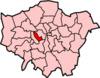
  World's End World's End shown within Greater London | |
| London borough |
|
| Ceremonial county | Greater London |
| Region |
|
| Country | England |
| Sovereign state | United Kingdom |
| Post town | LONDON |
| Dialling code | 020 |
| Police | Metropolitan |
| Fire | London |
| Ambulance | London |
| EU Parliament | London |
| UK Parliament |
|
| London Assembly |
|
World's End is a district of Chelsea, London, lying at the western end of the Kings Road. Once a Victorian slum area, council housing was built here in the 20th century, including the brutalist World's End estate.
Contents
1 History
2 The 1960s
3 Housing
4 Transport
5 References
6 Further reading
History

World's End, Chelsea, London. From Cary's New And Accurate Plan Of London And Westminster
The area takes its name from the public house The World's End, which dates back to at least the 17th century.
In the King's Road, near Milman Street, is an inn styled "The World's End." The old tavern... was a noted house of entertainment in the reign of Charles II. The tea-gardens and grounds were extensive, and elegantly fitted up for the reception of company. The house was probably called "The World's End" on account of its then considerable distance from London, and the bad and dangerous state of the roads and pathways leading to it. (Old and New London, 1878)[1]
It is mentioned in Congreve's Restoration comedy Love for Love (1695) as a place of questionable reputation to the west of London:
MRS. FORE. I suppose you would not go alone to the World’s End.
MRS. FRAIL. The World’s End! What, do you mean to banter me?
MRS. FORE. Poor innocent! You don’t know that there’s a place called the World’s End? (Act II, Scene IX)[2]
On Cary's New And Accurate Plan Of London And Westminster (1795), the inn is shown on the north side of Kings Road, the only building in the area.[3] The modern public house, the World's End Distillery, on the south side of King's Road, was built in 1897.[4]
The area has long been regarded as the less fashionable end of Chelsea, with Victorian slums being replaced with council housing in the 20th century.
The 1960s
The fashionable set who had made their home at the other end of the Kings Road discovered the gem that was the World's End and found it was the perfect place to open the boutique Granny Takes a Trip. There were several boutiques and hippie shops that clustered round World's End in the late 60's including Gandalf's Garden selling candles, incense, spiritual books and hippy paraphernalia. Sophisticat sold reconditioned pine furniture and was home to Christian the lion cub; The Sweet Shop at 28 Blantyre Street sold silk velvet patchwork and applique cushions, tunics, and wallhanging designed by artist Laura Jamieson. The shop was frequented by Twiggy, Jean Shrimpton, and Keith Richards. Just round the corner on the Kings Road was the Dragon Tea Garden, a meeting place for local aristocrats, bohemians and hippies who sat on floor cushions, played backgammon and sipped exotic teas. The World's End became a centre for the counter-culture world of the 1960s. This continued in the late '70s and '80s with the opening of the boutique SEX started by Vivienne Westwood in the 1970s (which is now known as World's End).
Housing
In the 1960s Chelsea Borough Council erected new social housing, in particular the Cremorne Estate (named after the historical Cremorne Gardens, which once stood on that site).
This was followed, in the 1970s, by the red brick towers of the World's End estate which swept away many Victorian terraced houses.[5][6] The estate was designed by Jim Cadbury-Brown and Eric Lyons, and is now known for its brutalist architecture.[7]
Transport
The nearest stations are:
Imperial Wharf (London Overground)
Fulham Broadway (London Underground)
References
^ Walford, Edward (1878). Old and New London. 5. London: Cassell, Petter & Galpin. p. 87. Retrieved 28 November 2017..mw-parser-output cite.citation{font-style:inherit}.mw-parser-output .citation q{quotes:"""""""'""'"}.mw-parser-output .citation .cs1-lock-free a{background:url("//upload.wikimedia.org/wikipedia/commons/thumb/6/65/Lock-green.svg/9px-Lock-green.svg.png")no-repeat;background-position:right .1em center}.mw-parser-output .citation .cs1-lock-limited a,.mw-parser-output .citation .cs1-lock-registration a{background:url("//upload.wikimedia.org/wikipedia/commons/thumb/d/d6/Lock-gray-alt-2.svg/9px-Lock-gray-alt-2.svg.png")no-repeat;background-position:right .1em center}.mw-parser-output .citation .cs1-lock-subscription a{background:url("//upload.wikimedia.org/wikipedia/commons/thumb/a/aa/Lock-red-alt-2.svg/9px-Lock-red-alt-2.svg.png")no-repeat;background-position:right .1em center}.mw-parser-output .cs1-subscription,.mw-parser-output .cs1-registration{color:#555}.mw-parser-output .cs1-subscription span,.mw-parser-output .cs1-registration span{border-bottom:1px dotted;cursor:help}.mw-parser-output .cs1-ws-icon a{background:url("//upload.wikimedia.org/wikipedia/commons/thumb/4/4c/Wikisource-logo.svg/12px-Wikisource-logo.svg.png")no-repeat;background-position:right .1em center}.mw-parser-output code.cs1-code{color:inherit;background:inherit;border:inherit;padding:inherit}.mw-parser-output .cs1-hidden-error{display:none;font-size:100%}.mw-parser-output .cs1-visible-error{font-size:100%}.mw-parser-output .cs1-maint{display:none;color:#33aa33;margin-left:0.3em}.mw-parser-output .cs1-subscription,.mw-parser-output .cs1-registration,.mw-parser-output .cs1-format{font-size:95%}.mw-parser-output .cs1-kern-left,.mw-parser-output .cs1-kern-wl-left{padding-left:0.2em}.mw-parser-output .cs1-kern-right,.mw-parser-output .cs1-kern-wl-right{padding-right:0.2em}
^ Congreve, William. "Love for Love". Project Gutenberg. Retrieved 29 November 2017.
^ Cary, John (1795). "Cary's New And Accurate Plan Of London And Westminster". MAPCO Map And Plan Collection Online. mapco.net. Retrieved 29 November 2017.
^ Historic England. "Worlds End Distillery public house (1391649)". National Heritage List for England. Retrieved 3 April 2015.
^ "The World's End Estate, Chelsea: 'Village style living in the heart of London'". Municipal Dreams blog. 29 October 2013. Retrieved 14 December 2015.
^ local studies
^ Jonathan Meades (13 February 2014). "The incredible hulks: Jonathan Meades' A-Z of brutalism". The Guardian. Retrieved 1 November 2015.
Further reading
 | Wikimedia Commons has media related to World’s End Estate. |
- Bignell, John. (Ed.) (1978). Chelsea seen from 1860 to 1980: A collection of photographs old and new pp. 96–99. Studio B.
ISBN 0-9506228-0-X
- Gullick, John (Ed.). (1975). A place called Chelsea pp. 106–109. City Journals Ltd.
ISBN 0-9504471-0-2
- Wheal, Donald James. (2005). World's End: A memoir of a Blitz childhood. Arrow Books.
ISBN 1-84413-682-5
Royal Borough of Kensington and Chelsea | ||
|---|---|---|
| Districts |
|  |
| Attractions |
| |
| Theatres |
| |
| Royal Parks |
| |
| Street markets |
| |
| Parliamentary constituencies |
| |
| Squares and streets |
| |
| Bridges |
| |
| Tube and railway stations |
| |
| Pubs |
| |
| Other topics |
| |
 Earl's Court
 Kensington (Olympia)

