Harai goshi
| Harai goshi (Harai gosh) | |
|---|---|
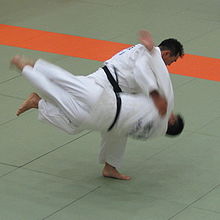 Harai goshi judo throw | |
| Classification | Nage-waza |
| Sub classification | Koshi-waza |
| Counter | Harai goshi gaeshi |
| Kodokan | Yes |
| Technique name | |
| Rōmaji | Harai goshi |
| Japanese | 払腰 |
| English | Sweeping hip throw |
| Korean | 허리 후리기 |
Harai goshi (払腰) is one of the original 40 throws of Judo as developed by Kano Jigoro.[1] It belongs to the second group of the traditional throwing list in the Gokyo no waza of the Kodokan Judo. It is also part of the current 67 Throws of Kodokan Judo, and classified as a hip technique (koshiwaza). Harai goshi is also one of the 20 techniques in Danzan ryu's Nagete list as well as one of the 18 throws in the Kar-do-Jitsu-Ryu martial arts system. English terms include "Sweeping hip throw" and "Hip Sweep".
Contents
1 See also
2 References
3 Further reading
4 External links
See also
- Judo technique
- The Canon Of Judo
References
^ Mifune, Kyuzo (2004), The Canon of Judo, Tokyo: Kodansha International Ltd., ISBN 4-7700-2979-9.mw-parser-output cite.citation{font-style:inherit}.mw-parser-output .citation q{quotes:"""""""'""'"}.mw-parser-output .citation .cs1-lock-free a{background:url("//upload.wikimedia.org/wikipedia/commons/thumb/6/65/Lock-green.svg/9px-Lock-green.svg.png")no-repeat;background-position:right .1em center}.mw-parser-output .citation .cs1-lock-limited a,.mw-parser-output .citation .cs1-lock-registration a{background:url("//upload.wikimedia.org/wikipedia/commons/thumb/d/d6/Lock-gray-alt-2.svg/9px-Lock-gray-alt-2.svg.png")no-repeat;background-position:right .1em center}.mw-parser-output .citation .cs1-lock-subscription a{background:url("//upload.wikimedia.org/wikipedia/commons/thumb/a/aa/Lock-red-alt-2.svg/9px-Lock-red-alt-2.svg.png")no-repeat;background-position:right .1em center}.mw-parser-output .cs1-subscription,.mw-parser-output .cs1-registration{color:#555}.mw-parser-output .cs1-subscription span,.mw-parser-output .cs1-registration span{border-bottom:1px dotted;cursor:help}.mw-parser-output .cs1-ws-icon a{background:url("//upload.wikimedia.org/wikipedia/commons/thumb/4/4c/Wikisource-logo.svg/12px-Wikisource-logo.svg.png")no-repeat;background-position:right .1em center}.mw-parser-output code.cs1-code{color:inherit;background:inherit;border:inherit;padding:inherit}.mw-parser-output .cs1-hidden-error{display:none;font-size:100%}.mw-parser-output .cs1-visible-error{font-size:100%}.mw-parser-output .cs1-maint{display:none;color:#33aa33;margin-left:0.3em}.mw-parser-output .cs1-subscription,.mw-parser-output .cs1-registration,.mw-parser-output .cs1-format{font-size:95%}.mw-parser-output .cs1-kern-left,.mw-parser-output .cs1-kern-wl-left{padding-left:0.2em}.mw-parser-output .cs1-kern-right,.mw-parser-output .cs1-kern-wl-right{padding-right:0.2em}
Further reading
Rougé, Jean-Luc (1991), "Harai-goshi", Judo Masterclass Techniques (second ed.), Ippon Books, ISBN 1-85223-597-7
External links
- Graphic
- Judo
- Danzan Ryu
- Demonstrated
- Tournament
 | This article related to judo is a stub. You can help Wikipedia by expanding it. |


