Giverny
| Giverny | |
|---|---|
| Commune | |
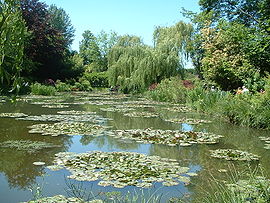 Water lilies in Claude Monet's garden in Giverny, from which he created his Water Lilies series. | |
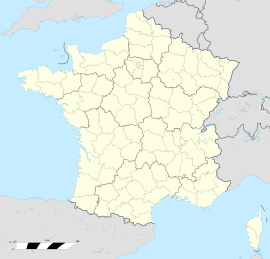  Giverny Location within Normandy region 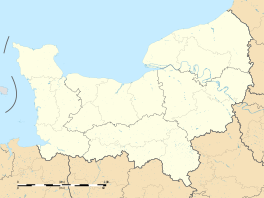 Giverny | |
| Coordinates: 49°04′37″N 1°31′48″E / 49.0769°N 1.53°E / 49.0769; 1.53Coordinates: 49°04′37″N 1°31′48″E / 49.0769°N 1.53°E / 49.0769; 1.53 | |
| Country | France |
| Region | Normandy |
| Department | Eure |
| Arrondissement | Les Andelys |
| Canton | Vernon |
| Intercommunality | Portes de l'Eure |
| Government | |
| • Mayor .mw-parser-output .nobold{font-weight:normal} (2008 - 2014) | Claude Landais |
| Area1 | 6.46 km2 (2.49 sq mi) |
| Population (2008)2 | 502 |
| • Density | 78/km2 (200/sq mi) |
| Time zone | UTC+1 (CET) |
| • Summer (DST) | UTC+2 (CEST) |
INSEE/Postal code | 27285 /27620 |
| Elevation | 10–139 m (33–456 ft) (avg. 17 m or 56 ft) |
1 French Land Register data, which excludes lakes, ponds, glaciers > 1 km2 (0.386 sq mi or 247 acres) and river estuaries. 2Population without double counting: residents of multiple communes (e.g., students and military personnel) only counted once. | |
Giverny (French pronunciation: [ʒi.vɛʁ.ni]) is a commune in the Eure department in northern France. It sits on the "right bank" of the River Seine where the river Epte meets the Seine. The village lies 80 km (50 mi) from Paris, west and slightly north, in the old province of Normandy. It is best known as the location of Claude Monet's garden and home. A number of American Impressionist artists also settled in Giverny, drawn by the landscapes, the overall atmosphere, and the presence of Monet. Other attractions include the Museum of Impressionism Giverny, dedicated to the history of impressionism and the Giverny art colony, and the Hôtel Baudy, which was the center of artistic life in Giverny's heyday. It is now a café and restaurant, with period decoration.
Contents
1 History
2 Monet at Giverny
3 The Giverny Colony
4 Attractions
5 Population
6 See also
7 References
8 Bibliography
9 External links
History
A settlement has existed in Giverny since neolithic times and a monument uncovered attests to this fact. Archeological finds have included bootees dating from Gallo-Roman times and to the earlier 1st and 2nd centuries AD. The town was known in ancient deeds as "Warnacum". The cultivation of grapes has been an occupation of the inhabitants of Giverny since Merovingian times. The village church dates from the Middle Ages and is built partially in the Romanesque style, though additions have since been made. It is dedicated to Sainte-Radegonde. The village has remained a small rural setting with a modest population (numbering around 301 in 1883 when Monet discovered it) and has since seen a boom in tourism since the restoration of Monet's house and gardens.
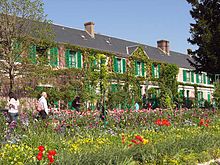
Monet's house in Giverny, Normandy

The water lily pond in Monet's garden at Giverny shown in his The Waterlily Pond, green harmony (1899)
Monet at Giverny

Giverny
Claude Monet noticed the village of Giverny while looking out of a train window. He made up his mind to move there and rented a house and the area surrounding it. In 1890 he had enough money to buy the house and land outright and set out to create the magnificent gardens he wanted to paint. Some of his most famous paintings were of his garden in Giverny, famous for its rectangular Clos Normand, with archways of climbing plants entwined around colored shrubs, and the water garden, formed by a tributary to the Epte, with the Japanese bridge, the pond with the water lilies, the wisterias and the azaleas.
Monet lived in the house with its famous pink crushed brick façade from 1883 until his death in 1926. He and many members of his family are interred in the village cemetery.
The Giverny Colony
Beginning around 1887, a number of American Impressionist artists settled to work in Giverny, drawn by the landscapes, the overall atmosphere, and the presence of Monet. These included Willard Metcalf, Louis Ritman, Theodore Wendel, and John Leslie Breck. Soon many American extended their visits from summer through the entire year.[1] American painter Theodore Earl Butler married Monet's stepdaughter and sometime-model Suzanne Hoschedé there in 1892.
Frederick Carl Frieseke spent every summer from 1906 through 1919 in a residence next door to Monet's. The term Decorative Impressionism was coined in 1911 to describe Frieseke's work, and the term describes the work of a "second wave" of American painters in Giverny such as Richard E. Miller. In December 1910, six of the Giverny artists (Frieseke, Miller, Lawton S. Parker, Guy Rose, Edmund Greacen and Karl Anderson) were given a show at the Madison Gallery in New York which termed them "The Giverny Group."
World War I largely marked the end of the art colony.[1]
Attractions

Monet's garden at Giverny, May 2002
Claude Monet's property at Giverny (house and gardens), left by his son to the Académie des Beaux-Arts in 1966, became a Museum opened to public visit in 1980 after completion of large-scale restoration work: the huge Nymphea's studio was restored and the precious collection of Japanese wood block prints was displayed in several rooms, hung in the manner chosen by the master himself; the gardens were replanted as they once were. The house became a popular tourist attraction (the Claude Monet Foundation), particularly in the summer when the flowers are in bloom.
The other main attraction of the village is the Museum of Impressionism Giverny, dedicated to the history of impressionism and its continuation in the Giverny art colony and along the valley of the river Seine.
The Hôtel Baudy was a center of artistic life in the Giverny heyday. It is now still a café and restaurant, with period decoration.

Population
| Historical population | ||
|---|---|---|
| Year | Pop. | ±% |
1793 | 422 | — |
1800 | 430 | +1.9% |
1806 | 327 | −24.0% |
1821 | 407 | +24.5% |
1831 | 396 | −2.7% |
1836 | 417 | +5.3% |
1841 | 406 | −2.6% |
1846 | 378 | −6.9% |
1851 | 348 | −7.9% |
1856 | 334 | −4.0% |
1861 | 354 | +6.0% |
1866 | 340 | −4.0% |
1872 | 328 | −3.5% |
1876 | 306 | −6.7% |
1881 | 279 | −8.8% |
1886 | 277 | −0.7% |
1891 | 305 | +10.1% |
1896 | 291 | −4.6% |
1901 | 250 | −14.1% |
1906 | 313 | +25.2% |
1911 | 273 | −12.8% |
1921 | 243 | −11.0% |
1926 | 309 | +27.2% |
1931 | 298 | −3.6% |
1936 | 276 | −7.4% |
1946 | 304 | +10.1% |
1954 | 372 | +22.4% |
1962 | 363 | −2.4% |
1968 | 386 | +6.3% |
1975 | 509 | +31.9% |
1982 | 502 | −1.4% |
1990 | 548 | +9.2% |
1999 | 524 | −4.4% |
2008 | 502 | −4.2% |
See also

- Communes of the Eure department
References
^ ab "The Colony of American Artists"..mw-parser-output cite.citation{font-style:inherit}.mw-parser-output q{quotes:"""""""'""'"}.mw-parser-output code.cs1-code{color:inherit;background:inherit;border:inherit;padding:inherit}.mw-parser-output .cs1-lock-free a{background:url("//upload.wikimedia.org/wikipedia/commons/thumb/6/65/Lock-green.svg/9px-Lock-green.svg.png")no-repeat;background-position:right .1em center}.mw-parser-output .cs1-lock-limited a,.mw-parser-output .cs1-lock-registration a{background:url("//upload.wikimedia.org/wikipedia/commons/thumb/d/d6/Lock-gray-alt-2.svg/9px-Lock-gray-alt-2.svg.png")no-repeat;background-position:right .1em center}.mw-parser-output .cs1-lock-subscription a{background:url("//upload.wikimedia.org/wikipedia/commons/thumb/a/aa/Lock-red-alt-2.svg/9px-Lock-red-alt-2.svg.png")no-repeat;background-position:right .1em center}.mw-parser-output .cs1-subscription,.mw-parser-output .cs1-registration{color:#555}.mw-parser-output .cs1-subscription span,.mw-parser-output .cs1-registration span{border-bottom:1px dotted;cursor:help}.mw-parser-output .cs1-hidden-error{display:none;font-size:100%}.mw-parser-output .cs1-visible-error{font-size:100%}.mw-parser-output .cs1-subscription,.mw-parser-output .cs1-registration,.mw-parser-output .cs1-format{font-size:95%}.mw-parser-output .cs1-kern-left,.mw-parser-output .cs1-kern-wl-left{padding-left:0.2em}.mw-parser-output .cs1-kern-right,.mw-parser-output .cs1-kern-wl-right{padding-right:0.2em}
Bibliography
- Katherine M. Bourguignon (ed), Impressionist Giverny. A Colony of Artists, 1885-1915 (Giverny: Terra Foundation for American Art, 2007).
External links
 | Wikimedia Commons has media related to Giverny. |
 | Wikivoyage has a travel guide for Giverny. |
- Museum of Impressionism Giverny
- Claude Monet Foundation
Monet's Years at Giverny: Beyond Impressionism, exhibition catalog fully online as PDF from The Metropolitan Museum of Art, which contains material on Giverny.- http://vernon-visite.org/index.shtml
- http://www.cape-tourisme.fr/
Claude Monet | ||
|---|---|---|
| Works |
|  |
| Painting series |
| |
| People |
| |
| Museums |
| |
| Portrayals |
| |
Communes of the Eure department  | |
|---|---|
|


