World war
| Part of a series on |
| War |
|---|
History
|
Battlespace
|
Weapons
|
Tactics
|
Operational
|
Strategy
|
Grand strategy
|
Organization
|
Personnel
|
Logistics
|
Related
|
Lists
|
A world war is a large-scale war which affects the whole world directly or indirectly. World wars span multiple countries on multiple continents or just two countries, with battles fought in many theaters. While a variety of global conflicts have been subjectively deemed "world wars", such as the Cold War and the War on Terror, the term is widely and usually accepted only as it is retrospectively applied to two major international conflicts that occurred during the 20th century: World War I (1914–18) and World War II (1939–45).
Contents
1 Origin of the term
2 First World War
3 Second World War
4 Third World War
5 Other global conflicts
5.1 Wars with higher death tolls than the First World War
5.2 Wars spanning continents
6 See also
7 References
8 External links
Origin of the term
The Oxford English Dictionary cited the first known usage in the English language to a Scottish newspaper, The People's Journal, in 1848: "A war among the great powers is now necessarily a world-war." The term "world war" is used by Karl Marx and his associate, Friedrich Engels,[1] in a series of articles published around 1850 called The Class Struggles in France. Rasmus B. Anderson in 1889 described an episode in Teutonic mythology as a “world war” (Swedish: världskrig), justifying this description by a line in an Old Norse epic poem, "Völuspá: folcvig fyrst i heimi" ("The first great war in the world".)[2] German writer August Wilhelm Otto Niemann had used the term "world war" in the title of his anti-British novel, Der Weltkrieg: Deutsche Träume (The World War: German Dreams) in 1904, published in English as The Coming Conquest of England.
In English, the term "First World War" had been used by Charles à Court Repington, as a title for his memoirs (published in 1920); he had noted his discussion on the matter with a Major Johnstone of Harvard University in his diary entry of September 10, 1918.[3]
The term "World War I" was coined by Time magazine on page 28b of its June 12, 1939 issue. In the same article, on page 32, the term "World War II" was first used speculatively to describe the upcoming war. The first use for the actual war came in its issue of September 11, 1939.[4] One week earlier, on September 4, the day after France and the United Kingdom declared war on Germany, the Danish newspaper Kristeligt Dagblad used the term on its front page, saying "The Second World War broke out yesterday at 11 a.m."[5]
Speculative fiction authors had been noting the concept of a Second World War in 1919 and 1920, when Milo Hastings wrote his dystopian novel, City of Endless Night.
Other languages have also adopted the "world war" terminology, for example; in French: "world war" is translated as guerre mondiale, in German: Weltkrieg (which, prior to the war, had been used in the more abstract meaning of a global conflict), in Italian: guerra mondiale, in Spanish and Portuguese: guerra mundial, in Danish and Norwegian: verdenskrig, and in Russian: мировая война (mirovaya voyna.)
First World War
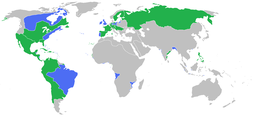
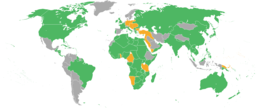
World War I occurred from 1914 to 1918. In terms of human technological history, the scale of World War I was enabled by the technological advances of the second industrial revolution and the resulting globalization that allowed global power projection and mass production of military hardware. Wars on such a scale have not been repeated since the onset of the Atomic Age and the resulting danger of mutually-assured destruction. It had been recognized that the complex system of opposing alliances (the German, Austro-Hungarian, and Ottoman Empires against the British, Russian, and French Empires) was likely to lead to a worldwide conflict if a war broke out. Due to this fact, a very minute conflict between two countries had the potential to set off a domino effect of alliances, triggering a world war. The fact that the powers involved had large overseas empires virtually guaranteed that such a war would be worldwide, as the colonies' resources would be a crucial strategic factor. The same strategic considerations also ensured that the combatants would strike at each other's colonies, thus spreading the wars far more widely than those of pre-Columbian times.
War crimes were perpetrated in World War I. Chemical weapons were used in the First World War despite the Hague Conventions of 1899 and 1907 having outlawed the use of such weapons in warfare. The Ottoman Empire was responsible for the Armenian genocide, the death of over one million Armenians during the First World War.
Second World War
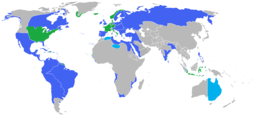
The Second World War occurred from 1939 to 1945 and is the only conflict in which atomic bombs have been used. Hiroshima and Nagasaki, in Japan, were devastated by atomic bombs dropped by the United States. Nazi Germany was responsible for genocides, most notably the Holocaust, the killing of six million Jews. The United States, the Soviet Union, and Canada deported and interned minority groups within their own borders, and largely because of the conflict, many ethnic Germans were later expelled from Eastern Europe. Japan was responsible for attacking neutral nations without a declaration of war, such as the bombing of Pearl Harbor. It is also known for its brutal treatment and killing of Allied prisoners of war and the inhabitants of Asia. It also used Asians as forced laborers and was responsible for the Nanking massacre where 250,000 civilians in the city were brutally murdered by Japanese troops. Non-combatants suffered at least as badly as or worse than combatants, and the distinction between combatants and non-combatants was often blurred by belligerents of total war in both conflicts.[citation needed]
The outcome of World War II had a profound effect on the course of world history. The old European empires either collapsed or were dismantled as a direct result of the wars' crushing costs and, in some cases, their fall was due to the defeat of imperial powers. The United States became firmly established as the dominant global superpower, along with its ideological foe, the Soviet Union, in close competition. The two superpowers exerted political influence over most of the world's nation-states for decades after the end of the Second World War. The modern international security, economic, and diplomatic system was created in the aftermath of the wars.[citation needed]
Institutions such as the United Nations were established to collectivize international affairs, with the explicit goal of preventing another outbreak of general war. The wars had also greatly changed the course of daily life. Technologies developed during wartime had a profound effect on peacetime life as well, such as by advances in jet aircraft, penicillin, nuclear energy, and electronic computers.[citation needed]
Third World War
Since the atomic bombings of Hiroshima and Nagasaki during the Second World War, there has been a widespread and prolonged fear of a potential Third World War between nuclear-armed powers. The Third World War is generally considered a successor to the Second World War and is often suggested to become a nuclear war, devastating in nature and likely much more violent than the First World War and the Second World War combined; in 1947, Albert Einstein commented that "I know not with what weapons World War III will be fought, but World War IV will be fought with sticks and stones."[6][7] It has been anticipated and planned for by military and civil authorities and has been explored in fiction in many countries. Concepts have ranged from purely-conventional scenarios, to limited use of nuclear weapons, to the complete destruction of the planet's surface.
Other global conflicts
Various former government officials, politicians, authors, and military leaders (including the following people: James Woolsey[8]Alexandre de Marenches,[9]Eliot Cohen,[10] and Subcomandante Marcos[11]) have attempted to apply the labels of the "Third World War" and "Fourth World War" to various past and present global wars since the closing of the Second World War, for example, the Cold War and the War on Terror, respectively. Among these are former American, French, and Mexican government officials, military leaders, politicians, and authors: Despite their efforts, none of these wars are commonly deemed world wars.
Wars described by some historians as "World War Zero" include the Seven Years' War[12] and the onset of the Late Bronze Age collapse.[13]
The Second Congo War (1998–2003) involved nine nations and led to ongoing low-level warfare despite an official peace and the first democratic elections in 2006. It has often been referred to as "Africa's World War".[14] During the early-21st century the Syrian Civil War and the Iraqi Civil War and their worldwide spillovers are sometimes described as proxy wars waged between the United States and Russia,[15][16][17][18] which led some commentators to characterize the situation as a "proto-world war" with nearly a dozen countries embroiled in two overlapping conflicts.[19]
Wars with higher death tolls than the First World War
The two world wars of the 20th century had caused unprecedented casualties and destruction across the theaters of conflict.[20] There have been several wars that occurred with as many or more deaths than in the First World War (16,563,868–40,000,000), including:
| Event | Lowest estimate | Highest estimate | Location | From | To | Duration (years) |
|---|---|---|---|---|---|---|
Three Kingdoms | 36,000,000[21] | 40,000,000[22] | China | 184 | 280 | 96 |
An Lushan Rebellion | 13,000,000[23] | 36,000,000[24] | China | 755 | 763 | 9 |
Mongol conquests | 30,000,000[25] | 40,000,000[23] | Eurasia | 1206 | 1324 | 118 |
Conquests of Timur | 15,000,000[26] | 20,000,000[26] | Asia | 1369 | 1405 | 37 |
Qing dynasty conquest of the Ming dynasty | 25,000,000[27] | 25,000,000 | China | 1616 | 1662 | 47 |
Taiping Rebellion | 20,000,000[28] | 100,000,000[29][30][31] | China | 1851 | 1864 | 14 |
World War II | 40,000,000[32] | 85,000,000[33] | Global | 1939 | 1945 | 6 |
Cold War | 22,345,162 | +94,000,000 | Global | 1947 | 1991 | 44 |
Wars spanning continents
There have been numerous wars spanning two or more continents throughout history, including:
| Event | Lowest estimate | Highest estimate | Location | From | To | Duration (years) |
|---|---|---|---|---|---|---|
Late Bronze Age collapse | Egypt, Anatolia, Syria, Canaan, Cyprus, Greece, Mesopotamia | 1200s BCE | 1150s BCE | 40–50 | ||
Greco-Persian Wars | Greece, Thrace, Aegean Islands, Asia Minor, Cyprus, Egypt | 499 BCE | 449 BCE | 50 | ||
Peloponnesian War | Greece, Asia Minor, Sicily | 431 BCE | 404 BCE | 27 | ||
Wars of Alexander the Great | Thrace, Illyria, Greece, Asia Minor, Syria, Babylonia, Persia, Sogdiana, India | 335 BCE | 323 BCE | 12 | ||
Wars of the Diadochi | Macedon, Greece, Thrace, Anatolia, Levant, Egypt, Babylonia, Persia | 322 BCE | 275 BCE | 47 | ||
First Punic War | 285,000 [citation needed] | 400,000[23] | Mediterranean Sea, Sicily, Sardinia, North Africa | 264 BCE | 241 BCE | 23 |
Second Punic War | 616,000 [citation needed] | 770,000[23] | Italy, Sicily, Hispania, Cisalpine Gaul, Transalpine Gaul, North Africa, Greece | 218 BCE | 201 BCE | 17 |
Roman–Seleucid War | Greece, Asia Minor | 192 BCE | 188 BCE | 4 | ||
Roman–Persian Wars | Mesopotamia, Syria, Levant, Egypt, Transcaucasus, Atropatene, Asia Minor, Balkans | 92 BCE | 629 CE | 721 | ||
First Mithridatic War | Asia Minor, Achaea, Aegean Sea | 89 BCE | 85 BCE | 4 | ||
Great Roman Civil War | Hispania, Italy, Greece, Illyria, Egypt, Africa | 49 BCE | 45 BCE | 4 | ||
Byzantine–Sassanid wars | Caucasus, Asia Minor, Egypt, Levant, Mesopotamia | 502 CE | 628 CE | 126 | ||
Muslim conquests | Mesopotamia, Caucasus, Persia, Levant, The Maghreb, Anatolia, Iberia, Gaul, Khorasan, Sindh, Transoxania | 622 | 1258 | 636 | ||
Arab–Byzantine wars | Levant, Syria, Egypt, North Africa, Anatolia, Crete, Sicily, Italy | 629 | 1050 | 421 | ||
Crusades | 1,000,000[34] | 3,000,000[35] | Iberian peninsula, Near East, Anatolia, the Levant, Egypt. | 1095 | 1291 | 197 |
Mongol conquests | 30,000,000[25] | 40,000,000[23] | Eurasia | 1206 | 1324 | 118 |
Byzantine–Ottoman Wars | Asia Minor, Balkans | 1265 | 1479 | 214 | ||
European colonization of the Americas | 2,000,000[36] | 100,000,000[37] | Americas | 1492 | 1900 | 408 |
Ottoman–Habsburg wars | Hungary, Mediterranean, Balkans, North Africa, Malta | 1526 | 1791 | 265 | ||
First Anglo-Spanish War | Atlantic Ocean, English Channel, Low Countries, Spain, Spanish Main, Portugal, Cornwall, Ireland, Americas, Azores, Canary islands | 1585 | 1604 | 19 | ||
Dutch–Portuguese War | Atlantic Ocean, Brazil, West Africa, Southern Africa, Indian Ocean, India, East Indies, Indochina, China | 1602 | 1663 | 61 | ||
Thirty Years' War | 3,000,000 | 11,500,000 | Europe, mainly present-day Germany | 1618 | 1648 | 30 |
Second Anglo-Spanish War | Caribbean, Spain, Canary Islands, Spanish Netherlands | 1654 | 1660 | 6 | ||
Nine Years' War | Europe, Ireland, Scotland, North America, South America, Asia | 1688 | 1697 | 9 | ||
Europe, North America, South America | 1701 | 1714 | 13 | |||
War of the Quadruple Alliance | Sicily, Sardinia, Spain, North America | 1718 | 1720 | 2 | ||
Third Anglo-Spanish War | Spain, Panama | 1727 | 1729 | 2 | ||
Europe, North America, India | 1740 | 1748 | 8 | |||
| 1,500,000[23] | Europe, North America, South America, Africa, Asia | 1754 | 1763 | 9 | ||
American Revolutionary War | North America, Gibraltar, Balearic Islands, India, Africa, Caribbean Sea, Atlantic Ocean, Indian Ocean | 1775 | 1784 | 8 | ||
Europe, Egypt, Middle East, Atlantic Ocean, Caribbean, Indian Ocean | 1792 | 1802 | 9 | |||
| 3,500,000 [citation needed] | 7,000,000[38] | Europe, Atlantic Ocean, Mediterranean Sea, North Sea, Río de la Plata, French Guiana, West Indies, Indian Ocean, North America, South Caucasus | 1803 | 1815 | 13 | |
Crimean War | 255,000[39] | 1,000,000[40] | Sicily, Sardinia, Spain, North America, Southeastern Europe, Black Sea | 1853 | 1856 | 3 |
| 15,000,000[41] | 65,000,000[42] | Global | 1914 | 1918 | 4 | |
| 40,000,000[32] | 85,000,000[33] | Global | 1939 | 1945 | 6 | |
| 22,345,162 (casualties by all wars started in the Cold War with Gulf War, Vietnam War, Korean War, Algerian War , Iran–Iraq War, Nigerian Civil War or Soviet–Afghan War included)[43][better source needed] | +94,000,000 ( 22 millions of people killed by all civil wars started in Asia, South America and Africa + number of people killed in Asia and Europe by the Communist governments, with casualties of Soviet famine of 1946–47, Cambodian genocide, Cultural Revolution, and Great Leap Forward included)[44][better source needed] | Global | 1947 | 1991 | 44 | |
| 272,000[45] | 1,260,000 [45][46][47] | Global | 2001 | present | 17 |





See also

- Neocolonialism
- New Imperialism
- Revolutionary wave
- List of largest empires
- First wave of European colonization
- List of military conflicts spanning multiple wars
- List of wars and anthropogenic disasters by death toll
References
^ Engels, Frederick. "Introduction to Borkheim"..mw-parser-output cite.citation{font-style:inherit}.mw-parser-output q{quotes:"""""""'""'"}.mw-parser-output code.cs1-code{color:inherit;background:inherit;border:inherit;padding:inherit}.mw-parser-output .cs1-lock-free a{background:url("//upload.wikimedia.org/wikipedia/commons/thumb/6/65/Lock-green.svg/9px-Lock-green.svg.png")no-repeat;background-position:right .1em center}.mw-parser-output .cs1-lock-limited a,.mw-parser-output .cs1-lock-registration a{background:url("//upload.wikimedia.org/wikipedia/commons/thumb/d/d6/Lock-gray-alt-2.svg/9px-Lock-gray-alt-2.svg.png")no-repeat;background-position:right .1em center}.mw-parser-output .cs1-lock-subscription a{background:url("//upload.wikimedia.org/wikipedia/commons/thumb/a/aa/Lock-red-alt-2.svg/9px-Lock-red-alt-2.svg.png")no-repeat;background-position:right .1em center}.mw-parser-output .cs1-subscription,.mw-parser-output .cs1-registration{color:#555}.mw-parser-output .cs1-subscription span,.mw-parser-output .cs1-registration span{border-bottom:1px dotted;cursor:help}.mw-parser-output .cs1-hidden-error{display:none;font-size:100%}.mw-parser-output .cs1-visible-error{font-size:100%}.mw-parser-output .cs1-subscription,.mw-parser-output .cs1-registration,.mw-parser-output .cs1-format{font-size:95%}.mw-parser-output .cs1-kern-left,.mw-parser-output .cs1-kern-wl-left{padding-left:0.2em}.mw-parser-output .cs1-kern-right,.mw-parser-output .cs1-kern-wl-right{padding-right:0.2em}
^ Rasmus Björn Anderson (translator: Viktor Rydberg), Teutonic Mythology, vol. 1, p. 139, London: S. Sonnenschein & Co., 1889
OCLC 626839.
^ The First World War Quite Interesting Ltd. Encyclopedia. Downloaded Feb. 11, 2017
^ "Grey Friday: TIME Reports on World War II Beginning". TIME. September 11, 1939. Retrieved 20 October 2014.World War II began last week at 5:20 a. m. (Polish time) Friday, September 1, when a German bombing plane dropped a projectile on Puck, fishing village and air base in the armpit of the Hel Peninsula.
^ "Den anden Verdenskrig udbrød i Gaar Middags Kl. 11", Kristeligt Dagblad, September 4, 1939.
^ Calaprice, Alice (2005). The new quotable Einstein. Princeton University Press. p. 173. ISBN 978-0-691-12075-1.
^ "The culture of Einstein". MSNBC. 2005-04-19. Retrieved 2012-08-24.
^ "World War IV". 2002. Retrieved 2010-02-04.Woolsey claims victory in WWIII, start of WWIV
^ The Fourth World War: Diplomacy and Espionage…. 1992. ASIN 0688092187.CS1 maint: ASIN uses ISBN (link) Book regarding alleged WWIV
^ "World War IV: Let's call this conflict what it is". 2001. Retrieved 2010-02-04.Why war on terrorism should be called WWIV
^ Subcomandante Marcos (2001). "The Fourth World War Has Begun". Nepantla: Views from South. 2 (3): 559–572. Retrieved 20 October 2014.
^ "Why the first world war wasn't really". The Economist. 2014-07-01.
^ "World War Zero brought down mystery civilisation of 'sea people'". New Scientist.
^ Prunier, Gerard (2014). Africa's World War: Congo, the Rwandan Genocide, and the Making of a Continental Catastrophe. Barnes & Noble. ISBN 9780195374209. Retrieved 20 October 2014.
^ Anne Barnard and Karen Shoumali (12 October 2015). "U.S. Weaponry Is Turning Syria Into Proxy War With Russia". The New York Times. Retrieved 14 October 2015.
^ Martin Pengelly (4 October 2015). "John McCain says US is engaged in proxy war with Russia in Syria". The Guardian. Retrieved 17 October 2015.
^ Holly Yan and Mark Morgenstein (13 October 2015). "U.S., Russia escalate involvement in Syria". CNN. Retrieved 17 October 2015.
^ Taub, Amanda (1 October 2015). ""The Russians have made a serious mistake": how Putin's Syria gambit will backfire". Vox. Retrieved 17 October 2015.
^ "Untangling the Overlapping Conflicts in the Syrian War". The New York Times. 18 October 2015. Retrieved 19 October 2015.
^ "Top 10 Causes of WWI". The Rich Ten. Retrieved 11 June 2014.
^ Robert B. Marks (2011). China: Its Environment and History (World Social Change). Rowman & Littlefield Publishers. ISBN 978-1442212756.
^ Caselli, Graziella (2005). Demography – Analysis and Synthesis: A Treatise in Population. Academic Press. ISBN 978-0127656601.
^ abcdef White, Matthew (2012). The Great Big Book of Horrible Things: The Definitive Chronicle of History's 100 Worst Atrocities. W. W. Norton. pp. 529–530. ISBN 978-0-393-08192-3.
^ "Death toll figures of recorded wars in human history".
^ ab The Cambridge History of China: Alien regimes and border states, 907–1368, 1994, p.622, cited by White
^ ab "Timur Lenk (1369–1405)". Users.erols.com. Retrieved 2013-08-23.
^ Macfarlane, Alan (1997-05-28). The Savage Wars of Peace: England, Japan and the Malthusian Trap. Wiley-Blackwell. ISBN 978-0-631-18117-0.
^ "Taiping Rebellion – Britannica Concise". Concise.britannica.com. Retrieved 2013-08-23.
^ "The Taiping Rebellion 1850–1871 Tai Ping Tian Guo". Taipingrebellion.com. Retrieved 2013-08-23.
^ Livre noir du Communisme: crimes, terreur, répression, page 468
^ By Train to Shanghai: A Journey on the Trans-Siberian Railway By William J. Gingles page 259
^ ab Wallechinsky, David (1996-09-01). David Wallechinskys 20th Century: History With the Boring Parts Left Out. Little Brown. ISBN 978-0-316-92056-8.
^ ab Fink, George: Stress of War, Conflict and Disaster
^ John Shertzer Hittell, "A Brief History of Culture" (1874) p.137: "In the two centuries of this warfare one million persons had been slain..." cited by White
^ Robertson, John M., "A Short History of Christianity" (1902) p.278. Cited by White
^ Rummel, R.J. Death by Government, Chapter 3: Pre-Twentieth Century Democide
^ Stannard, David E. (1993). American Holocaust: The Conquest of the New World. New York & Oxford: Oxford University Press. p. 11. ISBN 978-0-19-508557-0.In the 1940s and 1950s conventional wisdom held that the population of the entire hemisphere in 1492 was little more than 8,000,000—with fewer than 1,000,000 people living in the region north of present-day Mexico. Today, few serious students of the subject would put the hemispheric figure at less than 75,000,000 to 100,000,000 (with approximately 8,000,000 to 12,000,000 north of Mexico).
^ Charles Esdaile "Napoleon's Wars: An International History".
^ Bodart, Gaston (1916). Westergaard, Harald, ed. Losses of Life in Modern Wars: Austria-Hungary; France. Clarendon Press. p. 142.
^ Edgerton, Robert (1999). Death or Glory: The Legacy of the Crimean War. Boulder, CO: Westview Press. p. 5. ISBN 978-0-8133-3789-0.
^ Willmott 2003, p. 307
^ "Emerging Infectious Diseases journal - CDC". www.cdc.gov.
^ List of wars by death toll
^ The Black Book of Communism
^ ab "Human costs of war: Direct war death in Afghanistan, Iraq and Pakistan October 2001 – February 2013" (PDF). Costs of War. February 2013. Archived from the original (PDF) on 30 April 2013. Retrieved 14 June 2013.
^ "Update on Iraqi Casualty Data" Archived 2008-02-01 at the Wayback Machine. by Opinion Research Business. January 2008.
^ "Revised Casualty Analysis. New Analysis 'Confirms' 1 Million+ Iraq Casualties" Archived 2009-02-19 at the Wayback Machine.. January 28, 2008. Opinion Research Business. Word Viewer for.doc files.
External links
This is the Fourth World War, an interview with philosopher Jean Baudrillard
Globalization | |||||
|---|---|---|---|---|---|
| |||||
| Aspects |
| ||||
| Issues |
| ||||
| Theories |
| ||||
| Notable scholars |
| ||||
| |||||
 Outline
 Portal
 Category

