Baltoscandia

Location of the Nordic countries and of the Baltic states:
Nordic countries
Baltic states
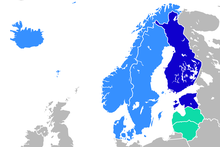
Language branches in Northern Europe
North Germanic (Iceland, Norway, Sweden and Denmark)
Finnic (Finland, Estonia)
Baltic (Latvia, Lithuania)
The Baltoscandian Confederation or Baltoscandia is a geopolitical concept of a Baltic–Scandinavian union (consisting of Sweden, Denmark, Norway, Iceland, Finland, Estonia, Latvia, and Lithuania).[1] The idea was proposed by a Swedish professor Sten de Geer (1886–1933) in the journal Geografiska Annaler in 1928 and further developed by Professor Kazys Pakštas[2] (1893–1960), a Lithuanian scientist in the field of geography and geopolitics.
Contents
1 Development of the concept
2 Advocacy
2.1 Other terms
3 See also
4 References
Development of the concept

Euler diagram indicating Baltoscandia among other subregions of Northern Europe
Pakštas states in his book The Baltoscandian Confederation that the term Baltoscandia was first used by Sten de Geer in an article in "Geografiska Annaler" in 1928.[3] In this book Baltoscandia is described in several different dimensions: as a geographical and cultural, as an economic and as a political and military unit.[4] Kazys Pakštas proposed that one of the ways for the small nations to withstand the influence coming from the large ones is to unite and to cooperate more closely among each other. As he mentions, unification is possible only among nations that are similar by their size, geographical environment, religion, also they have to respect and to tolerate each other.
As the foreign policy of Lithuania has shifted towards Northern Europe even more after Dalia Grybauskaitė came into post of the President of Lithuania,[5] voices questioning the return of the Baltoscandian Confederation idea are on the rise in this country.[6]
Advocacy
For almost 20 years, the Academy of Baltoscandia (Baltoskandijos akademija) functioned in Panevėžys, Lithuania. It was founded on 17 November 1991 as the institute of science researches which regularly organizes arrangements dealing with Baltic and Scandinavian cultural, historical and political contacts. Its main aims were to "develop versatile links of the lands and nations in the region of Baltoscandia and to integrate the culture of Lithuania into the cultural space of Baltoscandia".[7] The academy was liquidated at the end of 2009 because of funding-related problems. The funding was provided by the Panevėžys city municipality, but the functions of the academy did not meet the criteria of the functions of the mentioned municipality.
Other terms
The Nordic-Baltic Eight or "NB8", where 8 stands for the number of States (Estonia, Latvia, Lithuania, Iceland, Norway, Denmark, Finland and Sweden).
See also
 | Wikimedia Commons has media related to Baltoscandia. |
- Baltic region
- Fennoscandia
- Nordic Estonia
- Nordic countries
- Nordic Investment Bank
References
^ "SCAND 344: The Baltic States and Scandinavia, Spring 2002". Retrieved 16 March 2010..mw-parser-output cite.citation{font-style:inherit}.mw-parser-output q{quotes:"""""""'""'"}.mw-parser-output code.cs1-code{color:inherit;background:inherit;border:inherit;padding:inherit}.mw-parser-output .cs1-lock-free a{background:url("//upload.wikimedia.org/wikipedia/commons/thumb/6/65/Lock-green.svg/9px-Lock-green.svg.png")no-repeat;background-position:right .1em center}.mw-parser-output .cs1-lock-limited a,.mw-parser-output .cs1-lock-registration a{background:url("//upload.wikimedia.org/wikipedia/commons/thumb/d/d6/Lock-gray-alt-2.svg/9px-Lock-gray-alt-2.svg.png")no-repeat;background-position:right .1em center}.mw-parser-output .cs1-lock-subscription a{background:url("//upload.wikimedia.org/wikipedia/commons/thumb/a/aa/Lock-red-alt-2.svg/9px-Lock-red-alt-2.svg.png")no-repeat;background-position:right .1em center}.mw-parser-output .cs1-subscription,.mw-parser-output .cs1-registration{color:#555}.mw-parser-output .cs1-subscription span,.mw-parser-output .cs1-registration span{border-bottom:1px dotted;cursor:help}.mw-parser-output .cs1-hidden-error{display:none;font-size:100%}.mw-parser-output .cs1-visible-error{font-size:100%}.mw-parser-output .cs1-subscription,.mw-parser-output .cs1-registration,.mw-parser-output .cs1-format{font-size:95%}.mw-parser-output .cs1-kern-left,.mw-parser-output .cs1-kern-wl-left{padding-left:0.2em}.mw-parser-output .cs1-kern-right,.mw-parser-output .cs1-kern-wl-right{padding-right:0.2em}
^ "What is Baltoscandia? | Misija Lietuva 100". Retrieved 2016-09-28.
^ SCAND 344: The Baltic States and Scandinavia, Spring 2002
^ The Concept of Baltoscandia according to Kazys Pakstas before the war and now (in Lithuanian)
^ Lithuania looks towards Northern Europe
^ Back to Baltoscandia? (in Lithuanian)
^ "Politicians have closed the Academy of Baltoscandia". Retrieved 26 March 2010.
 Nordic countries Nordic countries | ||
|---|---|---|
| States |
|  |
| Autonomous countries |
| |
Special status/Cultural area |
| |
| Related |
| |
| See also |
| |
| ||


 Category
Baltic states | ||
|---|---|---|
| ||
| History |
|  |
| Geography |
| |
| Politics |
| |
| Economy |
| |
| Sport |
| |
| ||


 Commons
 Portal
Earth's primary regions | |||||||||||||||||
|---|---|---|---|---|---|---|---|---|---|---|---|---|---|---|---|---|---|
| |||||||||||||||||
 Book
Book

