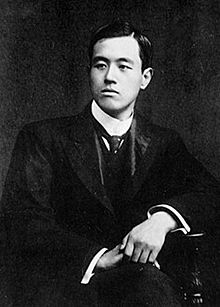
Ōtani Kōzui
Ōtani Kōzui | |
|---|---|
 | |
| Born | (1876-10-27)October 27, 1876 Kyoto |
| Died | October 5, 1948(1948-10-05) (aged 72) |
| Other names | 大谷 光瑞 |
| Occupation | Buddist, Historian |
| Part of a series on |
| Buddhism in Japan |
|---|
 |
Schools
|
Founders
|
Sacred texts
|
|
Count Ōtani Kōzui (大谷 光瑞, Buddhist name: 鏡如 Kyōnyo) (27 December 1876 – 5 October 1948) was the 22nd Abbot of the Nishi Honganji sub-sect of Jōdo Shinshū Buddhism in Kyoto, Japan. He is known for expeditions to Buddhist sites in Central Asia, such as Subashi.
Contents
1 Career
2 See also
3 References
3.1 Notes
3.2 Sources
Career
Between 1902 and 1910, he financed three expeditions to Central Asia although his participation was stopped for his succession. Ōtani was a fellow of the Royal Geographical Society, and played host to several of his fellow Central Asian explorers, such as Sven Hedin and Albert von Le Coq. His collection, often called "Ōtani collection" is still considered important in Central Asian studies, although it is today scattered in Tokyo, Kyoto, China and Korea. In addition to his spiritual responsibilities and his Central Asian activities, Ōtani wrote about China, Manchuria and Chinese porcelain. While playing the Great Game, British and Russian intelligence both suspected that his archaeological expeditions were little more than covers for espionage activities. Japan says they were solely investigations of the route along which Buddhism came to Japan, and had no political connections.[1]
After his father Myonyo's death, he succeeded as Abbot of the Nishi Honganji in 1903. While he continued to sponsor the expeditions, he devoted himself to the modernization of the Jōdo Shinshū sect. His sponsorship, however, brought huge amounts of debt to his sect. A financial scandal forced him to abdicate in 1914. His nephew Shonyo became 23rd Abbot.
See also
- 1902 Ōtani expedition
References
Notes
^ Information stand in the Tokyo National Museum.
Sources
Hopkirk, Peter (1980). Foreign Devils on the Silk Road: The Search for the Lost Cities and Treasures of Chinese Central Asia. Amherst: The University of Massachusetts Press. .mw-parser-output cite.citation{font-style:inherit}.mw-parser-output .citation q{quotes:"""""""'""'"}.mw-parser-output .citation .cs1-lock-free a{background:url("//upload.wikimedia.org/wikipedia/commons/thumb/6/65/Lock-green.svg/9px-Lock-green.svg.png")no-repeat;background-position:right .1em center}.mw-parser-output .citation .cs1-lock-limited a,.mw-parser-output .citation .cs1-lock-registration a{background:url("//upload.wikimedia.org/wikipedia/commons/thumb/d/d6/Lock-gray-alt-2.svg/9px-Lock-gray-alt-2.svg.png")no-repeat;background-position:right .1em center}.mw-parser-output .citation .cs1-lock-subscription a{background:url("//upload.wikimedia.org/wikipedia/commons/thumb/a/aa/Lock-red-alt-2.svg/9px-Lock-red-alt-2.svg.png")no-repeat;background-position:right .1em center}.mw-parser-output .cs1-subscription,.mw-parser-output .cs1-registration{color:#555}.mw-parser-output .cs1-subscription span,.mw-parser-output .cs1-registration span{border-bottom:1px dotted;cursor:help}.mw-parser-output .cs1-ws-icon a{background:url("//upload.wikimedia.org/wikipedia/commons/thumb/4/4c/Wikisource-logo.svg/12px-Wikisource-logo.svg.png")no-repeat;background-position:right .1em center}.mw-parser-output code.cs1-code{color:inherit;background:inherit;border:inherit;padding:inherit}.mw-parser-output .cs1-hidden-error{display:none;font-size:100%}.mw-parser-output .cs1-visible-error{font-size:100%}.mw-parser-output .cs1-maint{display:none;color:#33aa33;margin-left:0.3em}.mw-parser-output .cs1-subscription,.mw-parser-output .cs1-registration,.mw-parser-output .cs1-format{font-size:95%}.mw-parser-output .cs1-kern-left,.mw-parser-output .cs1-kern-wl-left{padding-left:0.2em}.mw-parser-output .cs1-kern-right,.mw-parser-output .cs1-kern-wl-right{padding-right:0.2em}
ISBN 0-87023-435-8.
Authority control  |
|
|---|


