Jiaohe ruins
يارغول قەدىمكى شەهىرى 交河 | |
 Buddhist stupa at Jiaohe Ruins. | |
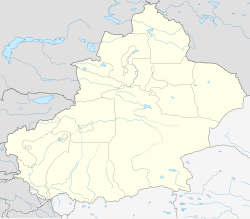  Shown within Xinjiang | |
| Location | Xinjiang, China |
|---|---|
| Coordinates | 42°57′02″N 89°03′50″E / 42.95056°N 89.06389°E / 42.95056; 89.06389Coordinates: 42°57′02″N 89°03′50″E / 42.95056°N 89.06389°E / 42.95056; 89.06389 |
| Type | Settlement |
| Site notes | |
| Condition | In ruins |
| Yarghul (Jiaohe) Ruins | |||||||||
| Chinese name | |||||||||
|---|---|---|---|---|---|---|---|---|---|
| Chinese | 交河故城 | ||||||||
| |||||||||
| Uyghur name | |||||||||
| Uyghur | .mw-parser-output .font-ugy{font-family:"UKIJ Tuz","UKIJ Nasq","UKIJ Basma","UKIJ_Mac Basma","UKIJ Zilwa","UKIJ Esliye","UKIJ Tuz Basma","UKIJ Tuz Kitab","UKIJ Tuz Gezit","UKIJ Tuz Qara","UKIJ Tuz Qara","UKIJ Tuz Tor","UKIJ Kesme","UKIJ Kesme Tuz","UKIJ Qara","UKIJ Basma Aq","UKIJ Basma Qara","UKIJ Basma Tuz","UKIJ Putuk","UKIJ Tuz Xet","UKIJ Tom Xet","UKIJ Tuz Jurnal","UKIJ Arabic","UKIJ CJK","UKIJ Ekran","UKIJ_Mac Ekran","UKIJ Teng","UKIJ Tor","UKIJ Tuz Tom","UKIJ Mono Keng","UKIJ Mono Tar","UKIJ Nokia","UKIJ SimSun","UKIJ Yanfon","UKIJ Qolyazma","UKIJ Saet","UKIJ Nasq Zilwa","UKIJ Sulus","UKIJ Sulus Tom","UKIJ 3D","UKIJ Diwani","UKIJ Diwani Yantu","UKIJ Diwani Tom","UKIJ Esliye Tom","UKIJ Esliye Qara","UKIJ Jelliy","UKIJ Kufi","UKIJ Kufi Tar","UKIJ Kufi Uz","UKIJ Kufi Yay","UKIJ Merdane","UKIJ Ruqi","UKIJ Mejnuntal","UKIJ Junun","UKIJ Moy Qelem","UKIJ Chiwer Kesme","UKIJ Orxun-Yensey","UKIJ Elipbe","UKIJ Qolyazma Tez","UKIJ Qolyazma Tuz","UKIJ Qolyazma Yantu","UKIJ Ruqi Tuz",FZWWBBOT_Unicode,FZWWHQHTOT_Unicode,Scheherazade,Lateef,LateefGR,"Noto Naskh Arabic","Microsoft Uighur";font-feature-settings:"cv50"1} يارغول قەدىمقى شەهىرى | ||||||||
| |||||||||

Model of the plateau on which Jiaohe is located

Jiaohe Ruins

Jiaohe Ruins

Landscape at the foot of the plateau on which Jiaohe is located
The Jiaohe Ruins is the archaeological site of the ancient city of Yarkhoto found in the Yarnaz Valley, 10 km west of the city of Turpan in Xinjiang Uyghur Autonomous Region.[1] Yarkhoto was the capital of the Gushi Kingdom. It is a natural fortress located atop a steep cliff on a leaf-shaped plateau between two deep river valleys.
Contents
1 Names
2 History
3 Conservation
4 See also
5 Footnotes
6 References
7 External links
Names
The Hou Hanshu says:
- "The king of Nearer Jushi [Turfan]1 lives in the town of Jiaohe [Yarkhoto, 20 li west of Turfan]. A river divides into two and surrounds the town, which is why it is called Jiaohe ['River Junction']."[2]
Lionel Giles recorded the following names for the city (with his Wade-Giles forms of the Chinese names substituted with pinyin):
- Jiaohe, ancient capital of Turfan [Han].
- Jushi Qianwangting (Royal Court of Anterior/Nearer Jushi) [Later Han]
- Gaochang Jun [Jin]
- Xi Zhou [Tang]
- Yarkhoto [modern name].[3]
Aurel Stein has suggested that the name Yarkhoto is a combination of Turkic and Mongolian words, being derived from yar (Turki: ravine) and khoto (Mongolian: town).[4]
History
Among the earliest settlers of this area are the Indo-European speaking Tocharians,who had populated the Tarim and Turfan basins no later than 1800 BC.[citation needed] From the years 108 BC to 450 AD the city of Yarkhoto was the capital of the Anterior Jushi Kingdom. Yarkhoto is a bit less than 2000 years old.
It was an important site along the Silk Road trade route leading west, and was adjacent to the Korla and Karasahr kingdoms to the west. From 450 AD until 640 AD it became Jiao prefecture in the Tang Dynasty, and in 640 AD it was made the seat of the new Jiaohe County. From 640 AD until 658 AD it was also the seat of the Protector General of the Western Regions, the highest level military post of a Chinese military commander posted in the west. Since the beginning of the 9th century it had become Jiaohe prefecture of the Uyghur Khaganate, until their kingdom was conquered by the Kyrgyz soon after in the year 840. Yarkhoto was also built on a plateau and this plateau is 30m high.
The city was built on a large islet (1650 m in length, 300 m wide at its widest point) in the middle of a river which formed natural defenses, which would explain why the city lacked any sort of walls. Instead, steep cliffs more than 30 metres high on all sides of the river acted as natural walls. The layout of the city had eastern and western residential districts, while the northern district was reserved for Buddhist sites of temples and stupas. Along with this there are notable graveyards and the ruins of a large government office in the southern part of the eastern district. It had a population of 7,000 according to Tang dynasty records.
It was finally abandoned after its destruction during an invasion by the Mongols led by Genghis Khan in the 13th century.
The ruins were visited by the archaeologist and explorer Aurel Stein, who described "a maze of ruined dwellings and shrines carved out for the most part from the loess soil", but complained that a combination of local farmers' use of the soil and government interference in his activities prevented examination.[5] The site was partially excavated in the 1950s and has been protected by the PRC government since 1961.[6] There are now attempts to protect this site and other Silk Road city ruins.
Conservation
Both the Nara National Cultural Properties Research Institute and the Xinjiang Cultural Relics Bureau have been cooperating in a joint venture to preserve the ruins of the site since 1992. In 2014, the Jiaohe Ruins became part of the Silk Road UNESCO World Heritage Sites, after several years of preparation.[7][8]
See also
Gaochang ruins- Tocharian languages
- Silk Road transmission of Buddhism
- Gushi culture
- Major national historical and cultural sites (Xinjiang)
Footnotes
^ Bonavia (2002), p.236.
^ Hill (2009), p. 48.
^ Giles (1930-1932), p. 846.
^ Stein, Aurel (1928). Innermost Asia: Detailed Report of Explorations in Central Asia, Kan-su and Eastern Iran, Carried Out and Described under the Orders of H.M. Indian Government. Oxford: Clarendon Press. p. 713.Text available here On 'yar' یار (ravine), see G. Raquette (1927),English-Turki Dictionary: Based on the Dialects of Kashgar and Yarkand, Lunds Universitet Årsskrift. N.F. Avd. 1. Bd. 23. Nr. 4, Lund: C. W. K. Gleerup, p.95. On khot[o]/ XOT, 'group of tents, town, etc.', see Charles Bawden (1997), Mongolian-English Dictionary, London: Kegan Paul, p.452.
^ Aurel Stein, On Ancient Central-Asian Tracks: Brief Narrative of Three Expeditions in Innermost Asia and North-western China (London: Macmillan and Co, 1933), p. 270.
^ Bonavia (2002), p. 236.
^ "Silk Road Aims at Site in UNESCO World Heritage List". china.org.cn. Retrieved 2007-09-18..mw-parser-output cite.citation{font-style:inherit}.mw-parser-output .citation q{quotes:"""""""'""'"}.mw-parser-output .citation .cs1-lock-free a{background:url("//upload.wikimedia.org/wikipedia/commons/thumb/6/65/Lock-green.svg/9px-Lock-green.svg.png")no-repeat;background-position:right .1em center}.mw-parser-output .citation .cs1-lock-limited a,.mw-parser-output .citation .cs1-lock-registration a{background:url("//upload.wikimedia.org/wikipedia/commons/thumb/d/d6/Lock-gray-alt-2.svg/9px-Lock-gray-alt-2.svg.png")no-repeat;background-position:right .1em center}.mw-parser-output .citation .cs1-lock-subscription a{background:url("//upload.wikimedia.org/wikipedia/commons/thumb/a/aa/Lock-red-alt-2.svg/9px-Lock-red-alt-2.svg.png")no-repeat;background-position:right .1em center}.mw-parser-output .cs1-subscription,.mw-parser-output .cs1-registration{color:#555}.mw-parser-output .cs1-subscription span,.mw-parser-output .cs1-registration span{border-bottom:1px dotted;cursor:help}.mw-parser-output .cs1-ws-icon a{background:url("//upload.wikimedia.org/wikipedia/commons/thumb/4/4c/Wikisource-logo.svg/12px-Wikisource-logo.svg.png")no-repeat;background-position:right .1em center}.mw-parser-output code.cs1-code{color:inherit;background:inherit;border:inherit;padding:inherit}.mw-parser-output .cs1-hidden-error{display:none;font-size:100%}.mw-parser-output .cs1-visible-error{font-size:100%}.mw-parser-output .cs1-maint{display:none;color:#33aa33;margin-left:0.3em}.mw-parser-output .cs1-subscription,.mw-parser-output .cs1-registration,.mw-parser-output .cs1-format{font-size:95%}.mw-parser-output .cs1-kern-left,.mw-parser-output .cs1-kern-wl-left{padding-left:0.2em}.mw-parser-output .cs1-kern-right,.mw-parser-output .cs1-kern-wl-right{padding-right:0.2em}
^ "Protection Scheme for Relics on Silk Road Launched in Xinjiang". china.org.cn. Retrieved 2007-09-18.
References
- Bonavia, Judy (2002). The Silk Road: Xi'an to Kashgar. Revised by Christoph Baumer. Odyssey Guides, Air Photo International, Hong Kong. Reprint 2004.
ISBN 962-217-741-7. - Giles, Lionel (1930–1932). "A Chinese Geographical Text of the Ninth Century." BSOS VI, pp. 825–846.
- Hill, John E. (2009) Through the Jade Gate to Rome: A Study of the Silk Routes during the Later Han Dynasty, 1st to 2nd Centuries CE. BookSurge, Charleston, South Carolina.
ISBN 978-1-4392-2134-1. - Stein, Aurel (1933), On Ancient Central-Asian Tracks: Brief Narrative of Three Expeditions in Innermost Asia and North-western China. London: Macmillan and Co.[1]
- Stein, Aurel (1928). Innermost Asia: Detailed Report of Explorations in Central Asia, Kan-su and Eastern Iran, Carried Out and Described under the Orders of H.M. Indian Government. Oxford: Clarendon Press. Full and searchable text available here
External links
Along the ancient silk routes: Central Asian art from the West Berlin State Museums, an exhibition catalog from The Metropolitan Museum of Art (fully available online as PDF), which contains material from Jiaohe Ruins
Xinjiang topics | |
|---|---|
Ürümqi (capital) | |
| History |
|
| Geography |
|
| Education |
|
| Culture |
|
| Cuisine |
|
| Visitor attractions |
|
| Xinjiang conflict |
|
| People |
|
| Related |
|
| |
 Category
 Commons

