Nuoro
Nuoro Nùgoro (Sardinian) | |
|---|---|
Comune | |
| Comune di Nuoro | |
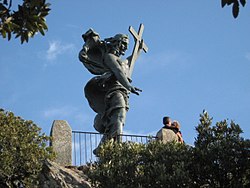 Redeemer's Statue, Monte Ortobene | |
  Nuoro Location of Nuoro in Sardinia | |
| Coordinates: 40°19′N 09°20′E / 40.317°N 9.333°E / 40.317; 9.333Coordinates: 40°19′N 09°20′E / 40.317°N 9.333°E / 40.317; 9.333 | |
| Country | Italy |
| Region | Sardinia |
| Province | Nuoro (NU) |
| Frazioni | Lollove |
| Government | |
| • Mayor | Andrea Soddu (civic list and Sardinian Action Party) |
| Area | |
| • Total | 192.27 km2 (74.24 sq mi) |
| Elevation | 554 m (1,818 ft) |
| Population (January 1, 2012)[1] | |
| • Total | 36,347 |
| • Density | 190/km2 (490/sq mi) |
| Demonym(s) | Nuoresi Nugoresos |
| Time zone | UTC+1 (CET) |
| • Summer (DST) | UTC+2 (CEST) |
| Postal code | 08100 |
| Dialing code | 0784 |
| Patron saint | Santa Maria della Neve |
| Saint day | August 5 |
| Website | Official website |
Nuoro (Italian pronunciation: [ˈnuːoro] ( listen) or less correctly [ˈnwɔːro];[2]Sardinian: Nùgoro [ˈnuɣoɾo])[2][a] is a city and comune (municipality) in central-eastern Sardinia, Italy, situated on the slopes of the Monte Ortobene. It is the capital of the province of Nuoro. With a population of 36,347 (2011),[3] it is the sixth-largest city in Sardinia.
Birthplace of several renowned artists, including writers, poets, painters, and sculptors, Nuoro hosts some of the most important museums in Sardinia. It is considered an important cultural center of the region[4] and it has been referred as the "Atene sarda" (Sardinian Athens).[5] Nuoro is the hometown of Grazia Deledda, the only Italian woman to win (1926) the Nobel Prize in Literature.
Contents
1 History
2 Culture
2.1 ISRE
2.2 Museums
2.3 Monuments and historical sites
2.4 Language
2.5 Food
2.6 Cultural international events
3 Transport
3.1 Road
3.2 Bus
3.3 Rail
3.4 Local Transport
4 Notable people
5 Twin towns
6 Notes
7 References
8 External links
History

View of Nuoro in winter from Monte Ortobene.

View of Nuoro
The earliest traces of human settlement in the Nuoro area (called " the Nuorese") are the so-called Domus de janas, rock-cut tombs dated at the third millennium BC. However, fragments of ceramics of the Ozieri culture have also been discovered and dated at c. 3500 BC.[6]
The Nuorese was a centre of the Nuragic civilization (which developed in Sardinia from c. 1500 BC to c. 250 BC), as attested by more than 30 Nuragic sites, such has the village discovered in the countryside of Tanca Manna, just outside Nuoro, which was made of about 800 huts.
The Nuorese was crossed by a Roman road which connected Karalis (Cagliari) to Ulbia (Olbia). The legacy of the Roman colonization can especially be found in the variety of the Sardinian language which is still spoken today in Nuoro: Sardu nugoresu is considered the most conservative lect of the Romance family.
After the fall of the Western Roman Empire, Sardinia was held first by the Vandals and then by the Byzantines. According to the letters of Pope Gregory I, a Romanized and Christianized culture (that of the provinciales) co-existed with several Pagan cultures (those of the Gens Barbaricina, i.e. "Barbarian People") mainly located in the island's interior. As the Byzantine control waned, the Giudicati appeared. A small village known as Nugor appears on a medieval map from 1147. In the two following centuries it grew to more than 1000 inhabitants. Nuoro remained a town of average importance under the Aragonese and Spanish domination of Sardinia, until famine and plague struck it in the late 17th century.
After the annexation to the Kingdom of Sardinia, the town became the administrative center of the area, obtaining the title of city in 1836.
Culture
ISRE
Since 1972 in Nuoro is active the Istituto superiore regionale etnografico (ISRE), which is an institution that promotes the study and documentation of the social and cultural life of Sardinia in its traditional manifestations and its transformations. In fact, in addition to managing museums and libraries, it organizes national and international events, including:
the Sardinia International Ethnographic Film Festival (SIEFF) and the Festival Biennale Italiano dell’Etnografia (ETNU) (Italian Biennial Festival of Ethnography).
Museums
Sardinian Ethnographic Museum (Museo Etnografico Sardo).
Grazia Deledda's Museum (Museo Deleddiano).
M.A.N., Museo d’Arte Provincia di Nuoro (Modern Art Museum of the Nuoro Province).
National Archeological Museum Nuoro (Museo Archeologico Nazionale di Nuoro).
Museo Ciusa, Museum dedicated to Francesco Ciusa and other artists
Monuments and historical sites

Nuoro's Cathedral
- Cattedrale della Madonna della Neve
- Piazza Sebastiano Satta
- Chiesa di Nostra Signora delle Grazie
- Chiesa della Solitudine
- The Redeemer's statue, Monte Ortobene, the 7 meters tall Vincenzo Gerace's bronze statue installed the 29th August 1901.
Nuraghe Ugolio
Chiesa di San Carlo, church built in the 17th century containing a copy of Francesco Ciusa's masterpiece La madre dell'ucciso.
Sas Birghines, Domus de Janas located in Monte Ortobene
Sanctuary Madonna of Montenero, Monte Ortobene
Language
Along with Italian, the traditional language spoken in Nuoro is Sardinian, in its Logudorese-Nuorese variety.
Food
Nuoro is home to the world's rarest pasta, su filindeu.[7][8] The name in Sardinian language means "the threads (or wool) of God" and is made exclusively by the women of a single family in the town, with the recipe being passed down through generations.
Cultural international events
- Sardinia International Ethnographic Film Festival
Transport
Road
Nuoro is served by the SS 131 DCN (Olbia-Abbasanta), the SS 129 (Orosei-Macomer), and the SS 389 (Monti-Lanusei).
Bus
ARST, Azienda Regionale Sarda Trasporti provide regular connections to Cagliari, Sassari, Olbia, and to several minor centres in the province and the region.
Other private operators (including Deplano Autolinee, Turmotravel, Redentours) connects Nuoro to various cities and airports in the island.
Rail
Nuoro is connected by train to Macomer via Ferrovie della Sardegna.
Local Transport
ATP Nuoro's bus system provides service within the city.
Notable people

Casa dei Contrafforti, Nuoro's Old Town

Nivola's sculptures in Piazza Sebastiano Satta, Nuoro
Priamo Gallisay (1853–1930), musician (opera composer)
Giampietro Chironi (1855–1918), senator
Franceschino Guiso-Gallisai (1859-1933) Knight, Order of Merit for Labour
Antonio Ballero (1864–1932), writer, painter
Sebastiano Satta (1867–1914), poet, lawyer
Pasquale Dessanai (1868–1919), poet
Grazia Deledda (1871–1936), writer, winner Nobel Prize
Francesco Ciusa (1883–1949), sculptor, winner of the Venice Biennale
Attilio Deffenu (1890–1918), trade unionist
Gonario Pinna (1898–1991), writer, politician, lawyer
Salvatore Mannironi (1901, 1971), politician, Ministry of Commercial Navy
Salvatore Satta (1902–1975), jurist, writer
Giovanni Ciusa Romagna (1907–1958), painter
Maria Giacobbe (born 1928), writer and essayist
Sebastiano Mannironi (born 1930), athlete. Olympic games medal winner.
Franco Oppo (born 1935), composer
Romano Ruiu (1935–1974), writer, poet, playwright
Piero Marras (born 1949), singer-songwriter
Giovanni Columbu (born 1949), film director
Marcello Fois (born 1960), writer
Flavio Manzoni (born 1967) car designer
Salvatore Sirigu (born 1987), footballer
Twin towns
 Corte, France
 Tolmezzo, Italy[9]


Notes
^ Probably from a root meaning "home" or "hearth" in Logudorese.
References
^ Population data from Istat.
^ ab "Nuoro". DOP..mw-parser-output cite.citation{font-style:inherit}.mw-parser-output q{quotes:"""""""'""'"}.mw-parser-output code.cs1-code{color:inherit;background:inherit;border:inherit;padding:inherit}.mw-parser-output .cs1-lock-free a{background:url("//upload.wikimedia.org/wikipedia/commons/thumb/6/65/Lock-green.svg/9px-Lock-green.svg.png")no-repeat;background-position:right .1em center}.mw-parser-output .cs1-lock-limited a,.mw-parser-output .cs1-lock-registration a{background:url("//upload.wikimedia.org/wikipedia/commons/thumb/d/d6/Lock-gray-alt-2.svg/9px-Lock-gray-alt-2.svg.png")no-repeat;background-position:right .1em center}.mw-parser-output .cs1-lock-subscription a{background:url("//upload.wikimedia.org/wikipedia/commons/thumb/a/aa/Lock-red-alt-2.svg/9px-Lock-red-alt-2.svg.png")no-repeat;background-position:right .1em center}.mw-parser-output .cs1-subscription,.mw-parser-output .cs1-registration{color:#555}.mw-parser-output .cs1-subscription span,.mw-parser-output .cs1-registration span{border-bottom:1px dotted;cursor:help}.mw-parser-output .cs1-hidden-error{display:none;font-size:100%}.mw-parser-output .cs1-visible-error{font-size:100%}.mw-parser-output .cs1-subscription,.mw-parser-output .cs1-registration,.mw-parser-output .cs1-format{font-size:95%}.mw-parser-output .cs1-kern-left,.mw-parser-output .cs1-kern-wl-left{padding-left:0.2em}.mw-parser-output .cs1-kern-right,.mw-parser-output .cs1-kern-wl-right{padding-right:0.2em}
^ Source: ISTAT
^ [1] Cultural Notes by the Comune of Nuoro (in Italian)
^ E. Corda, Atene Sarda. Storie di vita nuorese 1886-1946, Rusconi, 1992 - only available in Italian
^ Sardinia
ISBN 1-860-11324-9 p. 85
^ The secret behind Italy's rarest pasta, BBC.com
^ This is the Rarest Pasta in the World, The Daily Meal
^ "Twinning Ceremony" (in Italian). Retrieved 2010-04-01.
External links
 | Wikimedia Commons has media related to Nuoro. |
Official Website (in Italian)
Official (Municipality) Tourism Website (in Italian)
- Official (Region) Tourism Website
Places adjacent to Nuoro | ||||||||||
|---|---|---|---|---|---|---|---|---|---|---|
| ||||||||||

 Nuoro
Nuoro

Sardinia · Comuni of the Province of Nuoro | ||
|---|---|---|
 |
| |
Authority control  |
|
|---|


