No. 74 Squadron RAF
| No. 74 (Trinidad) Squadron RAF | |
|---|---|
 No. 74 Squadron badge (King's Crown) | |
| Active | 1 July 1917 – 3 July 1919 3 September 1935 – 25 August 1971 19 October 1984 – 1 October 1992 5 October 1992 – 22 September 2000 |
| Country |  United Kingdom United Kingdom |
| Allegiance | Great Britain, England |
| Branch |  Royal Air Force Royal Air Force |
| Role | Air Superiority / Ground Attack |
| Garrison/HQ | No.145 Wing |
| Nickname(s) | Tiger Squadron Trinidad[1] |
| Motto(s) | I Fear No Man[2] |
| Mascot(s) | Bengal Tiger |
| Equipment | S.E.5a, Spitfire Mk.I, Hurricane Mk.II, Spitfire Mk.IX, Spitfire Mk XVI, Meteor F.8, Hunter F.6, Lightning F.1, F-4J(UK) Phantom, Hawk T.1 |
| Battle honours | Western Front 1918*, France and Low Countries 1940*, Dunkirk*, Battle of Britain 1940*, Fortress Europe 1940–1941 and 1944*, Home Defence 1940–1941, Mediterranean 1943*, Walcheren, Normandy 1944*, France and Germany 1944–1945*, Rhine Honours marked with an asterisk are those emblazoned on the Squadron Standard |
| Insignia | |
| Squadron Badge heraldry | A tiger's face. Approved by King George VI in February 1937.[3](Developed from an unofficial emblem used during the First World War.) |
| Squadron Roundel |  |
| Squadron Codes | JH (Feb 1939 – Sep 1939) ZP (Sep 1939 – Apr 1942) 4D (Apr 1944 – Apr 1951) |
Number 74 Squadron, also known as "Tiger Squadron" from its tiger head motif, was a squadron of the Royal Air Force. It operated fighter aircraft from 1917 to the 1990s, and then trainers until its disbandment in 2000. It was the Royal Air Force's member of the NATO Tiger Association from 1961 until the Squadron's disbandment, it has since been replaced by No. 230 Squadron.[4]
Contents
1 History
1.1 First World War
1.2 Interwar years
1.3 Second World War
1.4 Post-War
1.4.1 Meteors, Hunters and Lightnings
1.4.2 Phantoms, Hawks and disbandment
2 Famous pilots
3 Aircraft operated
4 See also
5 References
5.1 Notes
5.2 Bibliography
6 External links
History
First World War

A replica Royal Aircraft Factory S.E.5a, similar to what No. 74 Squadron operated in 1918 and 1919.
No. 74 Squadron was first formed at Northolt on 1 July 1917 before relocating to the aerodrome at London Colney 9 days later.[5] The Squadron began life as a training unit with it flying Avro 504Ks before working-up to a fighter squadron. In February 1918, Mick Mannock became the flight commander of the Squadron as it reached front-line status.[6]
On 20 March 1918 the Squadron received its first operational fighters, the Royal Aircraft Factory S.E.5a. On 30 March the Squadron was sent over to the Royal Flying Corps headquarters in Saint-Omer, France. No. 74 Squadron saw its first action on 12 April when it engaged in a dogfight near Merville against the German Luftstreitkräfte, with Mannock scoring 'the Tigers' first kill - an Albatros Scout.[7] Within 70 days of being on the continent, No. 74 Squadron had notched 100 enemy kills to just one loss.[8] The Squadron served in France from April until February 1919, when it returned home to RAF Lopcombe Corner, Hampshire where it was disbanded on 3 July 1919.
During its 7 month-long wartime service, it was credited with 140 enemy planes destroyed and 85 driven down out of control, for 225 victories. Seventeen aces had served in the squadron, including Victoria Cross winner Major Edward "Mick" Mannock, Ira "Taffy" Jones, Benjamin Roxburgh-Smith, future Air Commodore Keith Caldwell, Andrew Kiddie, Frederick Stanley Gordon, Sydney Carlin, Frederick Hunt, Clive Glynn, George Hicks, Wilfred Ernest Young, Henry Dolan, Harris Clements, George Gauld, and
Frederick Luff.[9]
Interwar years
In response to the on-going Abyssinia Crisis of 1935, the Squadron was reformed in unusual circumstances on 3 September. The Squadron was reborn out of the combination of detachments of Nos 3, 23, 32, 56, 65 and 601 Squadrons who were on board the troopship ship Neutralia, which was en-route to Malta.[3] After arrival, No. 74 Squadron operated Hawker Demon two-seater fighters. While it had been officially re-established, the Squadron was prohibited from identifying its aircraft by squadron number until 14 November due to security reasons - until then it was referred to as 'Demon Flights'.[10]
In the following July, the Squadron and its Demons, were shipped back to England, with the Squadron arriving at RAF Hornchurch in September 1936. In February 1937 after years of unofficial use, No. 74 Squadron had its squadron badge design – a tiger's face – officially approved by King George VI.[3] 'The Tigers' re-equipped with Gloster Gauntlets in April 1937, forming part of the newly created Fighter Command. The Gauntlets were kept up until February 1939, when the Squadron began converting to the Supermarine Spitfire Mk.I.
Second World War
At the outbreak of war, No. 74 Squadron was operating from RAF Rochford, a satellite aerodrome of RAF Hornchurch. On 6 September 1939, after an early morning air raid alert, a flight of No. 56 Squadron Hawker Hurricanes took off from North Weald. These were followed by two reserve Hurricanes. The two reserves were identified as enemy aircraft and Spitfires from RAF Hornchurch, among them No. 74 Squadron, were ordered to attack them. Both were shot down. One pilot, P/O Montague Hulton-Harrop was killed; the other pilot, Frank Rose, survived. The pilot who fired the fatal shots was No. 74 Squadron's John Freeborn.
The exact story of what happened in this incident, which came to be known as the "Battle of Barking Creek", may never be known. Even the origin of the name is obscure, as it did not take place above Barking Creek but near Ipswich, in Suffolk. This was the first RAF operational death of the war. At the subsequent court martial, it was accepted that the entire incident was an unfortunate error.[11]
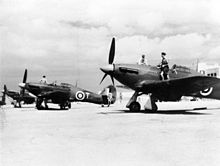
Hawker Hurricane Mk.IIBs, similar to what No. 74 Squadron operated from 1942 to 1943.
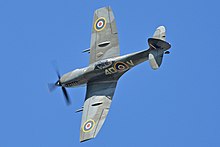
Supermarine Spitfire LF.XVIe in markings of Squadron Leader A. J. 'Tony' Reeves DFC, Commanding Officer of No. 74 Squadron from December 1944.
The Squadron, as part of No. 12 Group RAF, first saw combat in May 1940 during the evacuation from Dunkirk, in battles which exacted a heavy toll on both pilots and aircraft. Thereafter No. 74 Squadron served successfully through the Battle of Britain, being heavily involved throughout June and July. On 11 August, the Squadron flew four sorties and by the end of the day had claimed 24 victories and 14 damaged. In response they received a telegram from the Chief of the Air Staff Sir Cyril Newall which read, "A magnificent day's fighting, 74... Mannock started it and you keep it up."[8] On 14 August, No. 74 Squadron was posted to RAF Wittering for rest and shortly after moved onto RAF Kirton in Lindsey and then onto RAF Coltishall, Norfolk. It was here at Coltishall in September 1940 that the Squadron replaced their Spitfire Mk.Is with the Mk.IIa. The Squadron moved back south to RAF Biggin Hill in October for the end of the Battle. Between November and December 1940, No. 74 Squadron destroyed 38 enemy aircraft. With the Battle of Britain won, the Squadron were posted to RAF Manston in February 1941. The Squadron then went to the north of England to RAF Acklington in July 1941 to regroup, from there moving around to stations in Wales (RAF Llanbedr) and Northern Ireland (RAF Long Kesh). During this time the Governor of Trinidad and Tobago, Sir Hubert Winthrop Young, made a presentation of Spitfires to No. 74 Squadron. This subsequently led to the 'The Tigers' being named the 'Trinidad Squadron', a name that lasted until the 1950s.[8]
The Squadron finally made a move from RAF Long Kesh in April 1942 when it was sent the Middle East, arriving in Egypt in June. The ship carrying their aircraft they had been due to fly had been sunk leaving 'The Tigers' without anything to fly.[8] No. 74 Squadron was then moved to Palestine in July where a decision was made for the Squadron to operate as a maintenance unit for USAAF B-24 Liberators. The Squadron finally recovered its air capability in December 1942 when they received Hurricane Mk.IIBs, forming part of No. 219 (Fighter) Group. During this time they operated from RAF Habbaniya in Iraq and were also based in Iran. The Squadron moved back to Egypt in May 1943 in order to carry out shipping patrols. On 23 July, 'The Tigers' took part in an large offensive over Axis-occupied Crete in which they attacked RDF stations and barracks, among other targets, severely damaging them.[8] The Squadron converted back to Spitfires in September 1943, this time to Mk.Vbs and Mk.Vcs, as they were transferred over to Cyprus to participate in the failed Dodecanese campaign. The Squadron withdrew back to Egypt and in late October 1943, the Squadron got Mk.IX Spitfires, which were swapped for Mk.XVIs in March 1944.
No. 74 Squadron returned home in April 1944 to RAF North Weald before moving onto RAF Lympne. They had arrived back just in time to participate in the build up for Operation Overlord (the Allied invasion of Normandy in June 1944). It was equipped with the Spitfire Mk.IX HF operating while from RAF Lympne in Air Defence of Great Britain, though under the operational control of RAF Second Tactical Air Force (2nd TAF).[12] During this time they attacked Axis railway yards and escorted Allied bombing raids on V-1 launch sites in occupied France as part of D-Day preparations. On 3 July the Squadron left RAF Lympe for RAF Tangmere, as part of No. 134 Wing, before leaving for Sommervieu, Normandy in August 1944 and joining No. 145 Wing. From here they supported the Allied advance through France, Belgium and the Netherlands in a fighter-bomber role. No. 74 Squadron operated from airbases in Lille, Courtrai, Duerne and Schijndel during this time.[8] In March 1945 the Squadron received Spitfire Mk.XVIs, which they operated alongside their Mk.IXs. On 16 April, 'The Tigers' were based at Drope in Germany, from here they were used to carry out reconnaissance missions over Wilhelmshaven.[8] It was while based here that No. 74 Squadron received news of Germany's surrender. The Squadron finally left Germany on 11 May 1945, returning back to Britain.
Post-War
Meteors, Hunters and Lightnings

No. 74 Squadron Gloster Meteor F.8 (WL164) wearing "Tiger Stripes" at RAF Hooton Park, 1955.
Upon arrival back to England, No. 74 Squadron converted to their first jet aircraft – the Gloster Meteor F.3, being based at RAF Colerne, Wiltshire. The Squadron soon moved to RAF Bentwaters before finally settling at RAF Horsham St Faith in August 1946. While here, as one of the first adopters of the Meteor F.3, the Squadron formed the first all jet fighter wing with No. 616 Squadron and No. 504 Squadron.[10] 'The Tigers' had a brief stay at RAF Lübeck between July and August 1947. From December 1947 onward the Squadron began to re-equip with Meteor F.4s completing conversion by March 1948. In October 1950 the Squadron received the much improved Meteor F.8. From 1954 onward the Squadron's Meteors began to be camouflaged in Dark Green and Dark Sea Grey, this coincidentally marked the return of "tiger stripe" markings on the Squadron's aircraft – something not seen since the Gloster Gauntlets.[10] After 12 years of flying Meteors, No. 74 Squadron converted to the Hawker Hunter F.4 in March 1957. The Hunter F.4s wouldn't be operated for long as the Squadron started to re-equip with Hunter F.6s in November 1957 with the Hunter F.4s being phased out by January 1958.
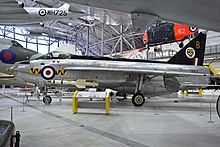
No. 74 Squadron English Electric Lightning F.1 (XM135) at Imperial War Museum Duxford.
On 8 June 1959, the Squadron, under the command of Squadron Leader John "Johnny" Howe, moved to RAF Coltishall for re-equipment with the English Electric Lightning F.1 in June 1960; this was the first Squadron in the RAF to receive the Lightning. In 1962, No. 74 Squadron formed an aerobatic display team - 'The Tigers', replacing No. 92 Squadron's Blue Diamonds as the RAF's official display team. On 2 March 1964, the Squadron moved up to RAF Leuchars in Scotland before getting the Lightning F.3 in April. While based at RAF Leuchars, No. 74 Squadron held their first Tiger Meet between 5 and 9 July 1966, having joined the NATO Tiger Association at its inception in 1961.[13] 'The Tigers' upgraded to Lightning F.6s in November 1966, with the last Lightning F.3s remaining up until January 1967. The Squadron moved to RAF Tengah in Singapore in June 1967, where it operated alongside No. 20 Squadron, which flew Hunters, and No. 81 Squadron, which flew Canberra PR.9s. In June 1969 while based in Singapore, four Lightning F.6s flew a distance of 2,000 miles from RAF Tengah to Darwin, Northern Territory in Australia, setting the longest non-stop flight made by a Lightning.[8] In 1971 the Squadron flew its Lightning F.6s to RAF Akrotiri, Cyprus to hand them over to No. 56 Squadron, who were flying Lightning F.3s, and then disbanded on 25 August 1971.[3][14]
Phantoms, Hawks and disbandment

No. 74 (F) Squadron McDonnell Douglas F-4J(UK) Phantom (ZE353) at RAF Waddington in 1990.
After a dormancy of 13 years, No. 74 Squadron was reformed at RAF Wattisham, Suffolk on 19 October 1984, with ex-US Navy McDonnell Douglas F-4J Phantom IIs (designated as the F-4J(UK) in RAF service) that were purchased by the RAF as a stop gap measure to replace those of No. 23 Squadron that had been sent to the Falklands after the war. The 15 F-4Js cost $125 million and underwent a full rework at the Naval Air Rework Facility at Naval Air Station North Island, San Diego. Here they received the ability to use the Skyflash air-to-air missile, their radar was upgraded and were brought up to a spec similar to the more definitive F-4S – they were also sprayed in a distinct duck egg blue colour.[15] The F-4Js were then ferried across the Atlantic in 3 different batches supported by Vickers VC10s, with the last group arriving on 5 January 1985.[8] The Squadron's operational capability was declared on 31 December 1985. On 26 August 1987 No. 74 Squadron lost an F-4J Phantom (ZE358) in a fatal accident near Aberystwyth, Wales.[16] Both crew members, Flt. Lt. Euan Holm Murdoch and Fg. Off. Jeremy Lindsey Ogg were killed.[17]
'The Tigers' operated their unique F-4Js up until January 1991 when they converted over to surplus Phantom FGR.2s, which were available due to other squadrons converting to the Tornado F.3. Plans had originally been for the RAF to retain two Phantom squadrons, 'The Tigers' and her sister No. 56 Squadron ('The Firebirds'), at RAF Wattisham but with the end of the Cold War these plans were shelved. Instead under the Options for Change defence review all remaining Phantoms would be withdrawn from service.[18] No. 74 Squadron participated in their penultimate Tiger Meet as a fighter squadron at Los Llanos Air Base, Spain between 14 and 22 May 1992, in which their entry was a Phantom FGR.2 painted in a full body tiger scheme.[19][20] Both Phantom squadrons carried out their final Armament Practice Camp (APC) at RAF Akrotiri, Cyprus in early June, marking a draw down in operations.
On 13 June 1992, both No. 56 Squadron and No. 74 Squadron participated in Queen Elizabeth II's official birthday flypast over Buckingham Palace with a 16-ship diamond formation (8 Phantoms from each squadron), one of the last acts by the Phantom fleet.[20] By August 1992, No. 56 Squadron had relocated to RAF Coningsby – having stood down on 31 July – and became the Operational Conversion Unit (OCU) for the Tornado F.3, leaving 'The Tigers' as the RAF's last remaining Phantom squadron.[21] Throughout its last year, No. 74 Squadron flew an aerobatic display around the country, sporting colours of both 'the Tigers' and 'the Firebirds'. The Phantom FGR.2 (XT914) was flown by Squadron Leader Archie Liggat and Flt. Lt. Mark "Manners" Manwaring. 'The Tigers' held a mini Tiger Meet at RAF Wattisham between 14 to 17 September to mark the Phantom's retirement, inviting the Dutch, French, Portuguese and the USAF among others – British Aerospace Hawk T.1s from 4 FTS, which No. 74 Squadron would soon operate, also participated.[22] One of No. 74 Squadron's last acts was to flyover RAF Wattisham in a diamond nine formation before finally disbanding on 1 October 1992. RAF Wattisham shortly thereafter began its transition over to the Army Air Corps, becoming Wattisham Airfield in October 1993.
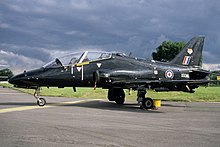
No. 74 (R) Squadron British Aerospace Hawk T.1A (XX316) at RIAT, 1998.
On 5 October 1992, No. 74 (R) Squadron stood up with the Hawk T.1 as part of No. 4 Flying Training School at RAF Valley in the weapon instruction role. At the 1993 Tiger Meet, No. 74 Squadron won the coveted 'Silver Tiger' trophy while competing against the likes of Spanish Mirage F1s and Belgian F-16's; as Flt. Lt. Will Jonas said, "Not bad for a training unit eh?!"[23] With the rationalisation of 4 FTS to just two squadrons, No. 74 (R) Squadron was disbanded on 22 September 2000.
In 2008, No. 74 Squadron would have celebrated its 90th anniversary; however, No. 74 (F) Squadron still lives on through the 74 (F) Tiger Squadron Association, which brings together former Tigers from all generations for a yearly reunion dinner. Pending raising the necessary funds, plans are in place to create a museum dedicated to the Squadron's history at their former RAF base of Horsham St Faith, now Norwich Airport. Since then plans have been made to create a special section at the City of Norwich Aviation Museum dedicated to the 'Tiger Squadron'.[24]
Famous pilots
Famous pilots associated with the squadron:
- Keith Caldwell
John Freeborn - 12 kills, 1 probable, 5 damaged, was with his squadron longer than any other Battle of Britain pilot and had flown more operational hours.
A.G. "Sailor" Malan - 32 victories
Edward Mannock - 61 victories of which 35 were made with No. 74 Squadron.
John Mungo-Park [25]
Aircraft operated
Avro 504K (Jul 1917–Mar 1918)
Royal Aircraft Factory S.E.5a (Mar 1918–Feb 1919)
Hawker Demon (Sep 1935–Apr 1937)
Gloster Gladiator I (Mar 1937)
Gloster Gauntlet II (Mar 1937–Feb 1939)
Hawker Hurricane I (1939)
Miles Magister 14A (1938–1940)
Supermarine Spitfire 1 & Ia (Feb 1939)
Supermarine Spitfire IIa & IIb (Jun 1940–Dec 1941)
Vickers-Supermarine Spitfire Vb (May 1941–Mar 1942)
Hawker Hurricane I, IIb, IIc (Dec 1942–Sept 1943)
Vickers-Supermarine Spitfire Vb (Sep 1943–Apr 1944)
Vickers-Supermarine Spitfire Vc (Sep 1943–Apr 1944)
Vickers-Supermarine Spitfire IX (Oct 1943–Apr 1944)
Vickers-Supermarine Spitfire LFIXe (Apr 1944–Mar 1945)
Vickers-Supermarine Spitfire LF16e (Mar 1945–May 1945)
Gloster Meteor F.3 (May 1945–Mar 1948)
Gloster Meteor F.4 (Dec 1947–Oct 1950)
Gloster Meteor T.7 (1950–1957)
Gloster Meteor F.8 (Oct 1950–Feb 1957)
Hawker Hunter F.4 (Mar 1957–Jan 1958)
Hawker Hunter F.6 (Nov 1957–1960)
Hawker Hunter T.7 (1959–1960)
English Electric Lightning F.1 & F.1a (Jun 1960–Apr 1964)
English Electric Lightning F.3 (Apr 1964–Sep 1967)
English Electric Lightning T.4 (1961–1967)
English Electric Lightning T.5 (Jun 1967–Aug 1971)
English Electric Lightning F.6 (Jun 1967–Aug 1971)
McDonnell Douglas F-4J(UK) Phantom (Aug 1984–Jan 1991)
McDonnell Douglas F-4M Phantom FGR.2 (Jan 1991–Oct 1992)
British Aerospace Hawk T.1/T.1A (Oct 1992–Sep 2000)
.mw-parser-output .mod-gallery{display:table}.mw-parser-output .mod-gallery-default{background:transparent;margin-top:0.5em}.mw-parser-output .mod-gallery-center{margin-left:auto;margin-right:auto}.mw-parser-output .mod-gallery-left{float:left}.mw-parser-output .mod-gallery-right{float:right}.mw-parser-output .mod-gallery-none{float:none}.mw-parser-output .mod-gallery-collapsible{width:100%}.mw-parser-output .mod-gallery .title{display:table-row}.mw-parser-output .mod-gallery .title>div{display:table-cell;text-align:center;font-weight:bold}.mw-parser-output .mod-gallery .main{display:table-row}.mw-parser-output .mod-gallery .main>div{display:table-cell}.mw-parser-output .mod-gallery .caption{display:table-row;vertical-align:top}.mw-parser-output .mod-gallery .caption>div{display:table-cell;display:block;font-size:94%;padding:0}.mw-parser-output .mod-gallery .footer{display:table-row}.mw-parser-output .mod-gallery .footer>div{display:table-cell;text-align:right;font-size:80%;line-height:1em}.mw-parser-output .mod-gallery .gallerybox .thumb img{background:none}.mw-parser-output .mod-gallery .bordered-images img{border:solid #eee 1px}
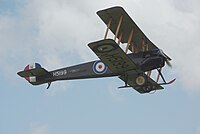
Avro 504K at the Shuttleworth Collection. This was the first aircraft type that No. 74 Squadron operated in 1917.
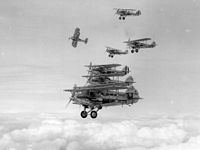
Hawker Demons similar to those No. 74 Squadron operated from 1935 to 1937 in Malta.
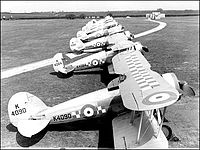
Gloster Gauntlets similar to what No. 74 Squadron flew from 1937 to 1939.

Supermarine Spitfire Mk.Vc which were flown by No. 74 Squadron from 1943 to 1944 in the Middle East.
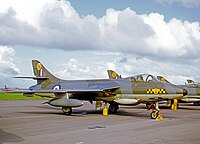
Hawker Hunter F.6 much like what No. 74 Squadron operated from 1957 to 1960.
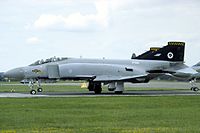
No. 74 (F) Squadron McDonnell Douglas Phantom FGR.2 (XT914) at RIAT, 1991. (This aircraft is today preserved at RAF Wattisham.)






See also
- List of RAF squadrons
References
Notes
^ Halley 1988, p. 142.
^ Pine, L.G. (1983). A dictionary of mottoes (1 ed.). London: Routledge & Kegan Paul. p. 74. ISBN 0-7100-9339-X..mw-parser-output cite.citation{font-style:inherit}.mw-parser-output q{quotes:"""""""'""'"}.mw-parser-output code.cs1-code{color:inherit;background:inherit;border:inherit;padding:inherit}.mw-parser-output .cs1-lock-free a{background:url("//upload.wikimedia.org/wikipedia/commons/thumb/6/65/Lock-green.svg/9px-Lock-green.svg.png")no-repeat;background-position:right .1em center}.mw-parser-output .cs1-lock-limited a,.mw-parser-output .cs1-lock-registration a{background:url("//upload.wikimedia.org/wikipedia/commons/thumb/d/d6/Lock-gray-alt-2.svg/9px-Lock-gray-alt-2.svg.png")no-repeat;background-position:right .1em center}.mw-parser-output .cs1-lock-subscription a{background:url("//upload.wikimedia.org/wikipedia/commons/thumb/a/aa/Lock-red-alt-2.svg/9px-Lock-red-alt-2.svg.png")no-repeat;background-position:right .1em center}.mw-parser-output .cs1-subscription,.mw-parser-output .cs1-registration{color:#555}.mw-parser-output .cs1-subscription span,.mw-parser-output .cs1-registration span{border-bottom:1px dotted;cursor:help}.mw-parser-output .cs1-hidden-error{display:none;font-size:100%}.mw-parser-output .cs1-visible-error{font-size:100%}.mw-parser-output .cs1-subscription,.mw-parser-output .cs1-registration,.mw-parser-output .cs1-format{font-size:95%}.mw-parser-output .cs1-kern-left,.mw-parser-output .cs1-kern-wl-left{padding-left:0.2em}.mw-parser-output .cs1-kern-right,.mw-parser-output .cs1-kern-wl-right{padding-right:0.2em}
^ abcd "74 Squadron". Royal Air Force. Retrieved 22 November 2018.
^ "74 (F) Squadron". NATO Tigers. Retrieved 23 November 2018.
^ "Royal Flying Corps at Shenley". Shenley in WWI. Retrieved 22 November 2018.
^ Franks, L. R. Norman; Saunders, Andy (2008). Mannock: The Life and Death of Major Edward Mannock VC, DSO, MC, RAF. Grub Street. pp. 80–81. ISBN 978-1-906502-12-6.
^ Wood, Alan C.; Sutton, Alan (2015). Military Aviation in the First World War: The Aces of the Allies and the Central Powers. Fonthill Media. p. 35. ISBN 978-1781554227.
^ abcdefghi Cossey, Bob. "The History of 74 (Fighter) Squadron". 74 Squadron Association. Retrieved 22 November 2018.
^ "Archived copy". Archived from the original on 3 March 2016. Retrieved 1 January 2016.CS1 maint: Archived copy as title (link) Retrieved 18 February 2010.
^ abc Kent, Rick. "Camouflage and Markings of No. 74 Squadron RAF". The Spitfire Site. Retrieved 22 November 2018.
^ The Most Dangerous Enemy: A history of the Battle of Britain, Stephen Bungay, Aurum Press 2001. p. 67
^ Delve, p. 137.
^ "Nato Tiger Meet: 1966". NATO Tigers. Retrieved 22 November 2018.
^ Halley 1988, p. 143.
^ "The Modern Era: Phantoms & Hawks". 74 Squadron Association. Retrieved 23 November 2018.
^ "Aircraft Accident To Royal Air Force Phantom F4J ZE358" (PDF). ukserials. Ministry of Defence. Retrieved 23 November 2018.
^ "Accident McDonnell Douglas F-4J(UK) Phantom ZE358, 26 Aug 1987". Aviation Safety Network. Retrieved 23 November 2018.
^ Tom King, Secretary of State for Defence (25 July 1990). "Defence (Options for Change)". Parliamentary Debates (Hansard). United Kingdom: House of Commons. col. 468–486.
^ "Nato Tiger Meet: 1992". NATO Tigers. Retrieved 23 November 2018.
^ ab "The Phantom". Wattisham Station Heritage. Retrieved 23 November 2018.
^ "Firebird Rising". Sharpshooter - Military Aviation Journal. Retrieved 22 November 2018.
^ Parsons, Gary. "Wattisham Chronicles - Spotlight: The first and only Tiger Meet, September 1992". Air-Scene UK [Archived]. Retrieved 23 November 2018.
^ "Nato Tiger Meet: 1993". NATO Tigers. Retrieved 22 November 2018.
^ "Notices for Visitors". City of Norwich Aviation Museum. Retrieved 23 November 2018.
^ John Colin Mungo Park at www.74squadron.org.uk Archived 26 November 2010 at the Wayback Machine. Retrieved June 2011
Bibliography
.mw-parser-output .refbegin{font-size:90%;margin-bottom:0.5em}.mw-parser-output .refbegin-hanging-indents>ul{list-style-type:none;margin-left:0}.mw-parser-output .refbegin-hanging-indents>ul>li,.mw-parser-output .refbegin-hanging-indents>dl>dd{margin-left:0;padding-left:3.2em;text-indent:-3.2em;list-style:none}.mw-parser-output .refbegin-100{font-size:100%}
- Cossey, Bob. Tigers: The Story of 74 Squadron, RAF. London: Arms & Armour Press, 1992.
ISBN 1-85409-143-3. - Ken Delve, D-Day: The Air Battle, London: Arms & Armour Press, 1994,
ISBN 1-85409-227-8. - Halley, James J. The Squadrons of the Royal Air Force & Commonwealth, 1918–1988. Tonbridge, Kent, UK: Air-Britain (Historians) Ltd., 1988.
ISBN 0-85130-164-9. - Jefford, Wing Commander C.G., MBE,BA,RAF (Retd). RAF Squadrons, a Comprehensive Record of the Movement and Equipment of all RAF Squadrons and their Antecedents since 1912. Shrewsbury: Airlife Publishing, 1998 (second edition 2001).
ISBN 1-84037-141-2. - Jones, Wing Commander Ira "Taffy". Tiger Squadron: The Story of 74 Squadron R.A.F., in Two World Wars. London: W.H. Allen, 1954 (republished by Award books in 1966, White Lion Publishers Ltd. in 1972 and by Time Life Education in 1994).
- Oughton, Frederick and Vernon Smyth. Ace With One Eye. The Life and Combats of Major Edward Mannock VC, DSO (2 bars), MC (1 bar), Royal Flying Corps and Royal Air Force. London: Frederick Muller Ltd., 1963.
- Rawlings, John D.R. Fighter Squadrons of the RAF and their Aircraft. London: Macdonald and Jane's (Publishers) Ltd., 1969 (new edition 1976, reprinted 1978).
ISBN 0-354-01028-X. - Tidy, Douglas. I Fear No Man: The History of No.74 Squadron Royal Air Force. London: Macdonald & Co. (Publishers) Ltd., 1972, & revised edition 1998.
- Tidy, Douglas. I Fear No Man: The History of No.74 Squadron Royal Air Force 1917–1997. J&KHP Publishers., 1998.
ISBN 1-900511-03-7
External links
 | Wikimedia Commons has media related to No. 74 Squadron RAF. |
- 74 Squadron Association
- Aircraft and markings of No. 74 Squadron
- Official history of No. 74 Squadron
- Official history of No. 74 Squadron (Archived)
- Article about the Battle of Barking Creek from North Weald Airfield History
- H.M Stephen talks of 74 Squadron air operations (1940 audio recording)
 Royal Air Force flying squadrons Royal Air Force flying squadrons | |||||||||||||||||||||||||
|---|---|---|---|---|---|---|---|---|---|---|---|---|---|---|---|---|---|---|---|---|---|---|---|---|---|
| Currently active |
| ||||||||||||||||||||||||
| Inactive |
| ||||||||||||||||||||||||
Australian Flying Corps units attached to the RAF during the First World War |
| ||||||||||||||||||||||||
Commonwealth air force units attached to the RAF during the Second World War |
| ||||||||||||||||||||||||
| Squadrons formed from non-Commonwealth personnel during the Second World War |
| ||||||||||||||||||||||||
| Royal Auxiliary Air Force |
| ||||||||||||||||||||||||
Fleet Air Arm of the RAF (1924–1939) |
| ||||||||||||||||||||||||
 Royal Air Force Royal Air Force  | ||
|---|---|---|
Royal Air Force portal | ||
| Formations and units |
|  |
| Branches and components |
| |
| Reserve forces |
| |
| Associated civil organisations |
| |
| Equipment |
| |
| Personnel |
| |
| Appointments |
| |
| Symbols and uniform |
| |
| ||


