Cotinga
| Cotingas | |
|---|---|
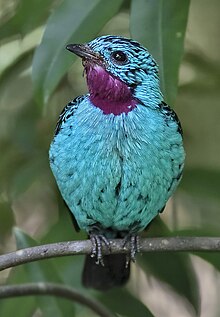 | |
Spangled cotinga (Cotinga cayana) | |
Scientific classification  | |
| Kingdom: | Animalia |
| Phylum: | Chordata |
| Class: | Aves |
| Order: | Passeriformes |
| Parvorder: | Tyrannida |
| Family: | Cotingidae Bonaparte, 1849 |
| Genera | |
Many, see text | |
 | |
| Geographical range of the cotingas. | |
The cotingas are a large family, Cotingidae, of suboscine passerine birds found in Central America and tropical South America. Cotingas are birds of forests or forest edges, that are primary frugivorous. They all have broad bills with hooked tips, rounded wings, and strong legs. They range in size from 12–13 cm (4.7–5.1 in) of the fiery-throated fruiteater (Pipreola chlorolepidota) up to 48–51 cm (19–20 in) of the Amazonian umbrellabird (Cephalopterus ornatus).[1][2]
Contents
1 Description
2 Breeding
3 Habitat
4 Taxonomy and systematics
5 See also
6 References
7 Further reading
8 External links
Description
Cotingas vary widely in social structure. There is a roughly 50/50 divide in the family between species with biparental care, and those in which the males play no part in raising the young.[3] The purple-throated fruitcrow lives in mixed-sex groups in which one female lays an egg and the others help provide insects to the chick.[4]
In cotinga species where only the females care for the eggs and young, the males have striking courtship displays, often grouped together in leks. Such sexual selection results in the males of these species, including the Guianan cock-of-the-rock, being brightly coloured, or decorated with plumes or wattles, like the umbrellabirds, with their umbrella-like crest and long throat wattles. Other lekking cotingids like the bellbirds and screaming piha, have distinctive and far-carrying calls. In such canopy-dwelling genera as Carpodectes, Cotinga, and Xipholena, males gather high in a single tree or in adjacent trees, but male cocks-of-the-rock, as befits their more terrestrial lives, give their elaborate displays in leks on the ground.[4]
The females of both lekking and biparental species are duller than the males.
Breeding
Nests range from tiny to very large. Many species lay a single egg in a nest so flimsy that the egg can be seen from underneath. This may make the nests hard for predators to find. Fruiteaters build more solid cup nests, and the cocks-of-the-rock attach their mud nests to cliffs.[4] The nests may be open cups or little platforms with loosely woven plant material, usually placed in a tree.
The clutches comprise one to four eggs. Incubation typically takes fifteen to twenty-eight days.
Fledging usually occurs at 28–33 days.
Habitat
Deserts, open woodlands, coastal mangroves, and humid tropical forests. Cotingas face very serious threats from loss of their habitats.[5]
Taxonomy and systematics
The family Cotingidae was introduced by the French naturalist Charles Lucien Bonaparte in 1849.[6]
The family contains 66 species divided into 25 genera.[7]
| Image | Genus | Living species |
|---|---|---|
 | Ampelion |
|
 | Phibalura |
|
| Zaratornis |
| |
| Doliornis |
| |
 | Phytotoma |
|
 | Carpornis |
|
 | Pipreola |
|
 | Ampelioides |
|
 | Rupicola |
|
 | Phoenicircus |
|
 | Cotinga |
|
 | Procnias |
|
 | Tijuca |
|
 | Lipaugus |
|
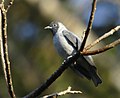 | Conioptilon |
|
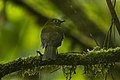 | Snowornis |
|
 | Porphyrolaema |
|
 | Xipholena |
|
 | Carpodectes |
|
 | Gymnoderus |
|
 | Querula |
|
| Haematoderus |
| |
 | Pyroderus |
|
 | Perissocephalus |
|
 | Cephalopterus |
|
A number of species previously placed in this family are now placed in the family Tityridae (genera Laniisoma, Laniocera and Iodopleura)[8]
See also
References
^ Snow, D.; Sharpe, C.J. (2018). del Hoyo, J.; Elliott, A.; Sargatal, J.; Christie, D.A.; de Juana, E., eds. "Fiery-throated Fruiteater (Pipreola chlorolepidota)". Handbook of the Birds of the World Alive. Lynx Edicions. Retrieved 30 June 2018. (Subscription required (help))..mw-parser-output cite.citation{font-style:inherit}.mw-parser-output .citation q{quotes:"""""""'""'"}.mw-parser-output .citation .cs1-lock-free a{background:url("//upload.wikimedia.org/wikipedia/commons/thumb/6/65/Lock-green.svg/9px-Lock-green.svg.png")no-repeat;background-position:right .1em center}.mw-parser-output .citation .cs1-lock-limited a,.mw-parser-output .citation .cs1-lock-registration a{background:url("//upload.wikimedia.org/wikipedia/commons/thumb/d/d6/Lock-gray-alt-2.svg/9px-Lock-gray-alt-2.svg.png")no-repeat;background-position:right .1em center}.mw-parser-output .citation .cs1-lock-subscription a{background:url("//upload.wikimedia.org/wikipedia/commons/thumb/a/aa/Lock-red-alt-2.svg/9px-Lock-red-alt-2.svg.png")no-repeat;background-position:right .1em center}.mw-parser-output .cs1-subscription,.mw-parser-output .cs1-registration{color:#555}.mw-parser-output .cs1-subscription span,.mw-parser-output .cs1-registration span{border-bottom:1px dotted;cursor:help}.mw-parser-output .cs1-ws-icon a{background:url("//upload.wikimedia.org/wikipedia/commons/thumb/4/4c/Wikisource-logo.svg/12px-Wikisource-logo.svg.png")no-repeat;background-position:right .1em center}.mw-parser-output code.cs1-code{color:inherit;background:inherit;border:inherit;padding:inherit}.mw-parser-output .cs1-hidden-error{display:none;font-size:100%}.mw-parser-output .cs1-visible-error{font-size:100%}.mw-parser-output .cs1-maint{display:none;color:#33aa33;margin-left:0.3em}.mw-parser-output .cs1-subscription,.mw-parser-output .cs1-registration,.mw-parser-output .cs1-format{font-size:95%}.mw-parser-output .cs1-kern-left,.mw-parser-output .cs1-kern-wl-left{padding-left:0.2em}.mw-parser-output .cs1-kern-right,.mw-parser-output .cs1-kern-wl-right{padding-right:0.2em}
^ Snow, D. (2018). del Hoyo, J.; Elliott, A.; Sargatal, J.; Christie, D.A.; de Juana, E., eds. "Amazonian Umbrellabird (Cephalopterus ornatus)". Handbook of the Birds of the World Alive. Lynx Edicions. Retrieved 30 June 2018. (Subscription required (help)).
^ See Cockburn, Andrew S.; ‘Prevalence of Different Modes of Parental Care in Birds’ (supplementary material)
^ abc Prum, Richard O.; Snow, David W. (2003). "Cotingas". In Christopher Perrins (Ed.). Firefly Encyclopedia of Birds. Firefly Books. pp. 432–433. ISBN 1-55297-777-3.CS1 maint: Extra text: editors list (link)
^ Complete Birds of the World. National Geographic. p. 200.
^ Bock, Walter J. (1994). History and Nomenclature of Avian Family-Group Names. Bulletin of the American Museum of Natural History. Number 222. New York: American Museum of Natural History. p. 149.
^ Gill, Frank; Donsker, David, eds. (2018). "Cotingas, manakins, tityras, becards". World Bird List Version 8.2. International Ornithologists' Union. Retrieved 27 June 2018.
^ Remsen, J. V., Jr., C. D. Cadena, A. Jaramillo, M. Nores, J. F. Pacheco, M. B. Robbins, T. S. Schulenberg, F. G. Stiles, D. F. Stotz, & K. J. Zimmer. 2007. A classification of the bird species of South America. Archived March 2, 2009, at the Wayback Machine American Ornithologists' Union. Accessed 12 December 2007.
Further reading
Berv, J.S.; Prum, R.O. (2014). "A comprehensive multilocus phylogeny of the Neotropical cotingas (Cotingidae, Aves) with a comparative evolutionary analysis of breeding system and plumage dimorphism and a revised phylogenetic classification". Molecular Phylogenetics and Evolution. 81: 120–136. doi:10.1016/j.ympev.2014.09.001.
Snow, D.W. (1976). "The relationship between climate and annual cycles in the Cotingidae." Ibis 118(3):366-401- Snow, D.W. (1982). The Cotingas: Bellbirds, Umbrella birds and their allies. British Museum Press.
ISBN 0-19-858511-X
External links
 | Wikimedia Commons has media related to cotingidae. |
Cotinga videos on the Internet Bird Collection
Cotinga sounds on xeno-canto.org


