Toyokawa, Aichi
Toyokawa .mw-parser-output .nobold{font-weight:normal} 豊川市 | ||
|---|---|---|
City | ||
  Upper stage:New Year day in Toyokawa Inari Lower stage:Toyokawa Skyline | ||
| ||
 Location of Toyokawa in Aichi Prefecture, highlighted in pink | ||
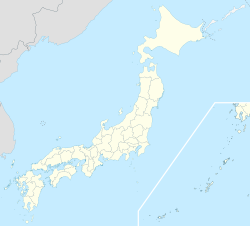  Toyokawa | ||
| Coordinates: 34°49′36.4″N 137°22′33.3″E / 34.826778°N 137.375917°E / 34.826778; 137.375917Coordinates: 34°49′36.4″N 137°22′33.3″E / 34.826778°N 137.375917°E / 34.826778; 137.375917 | ||
| Country | Japan | |
| Region | Chūbu (Tōkai) | |
| Prefecture | Aichi Prefecture | |
| Government | ||
| • Mayor | Minoru Yamawaki | |
| Area | ||
| • Total | 161.14 km2 (62.22 sq mi) | |
| Population (May 2015) | ||
| • Total | 181,051 | |
| • Density | 1,120/km2 (2,900/sq mi) | |
| Time zone | UTC+9 (Japan Standard Time) | |
| - Tree | Japanese Black Pine | |
| - Flower | Dwarf azalea | |
| Phone number | 0533-89-2111 | |
| Address | 1-1 Suwa-chō, Toyokawa-shi, Aichi-ken 442-0068 | |
| Website | Official website | |


Toyokawa City Hall
Toyokawa (豊川市, Toyokawa-shi) is a city located in the eastern part of Aichi Prefecture, Japan. As of May 2015, the city had an estimated population of 181,051 and a population density of 1120 persons per km². The total area was 161.14 square kilometres (62.22 sq mi). Toyokawa, famous for its Toyokawa Inari temple, is blessed with a good balance of industry, commerce, agriculture and forestry spread over its 160 km² boundary, and is situated in an area rich in history, traditions, and culture.
Contents
1 Geography
1.1 Surrounding municipalities
2 History
3 Transportation
3.1 Railway
3.2 Highways
3.2.1 Expressways
3.2.2 National highways
4 Local attractions
5 Military facilities
6 Notable people from Toyokawa
7 Sister cities
8 References
9 External links
Geography
Toyokawa is located in an area of rolling hills in southeastern Aichi Prefecture. It has a short coastline with Mikawa Bay.
Surrounding municipalities
- Aichi Prefecture
- Toyohashi
- Okazaki
- Shinshiro
- Gamagōri
History
The area of modern Toyokawa was settled in prehistoric times. During the Nara period, the kokubunji of Mikawa Province was established in 741. The temple of Toyokawa Inari, a popular pilgrimage destination, dates from 1441. A number of daimyō clans under the Tokugawa shogunate originate in what are now parts of Toyokawa, most notably the Makino clan. The area prospered during the Edo period with two post towns along the Tōkaidō, Goyu-shuku and Akasaka.
After the Meiji Restoration, on October 1, 1889 the area was organized into several villages within Hoi District, Aichi Prefecture, including Toyokawa Village. On March 13, 1893, Toyokawa was promoted to town status. Toyokawa City was founded on June 1, 1943 by the merger of Toyokawa town with neighboring Ushikubo Town and Yawata Village, all from Hoi District.
In 1939 the massive Toyokawa Naval Arsenal was established, one of the largest producers of machine guns, aviation ordnance and ammunition in the Empire of Japan. It was also had sections that produced military-issue katana, bayonets, and glass lenses for use in cameras, binoculars, and similar equipment. During World War II, many thousands of civilians were conscripted or volunteered to work at the Arsenal, and towards the end of the war, included hundreds of middle school students and high school girls. On August 7, 1945 the Toyokawa Naval Arsenal was targeted by a flight of B-29 bombers. About 2,500 people were killed during the Toyokawa Air Raid. Toyokawa was one of the last places to be targeted using conventional explosive and incendiary bombs in the closing days of World War II, occurring the day after Hiroshima was destroyed by an atomic bomb.[1]
After the war, on April 12, 1955 Toyokawa annexed Mikami village from Yana District. This was followed by the neighboring town of Goyu from Hoi District on April 1, 1959. Toyokawa further expanded on February 1, 2006 by annexing Ichinomiya, On January 15, 2008 the towns of Otowa and Mito became part of Toyokawa, and finally on February 1, 2010 the town of Kozakai likewise was merged into Toyokawa City.
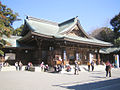
Toga Shrine

Toyokawa Inari

Ina Castle

Goyu-shuku

Akasaka-juku (Tōkaidō)



Transportation
Railway
JR Central – Tokaido Line
Nishi-Kozakai • Aichi-Mito
JR Central – Iida Line
Kozakai • Ushikubo • Toyokawa • Mikawa-Ichinomiya • Nagayama • Ejima • Tōjō •
Meitetsu – Toyokawa Line
Kō • Yawata • Suwachō • Inariguchi • Toyokawa-Inari
Meitetsu – Nagoya Main Line
Ina - Odabuchi - Kō - Goyu - Meiden-Akasaka - Meiden-Nagasawa
Highways
Expressways
- Tomei Expressway
National highways
- National Route 1
- National Route 23
- National Route 151
- National Route 247
- National Route 362
Local attractions

Toyokawa Inari Omotesando
- Castle
- Ina Castle
- Temple
Toyokawa Inari – noted Buddhist temple
Mikawa Kokubunji temple - Mikawa Provincial temple
- Shrine
Toga Shrine - Mikawa Ichinomiya shrine
Military facilities
- JGSDF Camp Toyokawa
Notable people from Toyokawa
Yuka Kato, Olympic swimmer
Gakuto Kondo, professional soccer player
Sion Sono, movie director
Sister cities
 Wuxi New Area, China.[2]
 Santa Rosa, Laguna, Philippines
 Cupertino, California, United States[3]


References
^ Air War Pacific Chronology: America's Air War Against Japan in East Asia and the Pacific 1941-1945 by Eric Hammel, (Pacifica, CA: Pacifica Press, 1988, .mw-parser-output cite.citation{font-style:inherit}.mw-parser-output q{quotes:"""""""'""'"}.mw-parser-output code.cs1-code{color:inherit;background:inherit;border:inherit;padding:inherit}.mw-parser-output .cs1-lock-free a{background:url("//upload.wikimedia.org/wikipedia/commons/thumb/6/65/Lock-green.svg/9px-Lock-green.svg.png")no-repeat;background-position:right .1em center}.mw-parser-output .cs1-lock-limited a,.mw-parser-output .cs1-lock-registration a{background:url("//upload.wikimedia.org/wikipedia/commons/thumb/d/d6/Lock-gray-alt-2.svg/9px-Lock-gray-alt-2.svg.png")no-repeat;background-position:right .1em center}.mw-parser-output .cs1-lock-subscription a{background:url("//upload.wikimedia.org/wikipedia/commons/thumb/a/aa/Lock-red-alt-2.svg/9px-Lock-red-alt-2.svg.png")no-repeat;background-position:right .1em center}.mw-parser-output .cs1-subscription,.mw-parser-output .cs1-registration{color:#555}.mw-parser-output .cs1-subscription span,.mw-parser-output .cs1-registration span{border-bottom:1px dotted;cursor:help}.mw-parser-output .cs1-hidden-error{display:none;font-size:100%}.mw-parser-output .cs1-visible-error{font-size:100%}.mw-parser-output .cs1-subscription,.mw-parser-output .cs1-registration,.mw-parser-output .cs1-format{font-size:95%}.mw-parser-output .cs1-kern-left,.mw-parser-output .cs1-kern-wl-left{padding-left:0.2em}.mw-parser-output .cs1-kern-right,.mw-parser-output .cs1-kern-wl-right{padding-right:0.2em}
ISBN 0-935553-26-6)
^ "International Exchange". List of Affiliation Partners within Prefectures. Council of Local Authorities for International Relations (CLAIR). Archived from the original on 24 December 2015. Retrieved 21 November 2015.
^ http://www.city.toyokawa.lg.jp/shisei/kokusaikoryu/shimaitoshi/shimaitoshicupertino.html
External links
Official website (in Japanese)
 | Wikimedia Commons has media related to Toyokawa, Aichi. |
 Aichi Prefecture Aichi Prefecture | ||
|---|---|---|
Nagoya (capital) | ||
Wards of Nagoya |
|  |
| Core cities |
| |
| Special cities |
| |
| Cities |
| |
| Districts |
| |
| Law Enforcement |
| |
List of mergers in Aichi Prefecture | ||
Authority control  |
|
|---|


